

FeiYi Network Files IPO Prospectus: Revolutionizing Healthcare Supply Chain Finance Through Digital Procurement Platform
Medical supply chain finance may be an unfamiliar term to many; even those who have heard of it may know the name but not its meaning. Yet, business opportunities are often “hidden away, unknown to most.”
Recently, Feiyi.com, a company specializing in this field, secured RMB 40 million in Series A financing—the largest funding round to date in this niche sector—and announced that it will provide procurement digitalization and supply chain finance services to more than 2,000 public hospitals within three years.
What Is Feiyi.com’s Trump Card? VCBeat (WeChat ID: vcbeat) Conducts an Exclusive Interview with Ou Jianxiong, Co-founder and President of Feiyi.com, Who Provides a Detailed Overview of the Company’s Business Model and Development Plans.

Ou Jianxiong, Co-founder and President of Feiyi.com
Solving Industry Pain Points with “Big Data”
According to Ou Jianxiong, Feiyi Wang was founded in 2014. The initial concept stemmed from several team members with extensive experience in the pharmaceutical industry. Having frequent interactions with hospitals, they engaged in sporadic offline medical supply chain finance services and identified the business opportunities inherent in this sector.
In 2016, the Kyee Group’s incubation platform, which focuses on investments in the healthcare information industry, took notice of this project, participated in Feiyi.com’s early-stage investment, and provided incubation support.
Ou Jianxiong joined Feiyi.com earlier this year. Since then, he has spearheaded team building and the design of the business model, thereby clarifying the company’s strategic direction.
Ou Jianxiong told VCBeat that medical supply chain finance is not a new business; some companies have previously engaged in this area, including traditional factoring and accounts receivable financing. However, traditional models face challenges such as difficult customer acquisition, cumbersome processes, and complex risk control, making it hard to achieve scalability.
“In traditional business practices, many institutions rely on static data and must conduct on-site inspections to verify operational conditions, transaction records, and other metrics. However, such offline inspections leave room for manipulation, posing significant risks and entailing high verification costs for banks and other financial institutions.”
Feiyi.com operates by establishing an electronic trading platform that enables hospitals and suppliers to conduct transactions online, thereby generating authentic transaction data. When suppliers require financial services, Feiyi.com provides data support to partner banks and financial institutions based on this transaction data. This approach streamlines service processes, reduces service costs, offers credit endorsement for suppliers, and facilitates risk management.
“We leverage a digital platform to verify the authenticity of transactions between suppliers and hospitals, assess the health of transaction status, and monitor risks through big data capabilities.” Ou Jianxiong believes that Feiyi.com has addressed the pain points inherent in traditional medical supply chain finance, which constitutes its innovation.
However, medical supply chain finance does not generate direct revenue for hospitals. The inability of previous service models to scale was also partly due to the difficulty of gaining access to hospitals (“hard-to-enter” barrier). To address this issue, Ou Jianxiong stated that Feiyi Network identified electronic transactions as an entry point.
He stated that, compared to some other industries, hospitals currently lag in the adoption of digital procurement, with relatively low utilization rates of digital tools. Hospitals are gradually recognizing this issue and have begun to adopt new digital solutions.
Furthermore, from a policy perspective, there is encouragement for hospitals to implement refined management, with the digitalization of procurement being a key direction. For instance, the "Guiding Opinions on Pilot Comprehensive Reform of Urban Public Hospitals," issued by the General Office of the State Council, mandates strengthening refined hospital management, enhancing financial and accounting oversight, and reinforcing cost accounting and control. Policies such as the “Two-Invoice System” and “Zero Markup” have transformed pharmaceuticals into operational costs for hospitals, thereby incentivizing them to control expenses in material procurement. This has drawn attention to online trading platforms like Feiyi.com.
Be a Connector in the Medical Supply Chain
According to Ou Jianxiong, in an interview with VCBeat, Feiyi Network adopts an “N+1+N” model in its specific business process design. This model connects N suppliers, one supply chain service platform, and N medical institutions, enabling information sharing and high-level collaboration among all business entities, thereby creating a new model for medical supplies management within the “Internet Plus” ecosystem.
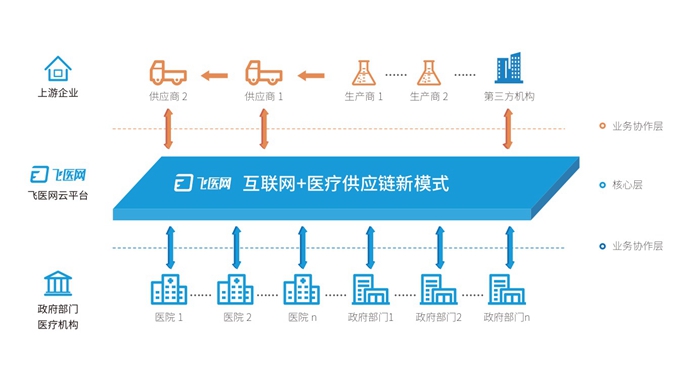
Feiyi Network Business Architecture Diagram
“Transactions” are the foundation of Feiyi Network. Centered on this core element, Feiyi Network has designed modules including order management, intelligent warehousing, supplies management, payment management, and financial management, providing healthcare institutions and suppliers with end-to-end solutions that cover their entire online transaction and offline management processes.
If the preceding section addressed why medical institutions need electronic procurement, the following section will explain why they should choose Feiyi.com as their online transaction platform.
“Hospitals prioritize trust and recognition when selecting a service provider, including recognition of the product, its positioning, and data security.”
Ou Jianxiong believes that, from a product perspective, the Feiyi.com team has a background in medical supplies and healthcare informatization, enabling them to effectively integrate industry needs with their understanding. Secondly, Feiyi.com’s positioning as a third-party platform, which is not affiliated with any specific stakeholder, allows for broader applicability.
Currently, there are roughly three types of companies operating in the field of IT solutions for medical supply chains. The first type consists of participants in hospital material supply, including pharmaceutical manufacturers and pharmaceutical distributors. The second type comprises vendors of Hospital Resource Planning (HRP) and Hospital Information Systems (HIS), for whom e-procurement is a module within their system solutions. The third type includes “Internet + Healthcare” companies such as Feiyi.
“If they were a traditional supplier, their capability in information technology might not be as strong. Moreover, since they are themselves suppliers of hospital materials, other suppliers may have data-related concerns when collaborating with them. For HRP and HIS vendors, material management is only a small part of their business segments, so they lack the energy and motivation to refine this functionality.” Ou Jianxiong identified sufficient competitive advantages for Feiyi.com against both trading platforms established by traditional enterprises and hospital IT vendors.
So, what are the advantages for companies under the “Internet + Healthcare” concept to enter healthcare supply chain finance? Examples include B2B pharmaceutical e-commerce platforms involved in supply chain finance and similar enterprises such as Feiyi Wang.
Ou Jianxiong believes that the unique advantage of Feiyi Wang lies in its entry point through electronic transactions. If it were to offer supply chain finance services alone, it would be difficult to penetrate into hospitals. However, by starting with electronic procurement, it not only aligns with the needs of refined hospital management but also lays the foundation for subsequent supply chain finance services.
“The supply chain finance services we refer to are based on big transaction data. We do not launch such services from the outset; rather, by leveraging the massive volume of transaction data accumulated in the early stages, we can provide decision-making support for financial services, including credit enhancement, verification of transaction authenticity, and risk control.”
VCBeat understands that Feiyi.com’s model of leveraging transaction data as the foundation for financial services is akin to “big data credit scoring,” a practice already established in the internet finance sector. Notable examples include Ant Check Later (Huabei) and JD Baitiao. By evaluating individual users’ borrowing and transaction data, these platforms can facilitate rapid loan disbursement while effectively managing lending risks.
“Before practical cases like those of Ant Financial emerged, no one would have believed that loans could be issued rapidly based solely on transaction data; however, practice has proven the model’s effectiveness. Over the past few years, personal credit scoring has become highly mature.”
Ou Jianxiong believes that there is a market for derivative financial services based on transaction services. After accumulating transaction data from suppliers and hospitals, Feiyi.com can draw on the application of big data in personal credit reporting to bring new service models to enterprise-level financial services.
“There is no ceiling in this market”
With both favorable trends and strong corporate competitiveness in place, the next step is to capture market share. Feiyi Network adopts a strategy of focused deployment and regional expansion: it first establishes a presence in a select group of hospitals to refine its business model and create benchmark cases, then leverages this foundation to expand across regions.
Ou Jianxiong provided VCBeat with a set of data as a reference for the industry’s market size. He stated that, according to the China Health Statistics Yearbook, there were 12,897 public hospitals nationwide in 2014, with an average revenue of RMB 146 million and material costs of RMB 122 million. Projecting forward at the same growth rate observed from 2014 to 2016, the national hospital procurement expenditure on materials is expected to reach RMB 1.3–1.5 trillion in 2017. This indicates substantial market potential for medical supply chain financial services.
“Hospitals typically have accounts receivable payment terms, while suppliers have working capital needs. As hospital procurement scales up year by year, our data services based on hospital transaction flows have no ceiling.”Furthermore, public hospitals themselves possess strong repayment capacity, so the risk associated with providing financial services in this sector is actually relatively low.”
In fact, the rapid growth of Feiyi.com also corroborates Ou Jianxiong’s viewpoint. Over the past few months, five prefecture-level city platforms and more than 200 public hospitals have signed agreements to join Feiyi.com. Meanwhile, Feiyi.com secured RMB 40 million in Series A financing and joined the incubation platform of Kyee Group, a well-known healthcare informatics enterprise.
“Our in-house sales team possesses strong regional promotion capabilities; meanwhile, the resource advantages of Jingyi Group’s incubation platform on the hospital side will also facilitate our expansion.” The rationale for selecting hospitals as the breakthrough point lies in the fact that hospitals hold a dominant position in medical supply procurement relationships. Once a hospital chooses a particular platform, suppliers will follow suit and onboard onto it.
Ou Jianxiong’s plan for Feiyi.com is to onboard more than 500 public hospitals this year, thereby consolidating its market share and service capabilities; by the end of 2020, it aims to sign contracts with 2,000 large- and medium-sized hospitals at Level II or above, becoming the unequivocally leading trading platform in the medical supply chain finance sector.