

Houston-Trained Biopharma Pioneer with 60+ Patents Chooses Gu'an to Develop Innovative Drugs; Files IPO Prospectus
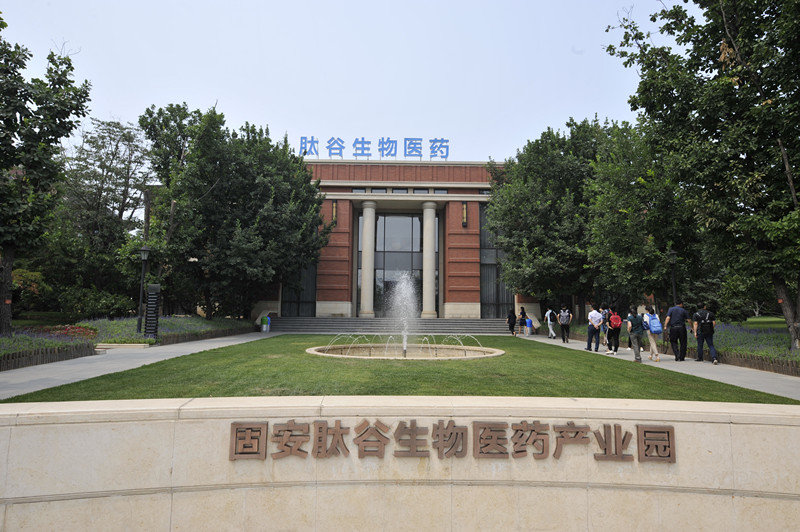
In June, the tree-lined paths and expansive green spaces of the Gu’an Peptide Valley Biopharmaceutical Industrial Park complement each other, outlining the tranquility of summer.
In the Laboratory Building 1 of Deyang Shengwu Gu’an Company, Zhao Mingzhi was frustrated with the mice. The mice brought from Beijing for experiments were supposed to be white, but black ones were mistakenly selected, making it particularly difficult to cannulate the tail veins during intravenous administration.
He “shouted out” in the industrial park’s WeChat group, and a colleague from a partner company who specializes in animal experiments “rushed over” to help him properly secure the black mouse.
It is a blessing to live in an industrial park where “transportation relies on walking, and communication depends on shouting.” Zhao Mingzhi stated that the clustering of upstream and downstream enterprises has fostered a focused industrial atmosphere.
Currently, the Gu’an Peptide Valley Biopharmaceutical Industrial Park, developed by China Fortune Land Development (CFLD), has attracted 32 innovative R&D enterprises specializing in genetic engineering protein drugs, antibodies, vaccines, and diagnostic reagents. By establishing an incubator in Silicon Valley, USA, and forging strategic partnerships with four international research institutions and universities, CFLD has built a comprehensive industrial chain model encompassing “technology introduction, pilot-scale incubation, and industrialization.”
As the first enterprise to settle in the industrial park, Deyang Biotechnology is a witness.
Today, with paths crisscrossing and the sounds of chickens and dogs within earshot, it is because here one can devote oneself wholeheartedly to scientific research and industrial development, even “unaware of the Han dynasty, let alone the Wei and Jin”—much like the Peach Blossom Spring.
Dr. Liu Hongyu, the founder of Deyang Biologics, pursued advanced studies at the University of Houston in his early years. Having served as an R&D executive at renowned pharmaceutical companies in the United States and Europe, he returned to China with over 60 international patents, driven by a strong belief in the substantial demand and promising prospects of the Chinese biopharmaceutical market. Dr. Liu is determined to collaborate with multiple domestic and international experts to deepen biopharmaceutical R&D efforts in China and secure a leading position in the future market.
Those in the pharmaceutical industry are well aware that genetically engineered protein drugs offer superior efficacy and relatively fewer side effects; however, this category remains a notable gap in China’s pharmaceutical market. Currently, biopharmaceuticals account for only about 10% of China’s drug market, yet they are experiencing an annual growth rate as high as 20%.
Liu Hongyu pointed out that the market demand for biologics is enormous. In 2011, sales of biopharmaceuticals reached $160 billion, accounting for 19% of the global pharmaceutical market share; it is projected that by 2020, biopharmaceuticals will account for more than one-third of global pharmaceutical sales.
Liu Hongyu stated, “Compared with developed countries, China has a relative scarcity of innovative biologics; it is time for China to develop its own novel drugs!”
High investment, long development cycles, and high risks serve as major barriers for those seeking to enter the field of innovative biologics. The laboratory-scale prototype of a new biologic represents merely the first step in a long journey; subsequent stages include pilot-scale manufacturing, preclinical process validation, preclinical safety evaluation, and Phase III clinical trials. All data must be complete and rigorous before an application for marketing authorization can be submitted to regulatory authorities.
“It was only after we encountered China Fortune Land Development that we officially raised the banner of ‘entrepreneurship,’” said Liu Hongyu.
Deyang Bio’s engagement with China Fortune Land Development (CFLD) began in 2010. “They had been planning the Gu’an Industrial New City for many years, and the Peptide Valley Biopharmaceutical Industrial Park is a flagship project developed by CFLD in Gu’an,” recalled Zhao Mingzhi, Technical Director of Deyang Bio, who still vividly remembers that initial encounter.
General criteria for evaluating industrial parks typically revolve around hardware facilities such as park scale, factory infrastructure, and transportation networks. However, for high-tech industries like biopharmaceuticals, the software environment and supporting services are the paramount considerations for companies deciding to locate there.
Just as in scientific research, enterprises can only make accurate judgments through comparison by conducting thorough investigations. Regarding the long-term strategic planning for a start-up pharmaceutical R&D company, Liu Hongyu, who possesses extensive industry experience, recognized that his entrepreneurial team had higher expectations for the park’s ancillary services, industrial clustering, opportunities for professional knowledge exchange, and comprehensive support.
“After careful selection and deliberation, we ultimately chose China Fortune Land Development.” Liu Hongyu believes that choosing the right home base for a startup will enable future efforts to yield twice the results with half the effort.
From the perspective of China Fortune Land Development, Deyang Biotech is akin to an “infant” in swaddling clothes; although it currently requires substantial nurturing, it is destined to become a pillar of strength in the future.
In April 2013, the Deyang Bio Gu’an team became the first pharmaceutical company to settle in the Peptide Valley Biopharmaceutical Industrial Park.
To this day, Zhao Mingzhi still remembers the scene of his first day moving in.
“We moved all the purchased instruments into this two-story building. On the first day, we connected them directly to the power supply and began commissioning.” In his recollection, there was no clamor of drills, no acrid stagnation of dust and smoke, nor any frantic scurrying about.
“Focusing wholeheartedly on scientific research is the ideal state pursued by entrepreneur-scientists. Thanks to China Fortune Land Development’s industrial support and facilitation system, Deyang Biotechnology does not need to worry about many ‘miscellaneous matters’ such as water and electricity supply, office space, and environmental impact assessment approvals.”
However, Rome was not built in a day. Equipment standards in the biopharmaceutical sector vary widely, and a one-size-fits-all approach cannot meet the specific technical requirements of tenant companies. In the year prior to their official move-in, the industrial park began close communication with the Deyang Bio team during the design and construction of laboratories and the procurement of instruments.
For instance, the E. coli fermenters required for R&D vary in specifications; which equipment specifications can meet the project’s specific “cleanliness” requirements? Could equipment from neighboring tenant enterprises be utilized by Deyang Biology through resource exchange and platform sharing to maximize benefits? After repeated discussions on such issues, both parties ultimately negotiated a solution.
The approach of “customized” management and “personalized” consulting is precisely what startups like Deyang Biology need most, which also sets Peptide Valley apart from other similar industrial parks.
“You focus solely on startup growth; leave the rest to us”—this is China Fortune Land Development’s promise.
Being the first to onboard signifies the courage to pioneer, a courage born of sufficient trust.
Liu Hongyu commented on the management team of China Fortune Land Development: “From the outset, the park management engaged in in-depth communication with us and demonstrated a broad and profound understanding of our areas of development and strategic direction.”
From the perspective of China Fortune Land Development, this understanding embodies the principle of “letting professionals handle professional matters.”
The era when scholar-entrepreneurs had to personally handle every task, fighting tooth and nail, is long gone. Yet securing venture capital does not grant one the power to command resources at will, with factories and equipment readily available on demand.
For the new drug industry, pilot-scale production enables small-batch manufacturing of laboratory-developed drugs on production lines, ensuring consistency in efficacy, making it a critical step.
However, for new drug companies that have not yet “launched,” a pilot production line represents a significant investment.
The incubation mechanism of the industrial park demonstrated its advantages at this stage. “When we moved into Peptide Valley, China Fortune Land Development had already put in place the pilot-scale production facilities and equipment to support R&D and manufacturing, which significantly reduced our upfront capital investment and time commitment,” said Zhao Mingzhi. For startups, this is not only a “necessity” but also a “luxury.”
Once the research conditions were established, Liu Hongyu began to worry about the “approval hurdle” for his drug. Having never been involved in drug approval work during his time in the United States, he had limited understanding of China’s policy environment and approval processes.
China Fortune Land Development Once Again “Provides Timely Assistance.”
While the drug under development was still in the preclinical pilot-scale trial phase, China Fortune Land Development began facilitating connections between Deyang Biologics and the provincial drug regulatory authorities. Staff members accompanied Liu Hongyu on multiple visits to relevant agencies to highlight the scientific innovation and forward-looking vision of the founding team.
As a result, relevant authorities in Hebei Province are almost universally aware that Deyang Biotech, based in Peptide Valley, is developing China’s first original innovative biologic drug.
China Fortune Land Development’s robust hardware and software support serves as a “reassurance” for the startup team.
Liu Hongyu stated, “We are deeply grateful to China Fortune Land Development for its recognition of our R&D prospects. As partners with shared interests, our strategic alliance—leveraging the strengths of both parties for mutual benefit—has enabled Deyang Biology to establish its operations here with nothing but motivation and no pressure.”
The dozens of enterprises that have successively moved into the industrial park have also received attentive services from the China Fortune Land Development Industrial Park Customer Service Center.
The park’s lawns have borne witness to numerous industry exchange events. As the organizer, China Fortune Land Development has assisted tenant companies in interpreting the latest national policies, industry regulations, and market development trends, helping resident enterprises and startup teams spark new ideas and foster collaboration.
In addition, in response to research teams’ strong demand for talent, knowledge, and insights into industry trends, the park management has spared no effort in promoting exchanges and collaboration between entrepreneurial teams within the park and institutions such as universities and research institutes.
Nowadays, with the continuous influx of startup teams and tech talent, a robust “symbiotic model” has taken shape under the park’s increasingly refined “knowledge ecosystem.”
As stated by the China Fortune Peptide Valley team, “This model embodies China Fortune Land Development’s strategic approach of ‘catalytic cultivation to create a multiplier effect’ for its tenant enterprises.”
Six years have passed in the blink of an eye. Deyang Biologics now has three new drug projects advancing at full speed, with strong momentum for growth. Notably, its novel long-acting pegylated interferon chimera achieved a breakthrough by progressing from “R&D” to “preclinical pilot-scale manufacturing” in just one and a half years—a process that typically takes three years.
Only with the mutual understanding of Boya and Ziqi can there be a compassionate bond between kindred spirits; the most beautiful harmony of shared aspirations is to gather in the Peach Blossom Spring, becoming the scenery in each other’s eyes.