

Huaibei Miner General Hospital and Airdoc Launch Anhui's First Large-Scale AI-Powered Disease Screening Initiative

Airdoc
Retinal Imaging Artificial Intelligence Field Product Developer
“We will leverage artificial intelligence technology to provide free fundus screening services for residents aged 65 and above and impoverished families in Huaibei City,” said Chen Qianjin, President of Huaibei Miners’ General Hospital, at the press conference.
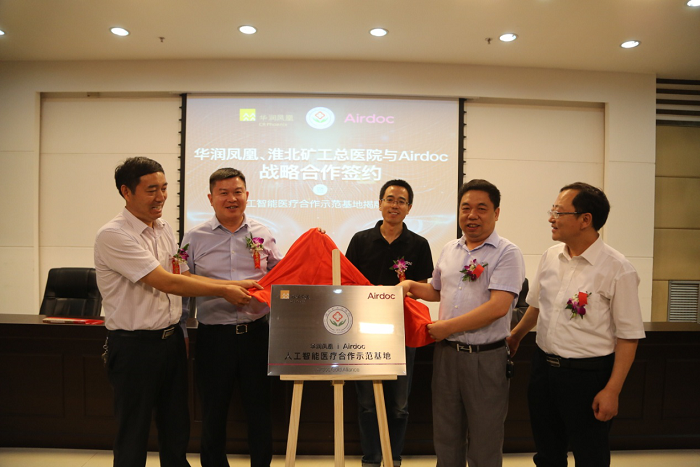
Unveiling Ceremony of China Resources Phoenix Huaibei Miners' General Hospital and Airdoc
This is the press conference for the signing of the strategic cooperation between Hua Run Phoenix Huaibei Miner General Hospital and Airdoc, as well as the unveiling ceremony of the Artificial Intelligence Medical Cooperation Demonstration Base. It is reported that Huaibei Miner General Hospital will serve as Hua Run Phoenix's first demonstration base for medical AI collaboration.
Dozens of attendees, including representatives from the Huaibei Municipal People’s Government, the Municipal Health and Family Planning Commission, the management team of Kuangzong General Hospital, and the Airdoc team, were present at the unveiling ceremony. The two parties will engage in deep collaboration in the clinical application of medical artificial intelligence, jointly promoting the practical implementation of AI in healthcare and striving to provide patients with higher-quality medical services.
AI-Assisted Diagnosis: A Potential New Revolution in Healthcare
China has the largest number of individuals with blindness and visual impairment worldwide. Data indicate that there are approximately 550 million myopia patients, 10 million glaucoma patients, 6 million cataract patients, and 11.6 million patients with neovascular fundus diseases in China. Blinding conditions such as refractive errors, glaucoma, and cataracts are increasingly affecting younger populations.
Diabetic retinopathy is a complication of diabetes that develops from background retinopathy and can ultimately lead to blindness, often by causing glaucoma.
“Individuals who have been blind since childhood may have already adapted to darkness, but for someone who loses their sight in their fifties or sixties, the impact on both themselves and their children is profound,” said Zhang Dalei, founder of Airdoc.
Australia has already begun promoting fundus screening, but this is difficult to implement in China. There are approximately 30,000 ophthalmologists nationwide, with only a small fraction actively engaged in clinical practice. Among this minority, those working at the primary care level are exceedingly rare.
With a large patient population and a wide spectrum of diseases, healthcare demands incremental value and efficient solutions. The emergence of artificial intelligence has brought new changes to this field.
“This is the significance of our endeavor,” Zhang Dalei told VCBeat. Artificial intelligence can simulate the human brain, learn from the expertise of numerous medical specialists, and provide their experience as reference recommendations to any physician, thereby equipping every doctor with a top-tier medical diagnostic and treatment assistant.
Since 2012, technological advancements in deep learning have driven rapid development of artificial intelligence (AI) in the field of image recognition. On July 20, 2017, the State Council issued the Development Plan for New-Generation Artificial Intelligence, which highlighted healthcare as a key application area. Promoting new AI-driven models and methods for diagnosis and treatment, and establishing a rapid and precise intelligent healthcare system, have become national strategies.
Airdoc has already achieved significant results in fields such as medical imaging and pathology recognition. It is reported that chronic disease screening has become the first collaborative project between the two parties. Airdoc positions itself as an auxiliary analysis tool; its products conduct preliminary screening for patients with chronic diseases, while the final diagnostic decisions remain with physicians.
Establish Collaborative Bases to Advance the Clinical Implementation of Medical AI
Huaibei Miner General Hospital, a Grade 3A hospital under China Resources Phoenix Healthcare, is committed to innovative management concepts and technological advancement, actively introducing advanced diagnostic and therapeutic techniques. In addition to its main campus, the hospital operates 16 branch facilities, some of which are located outside Huaibei City. Deploying medical experts to each facility is impractical; however, this very structure creates an ideal environment for the deployment of AI-assisted diagnostic products.
Huaibei Miner General Hospital will utilize Airdoc’s artificial intelligence technology to provide free fundus disease screening for residents aged 65 and above and impoverished families in Huaibei City.
“At the same time, we will also bring in ophthalmology MDs from Beijing to perform complex ophthalmic surgeries locally in Huaibei, thereby alleviating treatment concerns for screened patients,” said Chen Qianjin at the press conference.
The era of population aging has arrived, and the prevalence of chronic diseases increases with age. Constrained by physician shortages and limited image interpretation speed, traditional models struggle to screen large patient populations. In contrast, AI-powered solutions can rapidly and efficiently screen for chronic diseases on a large scale.
“With the introduction of Airdoc products, we have the capability and the desire to make a contribution to elderly residents aged 65 and above with chronic diseases, as well as to impoverished families across the city,” said Chen Qianjin.
Meanwhile, for Airdoc, although the company’s database is already sufficiently extensive, collaboration with hospitals can also provide a validation foundation for the real-world application of its future products.
Zhang Dalei, Founder and CEO of Airdoc, stated, “Over the past few decades, China has witnessed rapid development in medical imaging; however, there is a shortage of specialist physicians. Artificial intelligence (AI) offers fast and accurate image recognition, giving it inherent advantages when applied in the healthcare sector. AI can empower primary-care physicians with top-tier medical image interpretation capabilities while saving specialists significant amounts of time. Artificial intelligence will become the core engine driving the next round of upgrades and transformations in healthcare, propelling the evolution of the medical industry.”
According to VCBeat, the introduction of AI-based screening for fundus diseases and the unveiling of the AI Demonstration Base mark only the beginning of the collaboration between the two parties. In the future, Airdoc’s mature AI technologies in other clinical specialties will be first implemented at Huaibei Mining Group General Hospital.