

Veritas Genetics Files for IPO After Being Named to MIT's '50 Smartest Companies' List for Two Consecutive Years
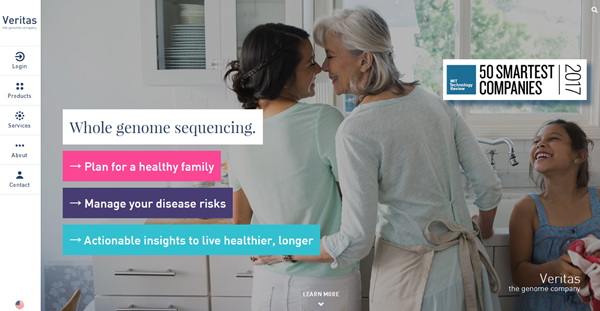
On Yizhen Bio’s website, you will find the tagline: “Understand your genetics to live healthier, longer” (Know Your Genes, Guide Your Actions). In line with their positioning, this phrase conveys that by understanding one’s genetic information, individuals can engage in more scientific health management, thereby achieving better health and greater longevity.
Headquartered in Boston, the company was founded in 2014. To date, Ezhou Bio has secured $42 million in financing from investors including Lilly Asia Ventures, Simcere Pharmaceutical, and Trustbridge Partners. Moreover, Ezhou Bio was named to MIT’s list of the “50 Smartest Companies” for two consecutive years, in 2015 and 2016.
So, what exactly makes this company smart?
An All-Star Lineup Endorsed by Nobel Laureates
Yizhen Bio’s co-founder is the renowned “father of genetics” and 2016 Nobel Prize laureate in Chemistry, George Church.
In 1954, Church was born in Florida, USA. In 1972, he enrolled at Duke University, where he earned bachelor’s degrees in zoology and chemistry within two years.
In the autumn of 1973, Church began conducting biochemical research at Duke University and received a National Science Foundation award a year later. Church used X-rays to study the three-dimensional structure of transcribed RNA, which was a groundbreaking study. He spent over 100 hours per week in the laboratory, to the extent that he neglected other courses.
Due to non-compliance with Duke University’s graduation requirements, Church withdrew from the university in 1976. He subsequently enrolled at Harvard University, where he earned a Ph.D. in Biochemistry and Molecular Biology. His doctoral advisor was Walter Gilbert, a Nobel laureate and pioneer in molecular biology who, together with Frederick Sanger, developed first-generation sequencing technologies. In 1986, Church officially joined Harvard Medical School as an Assistant Professor.
Church is currently one of the world’s most distinguished geneticists and a member of the Harvard-MIT Program in Health Sciences and Technology. Additionally, he is a founding core faculty member of the Wyss Institute for Biologically Inspired Engineering at Harvard University.
Church has founded nearly 10 biotechnology companies, such as eGenesis and Knome; and serves as a board member or scientific advisor at several globally renowned organizations, including 23andMe and the NIH’s Center for Excellence in Genomic Science.
Founder and CEO Mirza Cifric, like Church, has co-founded multiple biotechnology companies and previously served as Chief Executive Officer of AbVitro and Head of Business Development at FORMA Therapeutics.
Founder and CTO Dr. Preston Estep, a student of Church, also serves as the overall head of the Geriatrics Division of the Harvard Personal Genome Project.
Yining Zhao, Founder and Managing Director for Asia, holds an MBA and a Ph.D. in Chemistry from the Massachusetts Institute of Technology (MIT). Since joining Amgen in 1999, Dr. Zhao has served as Head of Strategic Development at both Amgen and Pfizer, accumulating 17 years of experience in pharmaceutical strategic management, business development, product development, and mergers and acquisitions.
Continuously Recruiting Professional Talent
Yizhen Bio’s founding team can be described as “star-studded,” and even more remarkably, the company has continued to attract top talent since its establishment.
From 2016 to the first half of 2017, Yizhen Bio’s advisory team welcomed five new members: Hans Lehrach, Founder of Alacris Theranostics GmbH and CEO of the Dahlem Center for Genomic Research; Scott Parazynski, former NASA astronaut and physiologist; Shamil Sunyaev, Professor of Biomedical Informatics and Medicine at Harvard Medical School; Robert C. Green, Professor of Genetics at Brigham and Women’s Hospital; and Natasha Frank, Professor at Harvard Medical School.
Like Church, these individuals are all globally leading scientists.
In October 2016, the company completed its Series B financing round and simultaneously onboarded three new senior executives:
COO Tim Smith brings 20 years of experience in operations and information technology, having held senior positions at Sapient, Fidelity, Hewlett Packard, and Cimpress, with decades of expertise in scaling organizations and technology.
CMO Rodrigo Martinez is IDEO’s Chief Strategy Advisor and a Principal Investigator at Boston Consulting Group. CBO Doug Flood brings extensive experience in business and corporate development management.
In February 2017, Birgit Funke, a globally renowned expert in molecular genetics, also announced her joining of Veritas Genetics as Vice President of Clinical Affairs.
Funke serves as a scientific advisor for the U.S. Food and Drug Administration’s NGS program and is also a member of the College of American Pathologists’ NGS committee. In addition to joining Veritas Genetics, Funke will continue to work at the Laboratory for Molecular Medicine within Partners HealthCare.
Prospective Studies in Large-Scale Populations, with a Strong Big Data Mindset
With such a dream team, the scientific research strength of Yizhen Bio is certainly not to be underestimated.
In 2005, Harvard University launched the Personal Genome Project, with George Church serving as one of its initiators. The project recruited thousands of healthy volunteers willing to publicly share their genomic and phenotypic data, aiming to promote the widespread adoption of whole-genome sequencing. Undoubtedly, Yizhen Biotech represents the commercialization of this research endeavor.
Building on the research foundation of the “Personal Genome Project,” Yizhen Biology launched the first whole-genome sequencing product priced under $1,000 in 2015. Although the ambitious goal of $1,000 genome sequencing was achieved as early as 2014, no company prior to Yizhen Biology had managed to deliver both whole-genome sequencing and interpretation for under $1,000. Church also stated, “This is a cause for celebration and a true milestone.”
In addition to facilitating the commercialization of outcomes from the Personal Genome Project, Yizhen Bio participated in the BRCA Screening Program in March 2017. Initiated by Dr. Mohammad Akbari and Dr. Steven Narod at Women’s College Hospital (WCH) in Toronto, the program selected Yizhen Bio as a partner through the Women’s College Research Institute (WCRI) to provide genetic testing for Canada’s BRCA screening initiative.
Women in Canada aged 18 and older can purchase Yizhen Bio’s saliva test kits online for $165. After completing sample collection, participants mail their samples to Yizhen Bio’s laboratory, which will provide them with a report within two to four weeks. If a participant tests positive for a BRCA mutation, the Family Breast Cancer Research Department at WCH will contact them and offer additional clinical guidance.
It is understood that the “BRCA Screening Program” is one of the first initiatives in Yizhen Biotech’s large-scale population studies. In the coming months, the company will roll out population-based screening services in multiple countries.
In May 2016, Yizhen Biology partnered with the Canadian biotechnology company Ranomic to leverage its functional research database for the functional classification of variants of uncertain significance (VUS) in hereditary breast cancer susceptibility genes.
VUSs: The Greatest Challenge for Physicians and Patients in Genetic Screening Is the Lack of Sufficient Information for Interpretation in Research and Clinical Studies.
BRCA mutations are currently the area where Yizhen Bio has invested the most effort. As early as 2015, the company joined FreeTheData and the Global Alliance for Genomics and Health (GA4GH), along with its BRCA Challenge, to establish the world’s best BRCA database.
This collaboration will formally leverage Ranomics’ functional research data to screen all variants in its database and reclassify mutations for which sufficient new evidence has been identified.
In 2017, artificial intelligence sparked a surge of interest in the healthcare sector. For genetic technology companies, genomic data is an invaluable resource; however, established standards for its generation and storage have yet to be formulated. To leverage this valuable information through artificial intelligence and machine learning, the industry urgently needs a standardized approach that enables rapid and secure data access without geographical or organizational barriers.
In August 2017, Yizhen Biology announced the acquisition of its affiliate company, Curoverse. Founded in 2010, Curoverse is a leading computing and bioinformatics company that provides management, computation, and sharing services for genomic and biomedical data using open-source software. This acquisition will accelerate the application of large-scale artificial intelligence and machine learning in genomics, creating the world’s first automated interpretation platform for millions of human genomes.
Clearly Positioned Products
In June 2015, Yizhen Biology launched its first product, myBRCA, which enables hereditary screening for BRCA1 and BRCA2 mutations using saliva samples. BRCA1 and BRCA2 are the same mutated genes carried by Angelina Jolie; these mutations confer a lifetime risk of up to 80% for breast cancer and up to 40% for ovarian cancer.
This product received EU CE certification in August 2015 and is distributed in the United States, Europe, and China, with a retail price of $199.
The reason for saying that Yizhen Biology has a “special affinity” for BRCA mutations lies not only in its cutting-edge research in this field, but also in the fact that, after launching its first BRCA mutation detection product, the company introduced an upgraded version, myBRCA HiRisk, in January 2016, priced at $299.
As the name suggests, this product is designed for individuals at high risk of breast and ovarian cancer. Compared with myBRCA, myBRCA HiRisk expands the scope to 26 genes associated with the development of breast cancer, ovarian cancer, and other hereditary cancers, including BRCA1 and BRCA2. It also helps identify family members who may be at potential risk.
In September 2015, Yizhen Biotechnology announced that it had reduced the price of personal whole-genome sequencing and interpretation to below $1,000. Five months later, the company officially launched its whole-genome sequencing product, myGenome, priced at $999, making it the world’s first whole-genome sequencing product available for under $1,000.
“Whole-genome sequencing is the most comprehensive genetic test.” CEO and Founder Mirza Cifric stated, “The whole genome is the foundation of precision medicine and a lifelong resource that can maximize both quality of life and lifespan.”
Yizhen Biotechnology launched MyBabyGenome, the first whole-genome screening product for newborns in China. Backed by NIH funding, Yizhen Biotechnology has been deeply engaged in the field of newborn screening for many years. MyBabyGenome, an expanded offering based on myGenome, covers risk assessments for 950 diseases and hundreds of genetic traits.
Scalable Collaboration
In February 2016, Yizhen Bio formed a strategic partnership with WorldCARE, becoming the first to integrate whole-genome sequencing with telemedicine to provide patients with services that combine cutting-edge technology and advanced clinical care expertise.
Yizhen Biotech will engage in targeted collaborations with multiple leading U.S. academic institutions, including Boston Children’s Hospital, Duke University School of Medicine, Mayo Clinic, Penn Medicine, Mass General Brigham (which includes Brigham and Women’s Hospital and Massachusetts General Hospital), Thomas Jefferson University Hospital, and the University of California, Los Angeles, leveraging WorldCare’s telemedicine and professional medical services. WorldCare clients will also have access to Yizhen Biotech’s full suite of genetic testing products and its personalized clinical service based on whole-genome sequencing, Veritas Concierge.
In addition to the service market, Yizhen Biology also engages frequently with the biopharmaceutical market. Simcere Pharmaceutical was an investor in the company’s Series B financing round. Beyond financial and investment interactions, Yizhen Biology has announced collaborations with Simcere Pharmaceutical, Seven Bridge, and Kindstar Global to jointly advance the development of personalized medicine in China.
On the same floor as Yizhen Biotechnology’s Hangzhou office is another biopharmaceutical company called Yi’an Jishi. Coincidentally, this company is also a multinational enterprise and an investment portfolio company of Eli Lilly Asia Ventures, while one of its founders, Zhao Yining, also appears on the list of founders of Yizhen Biotechnology.
Based in China, the U.S., and Europe, with a global perspective
Yizhen Biology has completed two rounds of financing since its inception, raising a total of $42 million. While this amount may not be considered particularly high in the genomics sector, the company’s vision is unequivocally global.
Two months after the launch of its first product, Yizhen Biology obtained CE certification in Europe, and its products are now sold in many countries around the world.
However, Yizhen Biotech appears to be more optimistic about the Asian market. Its investor roster underscores the company’s strategic emphasis on Asia, particularly China.
Eli Lilly Asia Ventures, the lead investor in the Series A round, was established in 2008. It focuses on equity investments in the biopharmaceuticals, biotechnology, medical devices, healthcare services, and animal health sectors across Asia, particularly in China. It is also the earliest industry fund in China established by a multinational pharmaceutical company.
Over the past nine years, Lilly Asia Ventures has also achieved impressive results, with its investment portfolio including leading industry players such as Innovent Biologics, Eisun Biopharma, Genetron Health, Eddingpharm, and CanSino Biologics.
The other two institutional investors are Simcere Pharmaceutical and Trustbridge Partners, with the former being a listed company in China’s pharmaceutical sector and the latter an offshore investment management platform focused on the Chinese market.
Additionally, the company officially entered the Chinese market in September 2015 and established its Asia-Pacific R&D center in Hangzhou, China, which commenced operations in July 2016.

Implications for Entrepreneurs
Although not every company can boast the endorsement of a Nobel laureate, I believe that an analysis of Yizhen Biotech’s development trajectory offers valuable insights for entrepreneurs in China.
The Chinese market is not short of gene sequencing companies, whether in research, clinical, or consumer sectors. However, it is not difficult to find that, except for a few unicorn-level or listed companies, it is hard for any company to integrate these three directions. Consumer-oriented companies consider research and clinical firms too serious and out of touch with the market; meanwhile, the latter two view consumer-focused enterprises as overly sensational and somewhat "frivolous."
However, are technical rigor and flexible marketing truly mutually exclusive? I think not.
Technologically, Yizhen Bio is undoubtedly a powerhouse. In terms of market strategy, the company pursues both clinical collaborative R&D and the mass consumer market. The pace, trends, and short- to long-term outcomes of these two parallel approaches differ significantly.
The mutual disdain between the domestic consumer sector and the clinical and research sectors actually reflects the industry's shortcomings in translational research.
This is not only a challenge faced by the gene sequencing industry, but also a problem confronting many other sectors in China.
The struggles in translational research are most directly reflected in the generation gap between products and the market: once a product is launched, it fails to gain market acceptance, or no suitable business model can be identified.
In addition, the proportion of R&D investment in the early stages will increase for enterprises. As mentioned earlier, Yizhen Biotechnology’s financing amount is not particularly high, but its product update cycle is fast. After the product launch, the company participated in large-scale population studies. On one hand, this serves as a promotion for the product; on the other hand, it allows the accumulation of substantial data for subsequent database iterations and upgrades or the development of other products. This approach is similar to that of Guardant Health. It should be noted that not every company can secure large-scale funding like Grail to burn through cash for extensive validation.
The final point is maintaining a broad, forward-looking perspective. This does not mean that every company must establish overseas offices; rather, it means adopting a global outlook during product development and holding oneself to the standards of the global market. We live in an era characterized by both global exchange and global competition.