J&J Bets Big on Preclinical DAC Platform with $1B Firefly Bio Acquisition

Johnson & Johnson
Medical Device R&D and Manufacturer
Firefly Bio
Cancer Treatment Platform Developer

▲9April 4-5 CBI Biomedical Innovation Expo Scan the QR code to register
Note:This article does not constitute any investment advice or recommendations; please refer to official/company announcements for authoritative information.This article is intended solely for informational purposes regarding medications related to medical and health care; it does not constitute a recommendation for treatment plans (if any are mentioned) and does not represent the platform’s position.Authorization is required for any article reprints.

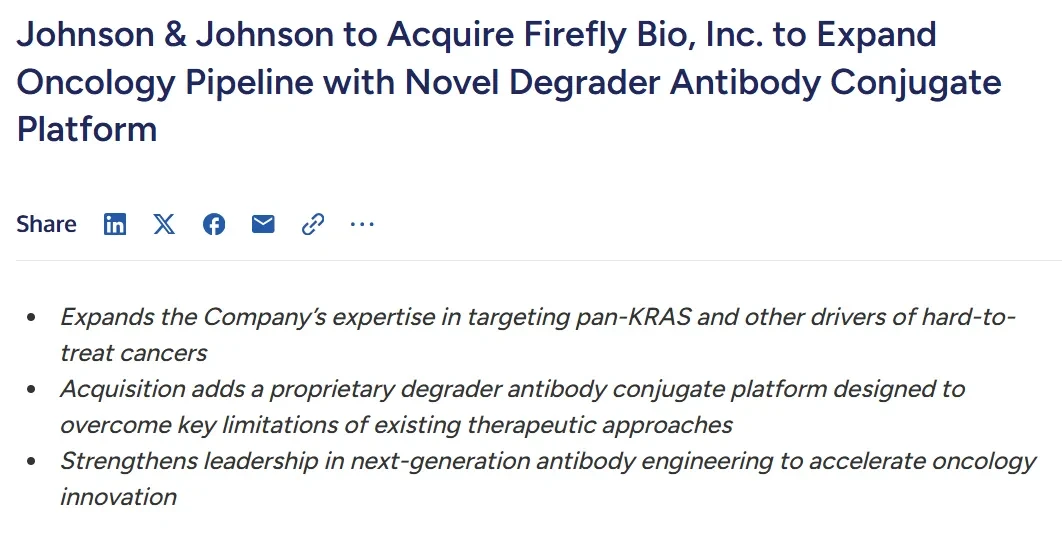
On June 8, 2026, Johnson & Johnson announced the all-cash acquisition of biotechnology company Firefly Bio for $1 billion, securing its proprietary Firelink™ Degrader Antibody Conjugate (DAC) platform.
Firefly Bio is an exceptionally young company. Incubated by the Ridgeline Discovery Engine under Versant Ventures, it officially debuted in February 2024 with a $94 million Series A financing round. Investors included Versant Ventures, MPM BioImpact, Decheng Capital, and Eli Lilly. The company’s co-founders are from 2022Nobel Laureate in Chemistry, Dr. Carolyn Bertozzi; CSO John Flygare, who previously led the ADC teams at Genentech and Merck & Co., core members have over 20 years of industry experience in the fields of ADCs and degraders.

The core concept of the Firelink™ DAC platform is to organically combine the “precise cell-targeting capability” of antibody-drug conjugates (ADCs) with the “highly selective catalytic degradation mechanism” of protein degraders. While traditional ADCs directly kill cells using cytotoxic payloads, the Firelink platform employs catalytic protein degraders as its payload. Leveraging proprietary linker technology, it minimizes the leakage of free payload into systemic circulation, thereby achieving potent tumor cell clearance while maximizing the preservation of healthy cells. Dr. John Reed, Executive Vice President of R&D at Johnson & Johnson Innovative Medicine, stated, “KRAS has long been considered an undruggable target, with patient survival measured merely in months. We believe the Firelink platform will overcome the limitations of existing therapies.”
Currently, there are no pipeline updates on Firefly Bio’s official website—this means Johnson & Johnson’s $1 billion acquisition was for a pure platform and team, rather than clinical-stage assets. This is extremely rare in recent ADC/DAC sector deals, reflecting major pharmaceutical companies’ strong confidence in the DAC direction and their strategic move to secure an early position.
About DAC
DAC (Degrader-Antibody Conjugate) is a novel class of conjugated therapeutics situated at the intersection of Antibody-Drug Conjugates (ADCs) and Targeted Protein Degradation (TPD) technologies. Structurally, DACs resemble ADCs, comprising three components: an antibody, a linker, and a payload. The core distinction lies in the payload: while ADCs deliver cytotoxic chemotherapeutic agents to directly kill cells, DACs carry protein degraders (such as PROTACs or molecular glues) that hijack the cell’s endogenous ubiquitin-proteasome system to selectively degrade target proteins.
This difference brings three advantages. First,DACs can theoretically target "undruggable" targets that are inaccessible to both traditional small molecules and ADCs—such as transcription factors and scaffold proteins lacking deep binding pockets—because degraders do not need to occupy active sites; they only need to bring the target protein into proximity with an E3 ubiquitin ligase to facilitate its tagging and destruction. Secondly, degraders act catalytically, where a single molecule can repeatedly degrade multiple protein copies, theoretically requiring lower doses and providing more sustained effects. Thirdly, antibody-mediated delivery confers tissue selectivity to degraders. Standalone PROTAC molecules, due to their high molecular weight (often exceeding 1,000 Daltons) and high polarity, face challenges such as poor oral bioavailability and systemic off-target effects, whereas antibody-mediated endocytic delivery can precisely deliver degraders into specific cells.
Of course,DACs also introduce greater system complexity: requirements for linker stability, intracellular release efficiency, and drug-to-antibody ratio (DAR) optimization are all higher than those for ADCs. Since the cytotoxicity of degrader payloads is lower than that of conventional toxins, a higher DAR (typically >4) is usually required, posing greater challenges to antibody function preservation and molecular homogeneity.
GlobalDAC Pipeline
As of now, there are no approved products available on the global marketDAC drugs.The entire field remains in the early proof-of-concept stage, with only a handful of pipelines having entered clinical trials, and these have already encountered significant setbacks.
BMS-986497 (formerly ORM-6151)is the fastest-progressing currentlyDAC Pipeline. Developed by Orum Therapeutics, this drug is indicated for the treatment of acute myeloid leukemia (AML) and myelodysplastic syndromes (MDS). In 2023, Bristol Myers Squibb (BMS) licensed the asset with a $100 million upfront payment. The drug is currently in Phase I clinical trials, with ongoing expansion of the study scope in Europe. Orum is also advancing its next-generation candidate, ORM-1153 (an anti-CD123/GSPT1 degrader), presenting positive preclinical data at the 2026 AACR Annual Meeting. The data demonstrated broad activity in primary AML patient samples and TP53-mutant models, with regulatory submission expected in the second half of 2026.IND。
Orum’s former pipeline candidate, ORM-5029, was terminated in 2024 due to safety concerns.AbbVie'sABBV-787 (an anti-CD33/BET degrader) also entered Phase I clinical trials but was discontinued for development reasons. Among the DAC pipeline candidates that have entered clinical trials to date, only BMS-986497 remains under development.
Global MajorDAC Pipeline Overview
Medication | Enterprise | Target Antigen | Degradation Target | Indications | Highest Stage |
BMS-986497 | Orum/BMS | CD33 | GSPT1 | AML/MDS | Phase I Clinical Trial |
ORM-1153 | Orum | CD123 | GSPT1 | AML | IND Preparation |
Firelink™ Platform | Firefly/J&J | Undisclosed | KRAS-related | Solid Tumor | Preclinical |
C4T DAC | C4T/Roche | Undisclosed | Not disclosed | Tumor | Preclinical |
Nurix DAC | Nurix/Pfizer | Undisclosed | Not disclosed | Tumor | Early Detection |
84-EBET | Ubix/Debiopharm | CEACAM6 | BET | Solid Tumor | Preclinical |
ORM-5029 | Orum | HER2 | GSPT1 | HER2+ Solid Tumors | Terminated |
ABBV-787 | AbbVie | CD33 | BET | Hematologic Malignancies | Terminated |
DAC Global BD Deal Overview
SinceSince 2023, major pharmaceutical companies have significantly accelerated their strategic布局 in the DAC field, with transaction frequency and value rising progressively:
BMS→Orum:In 2023, a $100 million upfront payment secured the license for ORM-6151 (now BMS-986497), the first DAC project to enter clinical trials.
Pfizer/Seagen→Nurix:In 2023, a $60 million upfront payment was made for the collaborative development of DACs. Following Pfizer’s acquisition of Seagen, this partnership was retained and is currently in the early discovery stage. Nurix is also exploring the application of DACs in the fields of inflammation and autoimmune diseases.
Merck→C4T:In 2023, a $10 million upfront payment secured exclusive rights to one target and option rights for three additional targets. However, in November 2025, Merck terminated the deal, causing C4T to miss out on $600 million in milestone payments.
Vertex→Orum:In 2024, collaborative development of DAC drugs reached as high as $945 million.
Roche→C4T:In April 2026, a $20 million upfront payment plus over $1 billion in milestones were agreed upon for the collaborative development of DACs targeting two oncology targets. Barbara Lueckel, Head of Global R&D Technical Collaborations at Roche, described this as another leap of faith.
J&J→Firefly:June 2026, $1 billion all-cash acquisition—the largest deal in the DAC field to date, targeting a pure platform company with no clinical pipeline.
Chinese Enterprise Layout
Chinese enterprises inThe strategic layout in the DAC field is also noteworthy; although development started slightly later, multiple projects have already entered the preclinical stage, and some companies are beginning to expand their technologies globally.
Hezheng Pharmaceutical:In January 2026, Hezheng Pharmaceutical announced a global collaboration on DAC drugs with a U.S. biotech company, marking the first overseas transaction by a Chinese enterprise in the DAC field.
Hengrui Medicine:AtAt the 2026 JPM Conference, Hengrui showcased its comprehensive strategic layout for novel drug modalities, with plans to submit an Investigational New Drug (IND) application in 2026 for a CD38 antibody-drug conjugate linked to an IKZF1/3 degrader within the DAC field, initially targeting multiple myeloma. This marks the formal entry of leading Chinese pharmaceutical companies into the DAC赛道.
Yilian Bio:DomesticLeading ADC company Yilian Biologics recently disclosed patents for its DAC platform, deploying anti-HER2 and anti-B7H3 antibody-drug conjugates targeting GSPT1 degraders.
Other Domestic Companies:Compass BioLayout establishedDAC-1 (solid tumors), DAC-2 (hematologic malignancies), and DAC-3 (autoimmune diseases);Fendi PharmaceuticalAdvance FD-004 (HER2 solid tumors) and FD-005 (CD33 hematologic malignancies);CSPC Pharmaceutical GroupData on CD38-DAC, a targeted IKZF1/3 degrader, were presented at AACR 2026, demonstrating a dual mechanism of degradation and CD38 targeting.
Summary
Johnson & JohnsonThe $1 billion acquisition of Firefly Bio indicates that large pharmaceutical companies are unwilling to wait for clinical data to mature before entering the field. When a platform without a pipeline is acquired at such a premium, the buyer is betting not on a specific molecule, but on the DAC technology itself becoming the next wave of conjugated drugs following ADCs. Given the global landscape of approximately 50 DACs in development, the Phase I clinical data for BMS-986497 over the next two to three years will serve as a key industry bellwether.
Copyright Notice: This article is reprinted fromFrom Yao Shi Zong Heng, such asMedia outlets or individuals who do not wish their content to be reposted may contact us, and we will remove it immediately.