

VB Group Interview Transcript: Song Jie, Founder of Hisign Technology, Reveals AI Collaboration with West China Hospital and Product Roadmap Ahead of IPO Filing
Artificial intelligence has become the hottest topic of the moment. The integration of artificial intelligence into the healthcare sector, particularly in clinical medicine, can significantly enhance the speed of disease assessment, the accuracy of diagnosis, and the pace of drug development, while reducing costs. In March 2017, West China Hospital and C-Image Medical Technology Co., Ltd. jointly established the West China-C-Image Medical Artificial Intelligence R&D Center. The two parties have already engaged in preliminary collaboration on the research and development of AI technologies for digestive endoscopy, achieving phased progress. This technology assists physicians in making high-quality diagnoses of various diseases observed during digestive endoscopy, and the research outcomes have attained a leading position internationally.
On the evening of August 31, VCBeat invited Mr. Song Jie, founder of Xishi Yigou, to participate in an interview session within the VB Group. As an entrepreneur who approaches AI healthcare from multiple perspectives, Mr. Song shared his experiences and insights accumulated over many years in the industry.
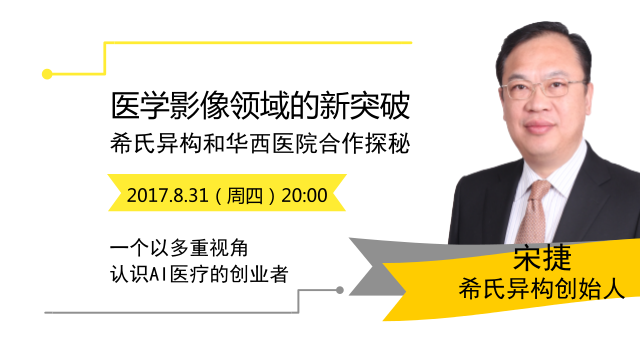
This group interview is the second installment of our AI special series. The live broadcast lasted two hours, and this article is excerpted from the full transcript. To listen to the complete interview, please find the link to the live streaming room at the end of this article.
Hisi Isomer & West China Hospital
Song Jie believes that there are two key core elements in AI-driven healthcare: AI technology and medicine, which are inseparable.
In the realm of AI technology, Dr. Wu Ren, Director and Chairman of the Expert Committee at Xishi Heterogeneous Computing, is a world-class technical luminary. He is one of the earliest experts to leverage GPUs for massive-scale data parsing, an internationally renowned specialist in computer game theory, and formerly served as a Senior Scientist at HP Labs and Chief Researcher at the CUDA Research Center.
In addition to robust AI technical support, the research and development of medical products require high-quality medical resources and big data as foundational conditions. In 2015, Xiishi Yigou partnered with several premium medical institutions in Beijing, achieving significant research outcomes by the end of 2016. In 2017, it expanded into Sichuan Province to collaborate with West China Hospital on joint R&D, establishing the West China–Xiishi Medical Artificial Intelligence R&D Center. Among the multi-disciplinary research collaborations with West China Hospital, the most in-depth work currently focuses on image and video recognition in digestive endoscopy, an area where Xiishi Yigou holds a competitive edge.
Song Jie stated that West China Hospital chose to collaborate with Hisi Yigou on R&D in this field primarily due to Hisi Yigou’s strong research experience and foundation in AI over the past two years, as well as its track record of implemented projects.
About Digestive Endoscopy
In the field of digestive endoscopy, Xishi Yigou currently offers procedures for the entire gastrointestinal tract (including the upper and lower gastrointestinal tracts).
“We are not merely identifying one or two specific diseases, nor are we simply determining whether a particular disease is benign or malignant. Instead, our research encompasses nearly all diseases of the entire gastrointestinal (GI) tract. Throughout this process, we have categorized these clinically significant GI diseases into major groups and developed AI-based diagnostic models for each category. For instance, we focus on identifying neoplasms—lesions that are highly suspected to be cancerous in clinical practice—as well as other types of lesions. We have conducted extensive training and analysis targeting these conditions, and progress has been very promising thus far. Looking ahead, we will continue to enhance the accuracy of disease identification, aiming to increase it from the current level of approximately 92% to over 96%, while incorporating training data for a broader range of diseases,” said Song Jie.
In the field of digestive endoscopy, the current major bottleneck lies in the massive volume of images generated by capsule endoscopy, which may amount to tens of thousands of still images or several hours of video footage. Manual identification and diagnosis by clinicians entail prohibitively high costs and place an excessive burden on medical resources. However, with the assistance of artificial intelligence (AI) technology, at least a preliminary screening can be completed within a very short time frame, thereby significantly reducing labor costs. Moreover, as technology advances, AI may indeed achieve highly definitive diagnoses, potentially surpassing the judgment of clinical experts, and even provide alerts for early-stage lesions that are undetectable to the naked eye.
Artificial Intelligence and Medical Imaging
Regarding the development of artificial intelligence technology, Song Jie believes that there are no significant bottlenecks. However, certain prerequisites must be met. On one hand, high-quality medical big data is essential, with two key requirements: superior data quality and a massive volume of data, which are necessary to build robust models. On the other hand, advanced AI training techniques are required; this cannot be achieved through a simple open-source platform alone, but rather demands a comprehensive suite of proprietary technologies.
Medical imaging can be further categorized into static and dynamic imaging. Relatively speaking, image recognition for dynamic video streams presents greater challenges. In addition to demanding high performance from AI algorithms—i.e., the final trained models—it also requires real-time analytical capabilities and hardware support.
The Impact of Artificial Intelligence Technology on Radiologists
Song Jie began his career as a physician, but in recent years he has been engaged in management roles, including the development of certain technologies, thereby forming his own perspectives.
“I believe that, ultimately, since AI in healthcare is rooted in the medical field, its medical attributes should outweigh its AI characteristics. However, AI will always serve as an excellent tool for technological development. In my view, the relationship between the two should be balanced at 50-50.”
The foundation of artificial intelligence (AI) development lies in human wisdom. In the future, AI will serve as a supportive tool for clinicians rather than replacing them. For instance, after Marie Curie discovered certain radioactive properties of radium, X-ray technology emerged and was applied to human medicine, enabling physicians to visualize internal structures that were previously unobservable. This advancement did not render doctors obsolete; instead, it enhanced diagnostic and therapeutic capabilities, eliminating the need for invasive procedures such as exploratory laparotomy. By improving diagnostic efficiency, AI allows physicians to dedicate more time to in-depth diagnostic research on complex or special cases.
However, technology has the potential to surpass human judgment. AI holds a distinct advantage: it can leverage experience summarized by humans and analyze vast medical big data. With sufficiently advanced technology and robust training capabilities, AI can identify or analyze intrinsic correlations among many previously unknown diseases. For instance, while our current diagnosis of a certain disease may rely on three established criteria, analysis of numerous existing clinical cases could reveal a fourth, fifth, or even tenth characteristic. These traits may remain undiscovered by humans at present; yet, once identified with the aid of AI, they could significantly enhance our understanding of certain diseases. Detecting evidence of disease onset in its early stages, before clinicians become aware of it, would hold profound clinical significance.
Song Jie believes that AI serves as an empowering tool for clinicians, enhancing their technical capabilities. From the perspective of future development, the source of sustained progress lies in the accumulated knowledge of these clinical experts.
Without physicians or clinical data, artificial intelligence cannot make any meaningful impact in the healthcare sector. At the same time, developing a high-quality AI-driven healthcare product demands exceptionally advanced AI capabilities. In practice, achieving superior outcomes in AI healthcare product development requires greater support and engagement from clinicians. However, given the immense work pressure faced by clinicians, how to free up their capacity to participate in such initiatives is, as Song Jie points out, essentially a societal issue.
The Entrepreneurial Journey: A Psychological Perspective
“I began my career as a clinician, although my time in clinical practice was relatively brief. I subsequently transitioned into various business roles within the healthcare sector, covering areas such as medical equipment and device R&D, marketing, and sales. Later, I became involved in hospital management, including participation in hospital administration and asset mergers and acquisitions. From my perspective, understanding healthcare requires more than just a technical or clinical viewpoint; it demands a comprehensive, multi-dimensional approach. Therefore, achieving meaningful impact in healthcare cannot be accomplished solely through AI technology or a single product, as it constitutes a highly integrated system. I believe I possess certain advantages in this regard and am thus positioned to make substantive contributions. It is quite a straightforward concept.”
To listen to the full recording of this group interview, please click:https://m.qlchat.com/topic/details?topicId=270000440252432&isGuide=Y
VB Group Interview: Artificial Intelligence Special, Issue 1《Deep Learning AI and Image Analysis | Airdoc Vice President Zhang Jinglei Joins VB Group Interview》Live Stream URL:https://m.qlchat.com/topic/details?topicId=230000539184061&isGuide=Y
The 2017 China Medical Big Data and Artificial Intelligence Industry Practice Forum will be grandly held at the Wuhan Conference Center on September 16–17. The following will be simultaneously released at the conference:China's First "2017 Report on the Medical Big Data and Artificial Intelligence Industry", the report will focus on quality, access regulations, and cost issues in the development of new technologies; AI developers, users, policymakers, and payers all need to consider what AI can do, what role AI physicians play in the healthcare industry, what the role of human physicians is, and how AI companies should establish their business models; attendees will engage directly with industry leaders to jointly discuss industry practices and gain insights into the latest industry dynamics and development trends.
For more details, pleaseClick the blue text