

Post-Public Sector Ventures: The Entrepreneurial Journey of China's Medical KOLs
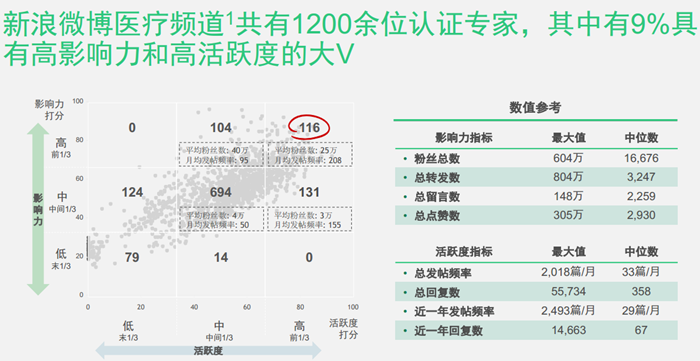
The circle of medical influencers is a place where “pedigree” matters. Among the more than 1,200 verified experts on Sina Weibo’s Medical Channel, one-quarter are affiliated with Peking Union Medical College Hospital (PUMCH) or were previously verified under its name. The rest are largely marketing accounts that attract attention by posting images of women with V-shaped faces and augmented breasts. The remaining few are bloggers focused on traditional Chinese medicine wellness, acupuncture, and tuina massage, none of whom have more than 1 million followers.
Cui Yutao, Duan Tao, Yu Ying, Gong Xiaoming, Zhang Qiang, Ou Qian... In mapping out the landscape of China’s internet-famous doctors, it becomes evident that these influencers have varying degrees of overlap. Some are offline friends, others have exchanged a few messages in shared WeChat groups, while some remain online acquaintances who have never met in person.
This, on one hand, underscores the small size of the medical community, with the circle of influential medical opinion leaders being even smaller. As a result, physicians often know each other personally; even if they do not, they frequently share mutual rapport. On the other hand, it reflects that few new figures have risen to prominence within the medical profession over the past two years. Those who were destined for fame have already achieved it, and these established figures are well-acquainted with one another, leaving no need to introduce newcomers into the spotlight.
In the past two years, an increasing number of prominent medical influencers have left their positions to launch startups, whether by resigning from public hospitals or withdrawing from multi-site practice arrangements. Entrepreneurship requires “primitive accumulation.” This capital base has been built through fifteen to twenty years of hard work in public hospitals, supplemented by tips and appearance fees earned during their time as online celebrities, and further bolstered by Series A funding fiercely competed for by venture capital firms such as Matrix Partners China, Sequoia Capital China, and Legend Star. Money is not the issue; the question is where to find talent. The team naturally includes old friends and colleagues who have known each other since medical school, as well as young professionals drawn by their reputation.
Highlight your pedigree, build your team, and secure venture capital. The community of medical influencers is growing increasingly close to—and resembles more and more—the internet sector.
Accidentally Became an Internet Celebrity
An individual’s destiny depends not only on personal effort but also on the course of history. There is a reason why few new medical influencers have risen to prominence in the past two years: the platforms for physicians’ public voices have largely been cemented, with WeChat, Weibo, and other self-media channels firmly dominating top-tier traffic and lacking the incentive to promote newcomers. Even aggressive tactics such as Toutiao’s reported RMB 50 million spending to recruit major influencers have not yielded any medical key opinion leaders (KOLs) coming forward to announce such moves. In short, visibility hinges on individual effort, while fame relies on platform support; without platforms that nurture new stars, no new medical influencers will emerge.
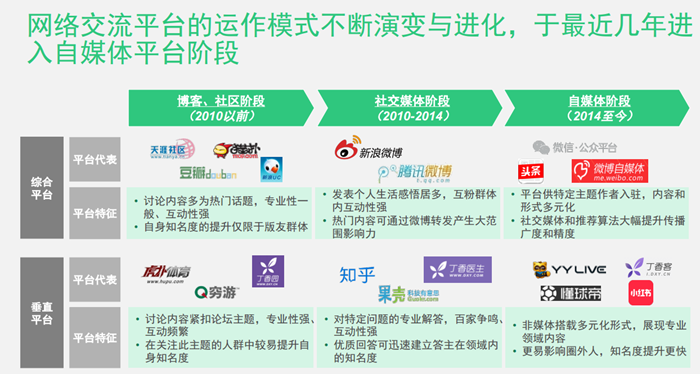
The “Physician Online Influence Report,” jointly launched by BCG and DXY, provides a detailed analysis of the evolutionary trajectory of operational models on Chinese online communication platforms, serving as corroborating evidence for the aforementioned assessment.
The report states that prior to 2010, the online landscape was in the blog community phase. Comprehensive platforms such as Tianya, Mop, and Douban primarily focused on trending topics, with generally limited professional depth. Healthcare was not a key area of discussion, which prevented the emergence of influential healthcare opinion leaders (medical “big Vs”).
After 2010, with the advent of the Weibo era, there was a strong demand for opinion leaders, leading to the emergence of influential figures (“big Vs”) across various fields. Coupled with the rise of vertical niche platforms such as Zhihu, Guokr, and DXY Doctor, physicians gained an environment for discussing professional issues, which gave rise to the first generation of medical “big Vs.”
After 2014, WeChat evolved into “a lifestyle.” A series of self-media platforms, including WeChat Official Accounts, upgraded the ways in which physicians communicated, giving rise to deeper and more diverse content. Medical key opinion leaders (KOLs) gradually entered a phase of stable growth and rapid follower acquisition.
Source: BCG, DXY Report
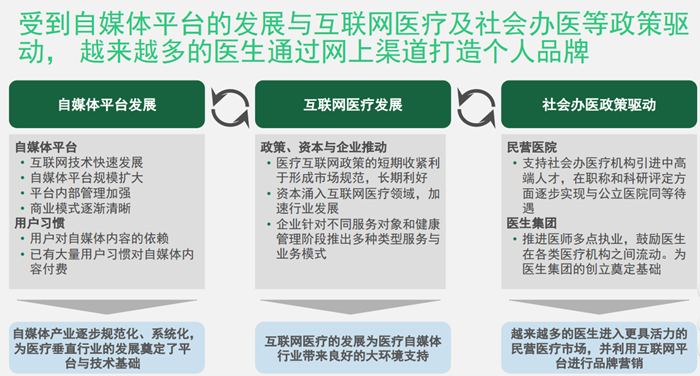
What the BCG and DXY report failed to mention is that 2010–2014 was also a period of rapid development in China’s mobile health sector. During this time, hundreds of mobile health companies used substantial investor funding to subsidize producers of high-quality medical content, leading to unprecedented activity among influential medical opinion leaders.
Taking Chunyu Doctor as an example, VCBeat (WeChat ID: vcbeat) pointed out in its “Interpreting Chunyu Doctor’s Report” series—the first salvo in the content arena—that Chunyu Doctor had already allocated over RMB 20 million in 2014 to incentivize physicians, enhance physician stickiness, and build a competitive moat. Other platforms, such as WeDoctor and Haodf Online, were equally aggressive in subsidizing physicians, enabling prominent medical influencers to reap both fame and financial rewards at that time.
It is often said that “fame should come early,” and this holds true for major medical influencers as well.Gong Xiaoming, who currently holds the titles of Founder of China Obstetrics and Gynecology Network and Co-Founder of Woyi Famous Obstetricians and Gynecologists Group, stated on Weibo that he “accidentally became one of China’s Top Ten Internet-Famous Doctors.” Born in Taizhou, Zhejiang Province, Mr. Gong made this remark specifically to local media in Taizhou, reflecting his genuine sentiments.
Gong Xiaoming first engaged with the internet in 2000, by which time he had already completed three years as a resident physician at Peking Union Medical College Hospital. At that time, many people were interested in the hospital’s case data, so Gong began sharing industry information and knowledge on his website. Initially, he taught himself web development software to build the site and registered a domain name. It was not until 2003, when he purchased an external content management system (CMS), that the website truly took shape.
Another individual who embarked on the path of building their own website is Li Tiantian, founder of DXY. A native of Jilin Province, Li established DXY while pursuing his graduate studies at Harbin Medical University, initially aiming to provide medical professionals with a platform for searching professional articles and information. This was back in 2000. By 2006, DXY began its commercial operations, and Li Tiantian rose to prominence—not as a physician, but as an internet entrepreneur.
Source: BCG, DXY Report
Why They Are Popular
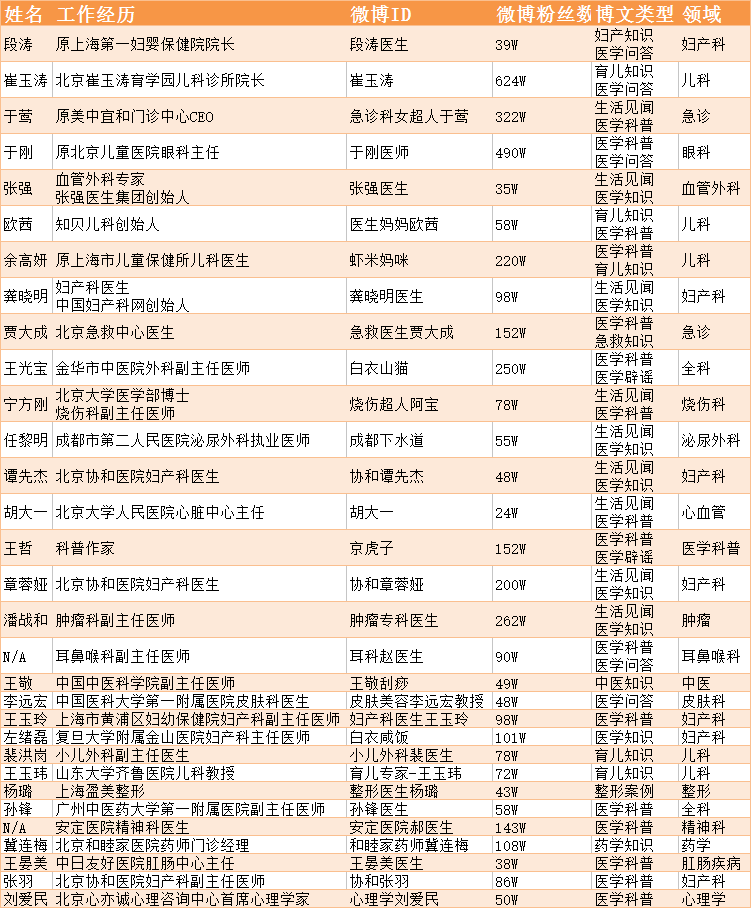
On Sina Weibo’s medical channel, among the top 100+ ranked accounts, a significant number are from Peking Union Medical College Hospital, and many others specialize in gynecology and pediatrics.
The underlying reasons are naturally linked to the platform’s user demographics. As a public discussion platform, Weibo boasts over 500 million registered users, with monthly active users (MAU) reaching 340 million. Female users surpass male users in both number and engagement level, making it logical that topics such as obstetrics and gynecology, as well as parenting, generate high levels of discussion.
Furthermore, content in obstetrics and gynecology and pediatrics is not reusable; each new mother requires different guidance during preconception and child-rearing. Influential figures in these fields remain highly active, dominating top-tier traffic.
Profiles of Selected Key Opinion Leaders (KOLs) in the Medical Field on Sina Weibo
“Chao Cuo Lun” states that those who have accomplished great deeds in ancient times not only possessed extraordinary talent but also unwavering perseverance. This principle also applies to influential medical opinion leaders: beyond having compelling topics, diligence is particularly crucial.
“Parenting Icon” Cui Yutao is about to turn 55, having passed the age of knowing fate. He now holds the title of Director of Cui Yutao’s Parenting Academy Pediatric Clinic and travels extensively for events, becoming a frequent flyer. His Weibo and WeChat accounts are consistently updated, and he still finds time to consider whether the Parenting Academy APP should venture into e-commerce, worrying about the company’s development direction.
Had Dr. Cui not left the public healthcare system, following the typical career trajectory for physicians in China—eight years of combined bachelor’s and master’s studies, followed by a three-year residency—he would have begun performing surgeries, publishing academic papers, and pursuing professional title promotions. By age 55, he could have attained the rank of Chief Physician (Senior Professional Title), precisely during the golden period of his career. He would have been able to conduct outpatient consultations at a leisurely pace, with pharmaceutical representatives visiting one by one to show their regards, ensuring both a comfortable income and a respected social status.
But look at Cui Yutao: he has authored more than a dozen books, appeared on television programs, interacted with celebrities, amassed over six million followers on Weibo, and even founded his own company. His public presence is arguably greater than that of physicians holding senior professional titles in public hospitals. As the saying goes, “What is lost at sunrise may be regained at sunset.”
Duan Tao, nicknamed “Master Duan,” is in his early fifties. He resigned from his position as President of Shanghai First Maternity and Infant Hospital in January this year. After lying low for six months, he announced his appointment as the General President of the WeDoctor Women’s and Children’s Medical Consortium, where he oversees, manages, and provides guidance on service delivery at partner institutions of WeDoctor Women’s and Children’s Hospitals. In August, the mobile health company Anxin Doctor announced a collaboration with Dr. Duan to establish a chain of mid-to-high-end community clinics. Meanwhile, Dr. Duan continues to see outpatients at the Maternity and Infant Health Care Hospital.
Duan Tao was likely among the last wave of prominent medical influencers to join Weibo. He began posting on the platform in 2014, seizing what he described as “a serendipitous yet inevitable, half-reluctant opportunity.” Starting with occasional answers to questions and personal reflections, he gradually established a highly consistent routine—posting two to three articles per week, “more regular than menstruation.” On his WeChat public account, Dr. Duan publishes an average of 22 articles per month, each substantial in both length and informational content. Engaged readers often leave comments beneath his posts, and he sometimes responds personally.
Medical influencers on social media largely possess the same level of diligence as Cui Yutao and Duan Tao. According to the “Report on Physicians’ Online Influence,” the maximum average annual posting frequency among highly influential medical influencers on Sina Weibo was 2,493 posts per month, with a median of 29 posts per month. In short, those who are smarter than you are also working harder than you.
Source: BCG, DXY Report
After Leaving the System
After Duan Tao announced his resignation, many people began to “persuade him to surrender,” offering high salaries and equity stakes; had he signed on the dotted line, he would have quickly achieved financial freedom. However, Duan chose not to take sides, aiming instead to build a management system for women’s and children’s hospitals and provide a platform for fellow physicians to realize their professional aspirations.
Relatively speaking, Yu Ying, who resigned four years ago, did not have such confidence at that time.
Yu Ying, known by her Weibo handle “Emergency Room Female Superman,” began sharing amusing hospital anecdotes and personal observations on Weibo in October 2011. Her humorous and witty writing style subverted the stereotypical image of doctors as stern and rigid, propelling her to fame; her follower count surged from zero to 20,000 in just over twenty minutes. In 2013, Yu Ying announced her resignation from Peking Union Medical College Hospital. At that time, she had amassed 2.76 million followers, surpassing many public figures and earning recognition as a representative voice for physicians.
However, online popularity does not equate to real-world influence. After resigning, Yu Ying planned to establish her own clinic and spent three months in Taiwan studying its general practice model.
That August, Yu Ying and Zhang Qiang, founder of the Zhang Qiang Doctor Group, visited a private hospital in Shanghai that was about to open. From across the street, they could see a banner hanging at the hospital entrance: “Welcome Dr. Yu Ying and Dr. Zhang Qiang for your inspection and guidance, as we jointly pioneer a new chapter in China’s healthcare reform.”
At the time, Yu Ying’s thinking was simply that she wanted to do her own thing and had nothing to do with reform.
However, Yu Ying ultimately failed to carry out her intended venture. After she submitted the required documents to the local health bureau for the chosen location, her application was directly rejected. The reason was straightforward: at that time, there were no provisions in the urban planning for the Beijing area between the North Fifth Ring Road and the East Fifth Ring Road that permitted the establishment of private clinics.
After being rejected, Yu Ying vented on Weibo: “Why is it so difficult for a PhD graduate who has received eight years of formal medical education and a physician with 12 years of experience at a large Grade A tertiary hospital to establish a legitimate clinic through proper channels?”
Ultimately, Yu Ying chose to partner with Amcare, acquiring an equity stake as a partner and serving as CEO of Amcare Medical Group’s Comprehensive Outpatient Center, thereby transitioning from a clinical role to a managerial position.
Three years later, Yu Ying revived her “dream,” resigning from Amcare to announce her plan to establish a chain of community clinics affordable to the general public. During her three-year tenure at Amcare, Yu Ying completed her transition from a physician to a professional manager.
How difficult is this transition? Ou Qian, who also left the public healthcare system, deeply relates to this challenge. In late 2015, Ou Qian resigned from the Guangzhou Women and Children’s Medical Center to establish Zhibei Pediatric Clinic, which officially opened this year and plans to expand into the Pearl River Delta region.
She believes that leaving the public sector to start a business requires overcoming three challenges. First is credibility: patients only trust doctors endorsed by public hospitals, making it difficult to attract them through online channels. Second is team-related issues: public hospitals offer certain advantages, and doctors are often reluctant to leave their stable positions. Even if sufficient staff can be recruited, team integration and management remain long-term processes. Third is financial constraints: healthcare is inherently a field with a long return-on-investment cycle, and funding represents a major bottleneck for physicians starting their own ventures.
Nevertheless, Ou Qian still encouraged doctors who were leaving their jobs to start businesses to “follow their hearts” and boldly venture forth.
Joining the Vast Ocean of Entrepreneurs
Over the past two years, the environment for physicians launching startups has improved significantly, leading to a surge in entrepreneurial ventures. Even among those who have not yet started their own businesses, many physicians are already mentally disengaged from traditional practice, eager to embark on new paths. As the saying goes, “One generation plants the trees; another gets the shade.” The entrepreneurial journeys of prominent medical influencers have been extensively analyzed and serve as practical guides to help physician entrepreneurs avoid common pitfalls.
Various clinics have become the top choice for doctors resigning from public institutions. This phenomenon of doctors leaving their posts to establish private practices has been dubbed the “clinic boom.”
The proponents of the clinic boom also include mobile health and internet healthcare companies that have grown alongside these prominent medical influencers, such as Chunyu Yisheng, DXY, and WeDoctor.
In May 2015, Chunyu Yisheng announced the opening of 25 offline clinics in five key cities across China, providing end-to-end medical services that integrate online and offline care. The company also set a target to expand to 300 clinics in 50 large and medium-sized cities nationwide by the end of 2015. Given this scale, Chunyu Yisheng will not rely solely on self-built facilities; instead, it will adopt a hybrid approach combining self-construction, partnerships, managed operations, and franchising.
DXY announced its plan to establish offline clinics in 2014. In January 2016, its first clinic officially opened in Hangzhou, followed by the opening of its second clinic six months later. By August this year, the third DXY Clinic had opened in Cangshan, Fuzhou. All DXY Clinics are operated under a self-built model.
Internet healthcare is turning its focus to offline services, aiming to establish a closed-loop integration of online and offline services and refine its business model.
Behind the clinic boom, investors have also been active. For instance, United Family Healthcare’s General Outpatient Center, where Yu Ying previously worked, has received backing from Hillhouse Capital. Zhibei Pediatrics, co-founded by Ou Qian, secured tens of millions of RMB in Series A financing from Sequoia Capital this July.
Hillhouse Capital, a super long-term value investor, has previously invested in a batch of internet companies including Baidu, Tencent, JD.com, and Didi Chuxing. Sequoia Capital adopts a “casting a wide net” investment strategy; its healthcare portfolio includes cases such as BGI Genomics, Angel Medical Group, Kangsheng Bio, Kangda Pre-diagnosis, and Fangrun Medical. Its focus on chain clinics marks a first for the firm.
The healthcare sector remains heavily policy-driven. On May 3 this year, Premier Li Keqiang of the State Council presided over an executive meeting of the State Council, at which three major measures were proposed to support privately run medical institutions. The first measure encourages social forces to establish general practice clinics and independently operated specialized institutions for medical laboratory testing, rehabilitation, and nursing care, while promoting cross-provincial and cross-municipal chain operations by capable privately run traditional Chinese medicine (TCM) clinics, outpatient departments, and similar facilities.
By August 8, the National Health and Family Planning Commission (NHFPC) issued the “Notice on Deepening the ‘Streamline Administration, Delegate Power, and Improve Services’ Reform to Stimulate Investment Vitality in the Medical Field.” The Notice stated that approval procedures for medical institutions should be further simplified, merging the setup approval and practice registration into a single license for secondary-level and lower-tier medical institutions. Meanwhile, the scope for social investment was expanded to promote the development of new business models in the health service industry. These measures were regarded as favorable factors contributing to the clinic boom.
Of course, investment ultimately comes down to people. What would the career trajectories of these prominent medical influencers have looked like without the internet or platforms like Weibo and WeChat? Ou Qian privately describes herself as energetic and mentally resilient; even after exhausting clinic hours, she still carves out time to post on Weibo, enduring online trolls and negative comments—a dedication that her colleagues greatly admire. Duan Tao has also remarked that “time is like a woman’s cleavage: if you squeeze, there’s always some,” which explains how he manages to sustain high-quality output, resulting in his “Doctor’s Diary” and “Hospital Director’s Diary,” works that young physicians regard as essential reading.
Opportunity always favors those who wait and endure. Medical influencers had already been writing books and appearing on television over a decade ago, building substantial reserves of expertise; Weibo and WeChat merely accelerated their rise to fame. Their diligence, persistence, dissatisfaction with the status quo, willingness to step out of their comfort zones, and openness to embracing change are the true essence of their success.
After the clinic boom, medical influencers have plunged into the vast ocean of entrepreneurship, with the second half of their careers just beginning.