

Pharnext Announces IPO Filing for PXT864, an AI-Driven Repurposed Drug Combination for Alzheimer’s Disease
Alzheimer’s disease is no longer an unfamiliar term for many families. The grandparents who once silently cared for the entire household have suddenly become increasingly forgetful: they cannot recall their own names, birthdays, or home addresses; they even forget meals they have just eaten or baths they have just taken. The faces of the children they raised with their own hands suddenly seem utterly unrecognizable. These scenes are deeply heartbreaking.
According to statistics, there are approximately 44 million dementia patients worldwide. Dementia has become the fourth leading cause of death globally, following cardiovascular diseases, cerebrovascular diseases, and cancer. However, to date, no pharmaceutical agent has demonstrated significant therapeutic efficacy. Commonly available medications such as Aricept (donepezil) and Ebixa (memantine) can only slow disease progression and require continuous administration. The annual cost for these medications alone exceeds RMB 10,000, imposing a substantial financial burden on many patient families from lower socioeconomic backgrounds.
Today’s spotlight is on Pharnext, which has made a novel attempt to provide more effective medications at lower costs. Leveraging artificial intelligence technology, the company identified two drugs for treating alcohol use disorder and combined them in specific proportions to develop a new drug, PXT864. This candidate has demonstrated promising efficacy in inhibiting neurodegeneration in Phase II clinical trials, offering hope to a broad population of patients with Alzheimer’s disease. Let us now take a closer look at Pharnext.
A New Paradigm for Drug Discovery: PLEOTHERAPY
Pharnext is a French pharmaceutical R&D company founded in 2007 by Professor Daniel Cohen, a renowned expert in the field of genetics. The company secured a total of $20 million in investment across three rounds and was listed on Euronext in July 2016. Its core technology is PLEOTHERAPY®, a proprietary new drug discovery paradigm that integrates artificial intelligence. As envisioned by Pharnext, this paradigm can significantly reduce the time and financial costs of research and development, while enabling the production of safer and more effective drugs at a lower cost.
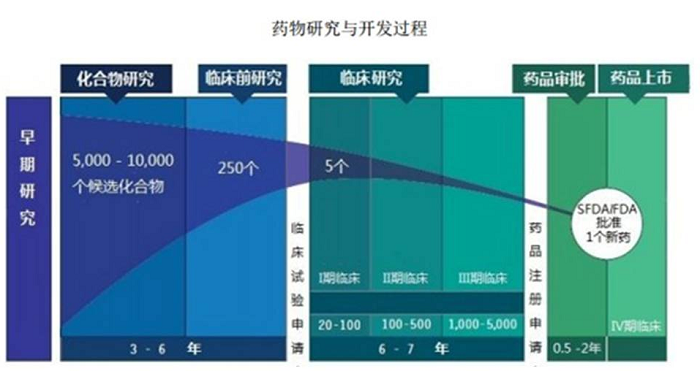
Traditional Pharmaceutical Manufacturing Process
Traditional drug development is time-consuming and capital-intensive. According to Deloitte’s 2016 report, “Measuring the Return from Pharmaceutical Innovation 2016,” the average time required to develop a new drug is 14 years, with an average cost of $1.54 billion. The journey from research and development (R&D) to market launch involves three stages: early-stage research, clinical trials, and regulatory approval. In the early-stage research phase, researchers first identify the drug’s therapeutic target, then develop the corresponding active pharmaceutical ingredient, and subsequently conduct in vitro and in vivo experiments. Only after successfully completing all these steps can an application be submitted to the relevant regulatory authorities for approval to proceed to the next stage: clinical trials involving human subjects. This phase typically takes 3–6 years.
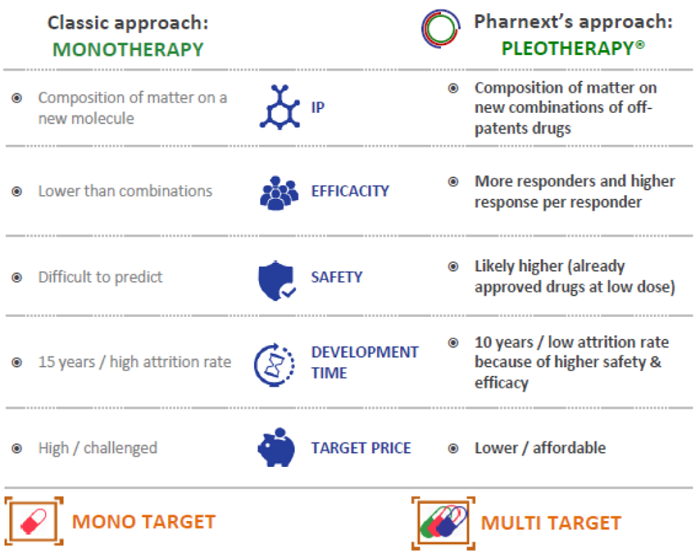
Comparison of the Traditional Drug Development Paradigm and PLEOTHERAPY. Image source: Pharnext official website
Pharnext’s PLEOTHERAPY replaces the early stages of traditional drug development. Instead of developing compounds from scratch, it fully leverages the efficacy of approved drugs by combining them in specific ratios to harness their synergistic effects, thereby creating novel therapeutic agents.
First, since the drugs used are already marketed products that have undergone long-term market validation, and the new drug combines them at low doses, it offers a greater safety profile. Second, compared with single-agent therapies, Pharnext’s new drug targets multiple pathways, potentially achieving superior efficacy. Finally, because these drugs are off-patent and the development timeline is significantly shortened, the medication will be more affordable.
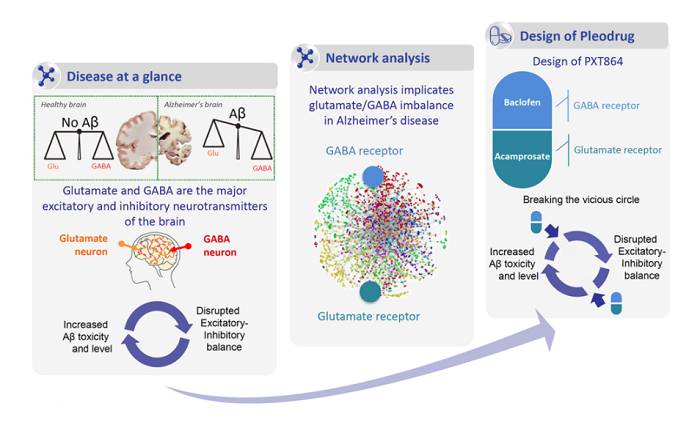
Introduction to PXT864. Image source: Pharnext official website
Core Products: PXT864 and PXT3003
Take PXT864, developed by Pharnext for the treatment of Alzheimer’s disease, as an example. It combines two drugs: baclofen and acamprosate. Notably, neither of these drugs had previously been used to treat Alzheimer’s disease (both are indicated for the treatment of alcoholism). Their inclusion in PXT864 stems from Pharnext’s network analysis, which revealed that the concurrent use of both drugs can restore the balance between excitatory and inhibitory neurotransmitters in the brain, thereby alleviating the imbalance caused by β-amyloid accumulation.
PXT864 completed the data analysis for Phase II(a) of its clinical trial last December. Forty-five patients with Alzheimer’s disease participated in this stage of the trial. The results showed that PXT864 can slow disease progression in patients with mild Alzheimer’s disease.
The interim results for PXT864 provide support for PLEOTHERAPY, a new R&D paradigm, and have raised expectations that this approach will yield superior therapeutics. After all, to date, no drug has been able to fully inhibit or alter the progression of Alzheimer’s disease.
In the upcoming Phase II(b) clinical trial, researchers will further evaluate the therapeutic efficacy of PXT864 for Parkinson’s syndrome and amyotrophic lateral sclerosis (ALS), with final results expected around 2020.
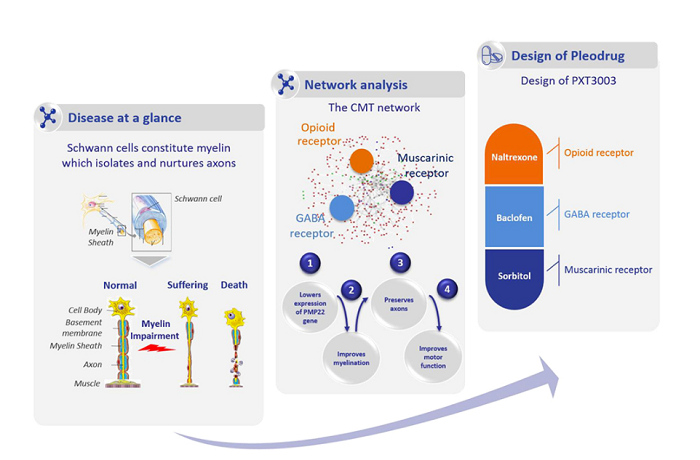
Introduction to PXT3003, image source: Pharnext official website
Pharnext’s drug pipeline, developed using its novel approach, extends beyond PXT864. The company is also targeting another ultra-rare neurodegenerative disorder—Charcot-Marie-Tooth disease type 1A (CMT1A). With a prevalence of 1 in 3,300 to 1 in 2,500 in Europe and the United States, CMT1A manifests clinically as muscle weakness in the limbs, and most patients require wheelchairs for mobility.
To date, there are no approved medications for the treatment of this disease. PXT3003, another drug developed by Pharnext, is an orphan drug designed to address this unmet medical need. Similarly, it consists of a specific combination of baclofen (used to treat alcoholism), naltrexone (used to aid in drug addiction recovery), and sorbitol. Phase II trials demonstrated that PXT3003 has a favorable safety profile and significant therapeutic efficacy in children with CMT1A. The Phase III trial was initiated in December 2015, enrolling 323 patients with CMT1A in a double-blind study, with results expected in the second half of 2018.
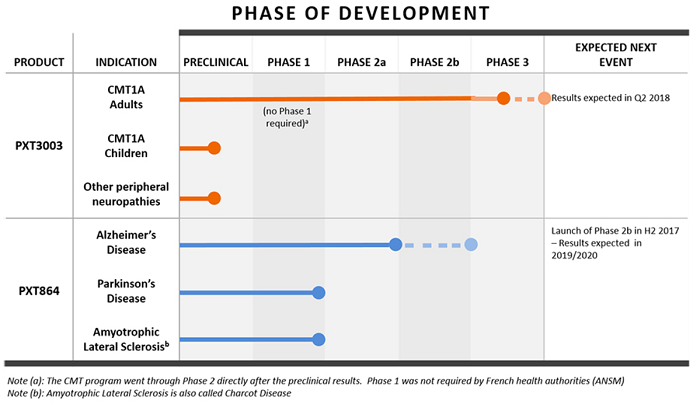
Development Progress of PXT3003 and PXT864, Image Source: Pharnext Official Website
Combining different drugs in specific proportions to create a panacea for intractable diseases sounds almost unbelievable, even today. This bold idea is closely tied to the long-held vision of founder Daniel Cohen. In an interview with Nature Biotechnology, Daniel Cohen revealed that his inspiration stemmed from one of nature’s most fundamental principles: pleiotropy.
Specifically, the synthesis of protein macromolecules controlled by genes participates in multiple biological metabolic and growth processes, thereby influencing various traits. However, a significant portion of these associations remains unknown. Therefore, Cohen proposed leveraging artificial intelligence and powerful computational capabilities to help identify and infer these potential connections, thus providing insights for repurposing existing drugs and developing new ones.
In an interview with Mads Medical, Daniel Cohen also stated that Pharnext’s core competitiveness lies in its PLEOTHERAPY technology platform. Combining marketed drugs may sound simple, but even selecting just three drugs from a pool of 2,000 yields over one billion possible combinations. PLEOTHERAPY narrows these 2,000 drugs down to 15 candidates, thereby significantly reducing the search space. Compared with traditional drug development approaches, drug combination therapies offer greater safety and efficacy, while substantially lowering R&D costs and shortening development timelines. This is a conviction Cohen has held firmly after decades of work in the biopharmaceutical industry.
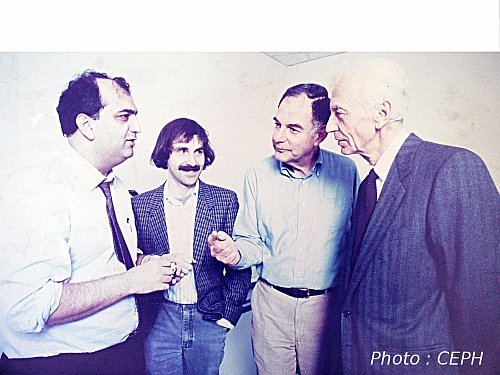
Daniel Cohen (far left) and his mentor Jean Dausset (far right)
At the CEPH (Center for the Study of Human Polymorphisms), Jean Dausset is the founding father of human genetics.
Won the Nobel Prize for his pioneering work in immunology in 1980. Professor Daniel Cohen himself, in genetics
His expertise is also profound; he was the first to map the human genome’s physical map. Image source: CEPH official website.
Overview of AI + New Drug Discovery Abroad
VCBeat previously conducted a review of companies applying artificial intelligence to new drug discovery in its article, “The AI Healthcare Industry: Booming Abroad, with Only One Player Domestically.”
As we can see from the article, most companies are targeting early-stage drug synthesis, aiming to reduce the time spent in this phase. However, the data sources they leverage vary slightly. For instance, BenevolentAI analyzes scientific literature, while others derive insights into disease-drug associations from genomic, metabolomic, and other types of data. The diseases of focus are predominantly cancers, along with neurological disorders and various rare diseases.
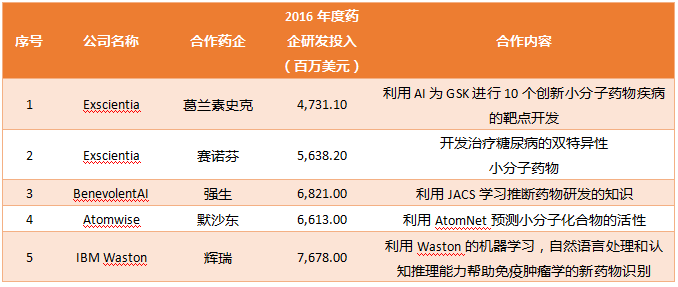
Collaborations Between Global Pharmaceutical Giants and AI Companies
In contrast, the development of related domestic enterprises appears significantly inadequate. Admittedly, there is a substantial disparity in scale between Chinese pharmaceutical companies and their international counterparts. Global pharmaceutical giants such as Pfizer, Novartis, Johnson & Johnson, Roche, GSK, and Sanofi each invest nearly USD 5 billion or more annually in research and development (R&D), providing robust financial support for new drug development. In comparison, Hengrui Medicine, China’s largest pharmaceutical company, spends only around RMB 1 billion on R&D per year, highlighting a considerable gap in R&D funding. Nevertheless, it should be noted that Hengrui’s R&D expenditure in 2016 increased by 30% year-on-year, with R&D spending accounting for over 10% of its operating revenue—figures that lead among peer domestic pharmaceutical companies.
From this data, we can see that although Hengrui has performed quite well, there is still a significant disparity in scale compared to large foreign pharmaceutical companies. This results in our absolute R&D expenditure being far lower than that of foreign counterparts. Meanwhile, it is important to note that while many foreign pharmaceutical companies have begun to leverage artificial intelligence for drug development, no AI-developed drug has yet reached the market. Therefore, accurately estimating the time and financial costs associated with this approach remains challenging. In this context, it is understandable that smaller domestic pharmaceutical companies are adopting a wait-and-see stance.
However, purchasing AI services from smaller companies for new drug development is not the only path for large corporations. For those whose scale does not justify direct service procurement, establishing joint ventures is a viable alternative. The protagonist of this case, Pharnext, partnered in May this year with Tasly, a major Chinese traditional medicine company. According to official information from Tasly: Tasly invested €20 million in Pharnext; meanwhile, Pharnext, Tasly, and Daniel Cohen agreed to jointly establish Tasly International Gene Network Drug Innovation Center Co., Ltd. in Tianjin, which will hold the rights for clinical trials, product launch, manufacturing, and sales of PXT3003 in the Greater China region. Furthermore, the company will leverage Tasly’s biopharmaceutical research platform, natural plant component database, and Tasly’s proprietary combination drug network development technology (i.e., PLEATHERAPY) to build additional network pharmacology models and advance the development of modern traditional Chinese medicines with clearly defined mechanisms.
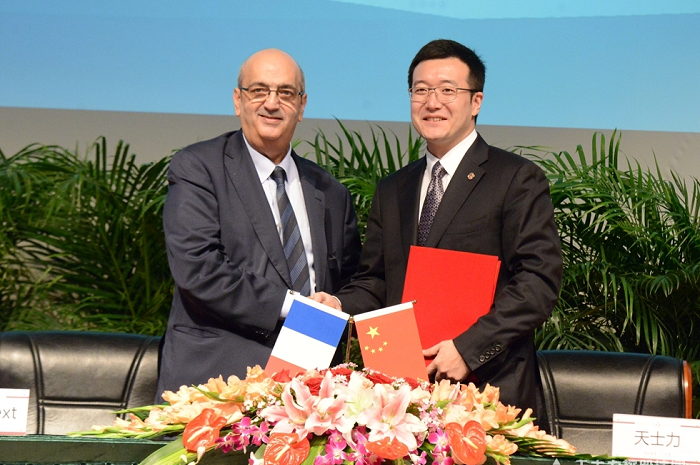
Pharnext and Tasly Hold Partnership Ceremony. Image source: Tasly official website
In an interview with MedSci, Daniel Cohen revealed that a key reason for choosing to partner with the traditional Chinese medicine (TCM) enterprise Tasly is his belief that TCM inherently embodies the concept of combination therapy—TCM formulations typically consist of combinations of more than ten herbal ingredients, each of which itself comprises numerous compounds. This perspective aligns closely with Pharnext’s research philosophy. He therefore believes that this collaboration will better leverage the respective strengths of both companies and advance the development of superior TCM products.
We look forward to the performance of this joint venture. We also anticipate that artificial intelligence will truly bring about substantive changes in new drug discovery.
References
Video:
MedSci’s Exclusive Interview with Daniel Cohen
Audio:
Nature Biotechnology: An Exclusive Interview with Daniel Cohen
Official Website
Pharnext Official Website
Tasly Official Website
CEPH Official Website
Genethon Official Website
2016 Annual Report of Jiangsu Hengrui Medicine Co., Ltd.
Deloitte Pharmaceutical Report
News
http://www.prnewswire.co.uk/news-releases/daniel-cohen-to-join-genset-156603725.html (Daniel Cohen to join geneset)
http://news.bioon.com/article/6698777.html?from=groupmessage(Former Minister of Health Chen Zhu meets with Daniel Cohen)