

GuideMia Technologies Files IPO Prospectus to Revolutionize Dentistry with FDA-Approved Digital Implant and Orthodontic Solutions
According to an industry research report by Haitong Securities, a key pain point in the dental market is the bottleneck of scarce physician resources hindering the expansion of the traditional dental industry. The report posits that digital dental technology is the primary disruptive force in the sector.
However, the foundation of digital dentistry in China remains weak. The Chinese Stomatological Association has vigorously promoted digital technologies in recent years, a move grounded in its understanding of the current state of the industry.
Leveraging digital technology to transform the dental industry is the core mission of GuideMia Technologies. Digital implantology and orthodontics are key to breaking through industry bottlenecks.
GuideMia Technologies, registered in California, USA in 2012, focuses on digital implantology and orthodontics, providing core technologies, platforms, as well as supporting equipment and consumables. It has pioneered a new integrated model encompassing technology, laboratory services, clinical practice, and platform solutions. In 2016, the company established a new entity in Shanghai. What kind of company is it? VCBeat (WeChat ID: vcbeat) conducted an exclusive interview with Gao Fei, founder of GuideMia Technologies.
Gao Fei holds a Ph.D. from Xidian University and completed his postdoctoral research at Shanghai Jiao Tong University. His primary areas of expertise include computer-aided design and manufacturing (CAD/CAM) and 3D modeling. From 1997 to 1999, he served as a Humboldt Research Fellow in the Department of Computer Science at the University of Stuttgart in Germany. Between 1999 and 2005, he worked at UGS (Siemens PLM), the world’s largest CAD/CAM software company, where he headed the System Architecture Group.
From 2005 to 2008, Gao Fei served as Chief Software Engineer at Multi-Dimensional Imaging Co. in Southern California, USA, where he specialized in developing next-generation CT scanning technology and image processing software for the U.S. Department of Defense’s DARPA. The company had a subsidiary that had long been engaged in preventive medicine services based on whole-body CT scanning.
From 2008 to 2010, served as Manager of the Software Development Department at Glidewell Dental Laboratories, the largest dental laboratory and denture manufacturing facility in the United States. This role marked the formal entry into the dental industry, with responsibilities encompassing the development of software systems in areas such as image processing, CAD, and PACS.
Gao Fei told reporters that he was greatly surprised when he attended his first dental exhibition: “It turns out that dentistry also involves many high-tech innovations. Intraoral scanners and CBCT had only recently been introduced to the market. These hardware solutions naturally aligned with my professional background in 3D graphics and imaging.”
However, he also noted that dental digital technology still faces some urgent issues to be resolved. Regarding intraoral scanning, Gao Fei stated, “Some manufacturers have not yet adequately addressed the issue of whether or not to use powder spraying. Furthermore, the scanning time, procedure, and the level of operator experience required are much more challenging than anticipated. If the operator is not proficient, it may take up to 20 minutes to complete a single case scan, and the resulting model may still contain numerous defects.”
GuideMia Technologies currently offers a suite of implant design software, orthodontic software, and a set of surgical tools for dental implants, which have obtained U.S. FDA clearance and European CE certification, along with holding multiple patents. All intellectual property rights will be transferred to the Shanghai-based company.
Gao Fei stated, “After extensive R&D and initial market promotion, the implantation technology has reduced the time required for a dental implantologist to reach proficiency from 5–8 years to just 3–6 months, thereby enabling a rapid increase in the number of qualified implantologists. The software has been sold to 15 countries worldwide, with nearly 1,000 installations of the clinician-facing application.”
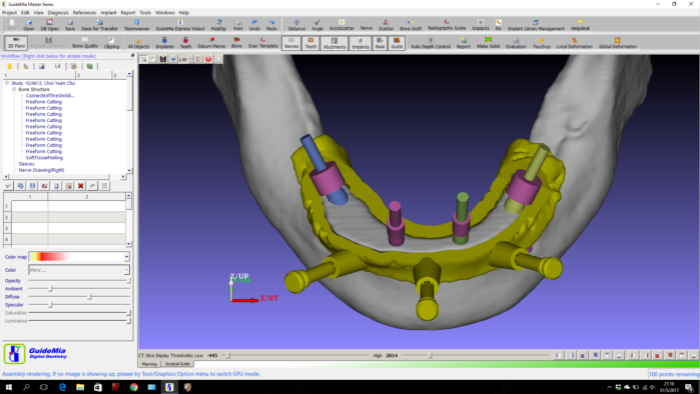
Implant Guide Design Software, Highly Recognized by Leading Implant Experts Dr. Scott Ganz and Dr. Zhou Guohui
The software’s version settings (Master Edition, Planner Edition, Dentist Edition, Browser) and other options are specially customized to meet the needs of promoting guided implant technology in the dental laboratory industry, and have been endorsed by global implant authorities such as Dr. Scott Ganz and Dr. Zhou Guohui.
GuideMia Technologies’ orthodontic software, which has received FDA approval, facilitates the design and fabrication of orthodontic appliances through digital planning of patients’ dentitions. “Unlike conventional orthodontic software, our platform incorporates modeling of the gingiva, tooth roots, and alveolar bone. By integrating advanced technology with clinical expertise, we have significantly lowered the barrier to entry for orthodontic treatment.”
The benchmark company for clear aligner orthodontics is Align Technologies (Invisalign) in the United States. Orthodontic services represented by Invisalign, along with 3Shape’s orthodontic software and their users, frequently encounter a common issue: treatment plans cannot proceed and must be redesigned.
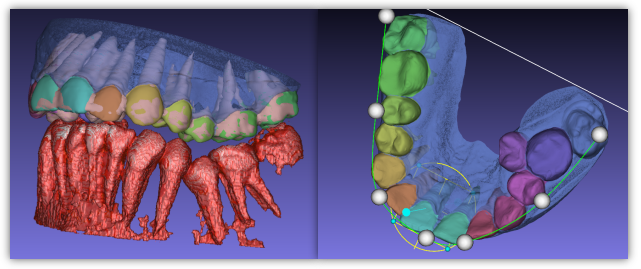
Invisible Orthodontic Software Capable of Modeling Tooth Roots
“Invisalign has even patented the refinement process. In fact, there is a technical issue here that no one has directly addressed. The anatomical models in orthodontic software include only the tooth crowns and gingiva, or even just simulated gingiva, making it difficult for users to accurately assess root morphology and the feasibility of tooth movement.”
A study conducted by Professor Bai Yuxing’s team in China addressed this issue. By arranging teeth solely based on crowns without modeling the roots and alveolar bone, and comparing the alignment results with patients’ actual imaging data, the researchers found that 100% of the test cases exhibited root exposure or alveolar bone fenestration.
Although alveolar bone clinically undergoes coupled remodeling, thereby avoiding such a high incidence of complications, the likelihood and extent of patient-specific bone coupling remain difficult to quantify. Therefore, accurate modeling of tooth roots and alveolar bone is critical. Tooth arrangement and orthodontic movement path planning based on this foundation can effectively ensure the feasibility and safety of an orthodontic treatment plan.
Thanks to years of R&D in the field of dental implantation, GuideMia Technologies has accumulated extensive expertise in CT data processing and has filed patents for its software system based on comprehensive anatomical models.
“A complete anatomical model is the guarantee of successful treatment. Our orthodontic software is based on a comprehensive anatomical model and biomechanical simulation. By modeling and simulating tooth roots, users can more intuitively assess the feasibility of orthodontic treatment plans, thereby improving the success rate in clinical applications and fundamentally addressing the high rate of orthodontic retreatment currently seen in the market,” Gao Fei told reporters, highlighting the advantages of clear aligner orthodontic software with tooth root modeling.
Reporters learned that GuideMia Technologies’ primary revenue model currently revolves around the sale and leasing of surgical guides and orthodontic software. Software clients subsequently utilize these tools to provide services such as the fabrication of surgical guides and orthodontic aligners. The company’s customer base includes dental laboratories, hospitals, and clinics.
The company’s long-term goal is to leverage its core technologies to unite industry stakeholders in building a digital ecosystem for dental implantology and orthodontics, extending downstream to clinical services and upstream to integrate solutions across the supply chain.
Under the leasing model, users pay only for what they use. The greatest benefit for customers is the tighter alignment with software vendors: as the customer base grows, so do the vendors’ revenues, incentivizing them to deliver superior service and encouraging customers to expand their usage. “This model facilitates a virtuous cycle between vendors and customers. Of course, since the leasing model does not involve exclusive services, it will face greater competition.”
When it comes to customer selection, dental laboratories are ideal clients. Gao Fei stated, “Dental laboratories already have their own networks of dentists and clinics, which facilitates early-stage market expansion through collaboration. Furthermore, dental laboratories offer comprehensive support services. The goal of providing surgical guides for dental implants is not an end in itself; rather, the ultimate objective of implant placement is prosthetic restoration. Patients need to take home their final dentures or crowns.”
It is important to highlight that although many companies currently offer surgical guides on the market, they all rely on closed software systems. After designing the patient’s surgical plan, clinicians must send the case to traditional software vendors and then wait for the surgical guide to be returned, resulting in a lengthy workflow.
GuideMia Technologies’ software is an open system that allows anyone to design and fabricate surgical guides, offering excellent compatibility. Gao Fei stated, “Another advantage of GuideMia Technologies is the high degree of commercialization and maturity of its software. The system has undergone extensive long-term use by a large user base and continuous version updates, making it highly suitable for large-scale adoption. Furthermore, backed by a strong team of physician advisors, the company effectively integrates clinical practice with technology.”
GuideMia Technologies aims to become a global leader in digital technologies for the dental industry, empowering every dentist to perform implant and orthodontic procedures, enabling the vast majority of patients to benefit from minimally invasive and precise treatments, and establishing China as the global hub for designing implant and orthodontic solutions. The company is currently seeking Pre-A round financing.