

Tencent and Fudan University Shanghai Cancer Center Launch WeChat-based Digital Outpatient Card to Tackle 'Three Long Waits, One Short Visit' Challenge
“Three hours in line, five minutes with the doctor.” This statement may be somewhat exaggerated, but it does reflect, to some extent, the awkward predicament patients face when seeking medical care at hospitals. Many people rise before dawn, armed with various IDs, cards, and cash, rushing to the hospital in hopes of securing an earlier spot in line, seeing a doctor sooner, and returning home earlier after their appointment. However, things rarely go as planned. After queuing for registration, they must then wait in lines for consultation, payment, and examinations. By the time they finish their visit and leave the hospital, it is often already afternoon.
This situation has long been criticized by many patients seeking medical care at major hospitals in Beijing, Shanghai, and Guangzhou. For hospitals, the large number of patients and family members who are unaccustomed to scheduled appointment times result in prolonged stays on hospital premises, leading to overcrowded and noisy outpatient buildings and making it difficult to ensure a proper clinical environment for physicians.
VCBeat (WeChat ID: vcbeat) has learned, on September 15, to address the challenges of medical consultations and improve patients' healthcare experience through information technology, Fudan University Shanghai Cancer Center and Tencent held a event in Shanghai themed“Strategic Cooperation Signing Ceremony Themed ‘Co-building a Smart Healthcare Ecosystem’”Li Duanshu, Secretary of the Hospital’s Party Committee; Wu Jiong, Vice President of the Hospital; Ding Ke, Vice President of Tencent; Wu Bo, General Manager of Tencent Medical Product Center; and numerous hospital experts and department directors attended the signing ceremony.
Both parties will fully leverage the medical service capabilities of Fudan University Shanghai Cancer Center and Tencent’s information technology advantages to collaboratively develop new features—such as appointment payment and queue management—based on the hospital’s official WeChat account. This initiative aims to deliver a “smart upgrade” to patient care services, returning time to patients and enhancing efficiency for physicians.
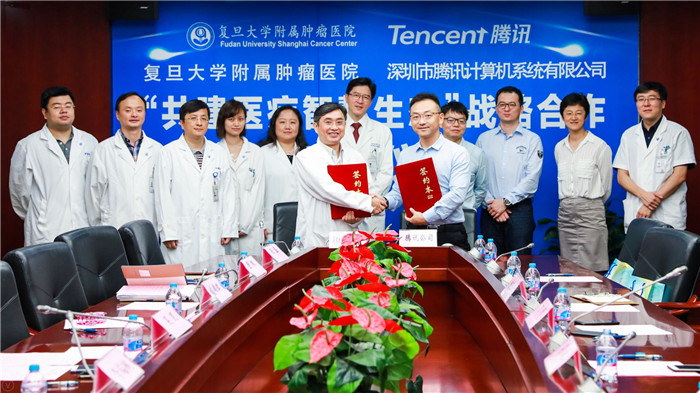
(Fudan University Shanghai Cancer Center and Tencent Sign Strategic Cooperation Agreement)
Skip the lines for registration and payment, check test reports via WeChat, and enjoy a hassle-free medical visit with just your smartphone.
Fudan University Shanghai Cancer Center is a renowned specialized oncology hospital in China, receiving a large number of patients and their family members from across the country every day for consultations, examinations, and treatment planning. Currently, seeking medical care at this cancer center involves at least six steps, including triage, registration, waiting, consultation, printing of medical records/prescriptions, and payment, excluding subsequent procedures such as diagnostic tests, medication pickup, and injection therapies.
Although hospitals have provided a certain number of self-service kiosks for payment and registration, these still fail to meet patient demand, particularly in effectively addressing the issue of prolonged waiting times in queues. Many first-time patients are unfamiliar with the clinical workflow, unsure how to make appointments, which window to use for registration, or which floor to visit for payment, and often forget to bring their identification documents, causing significant inconvenience during the medical consultation process.
Taking the hospital’s Department of Pathology as an example, which ranks first nationwide in specialty reputation, it routinely handles a large volume of patients from across China seeking pathological consultations. However, due to professional review requirements, the current process is relatively complex. In addition to reviewing the slides submitted for pathological consultation, uncertainties regarding payment items and report turnaround times contribute to significant overcrowding of patients and their families in the pathology waiting area. This leads to heightened anxiety among patients and their relatives, while also placing substantial pressure on frontline medical staff to provide explanations.
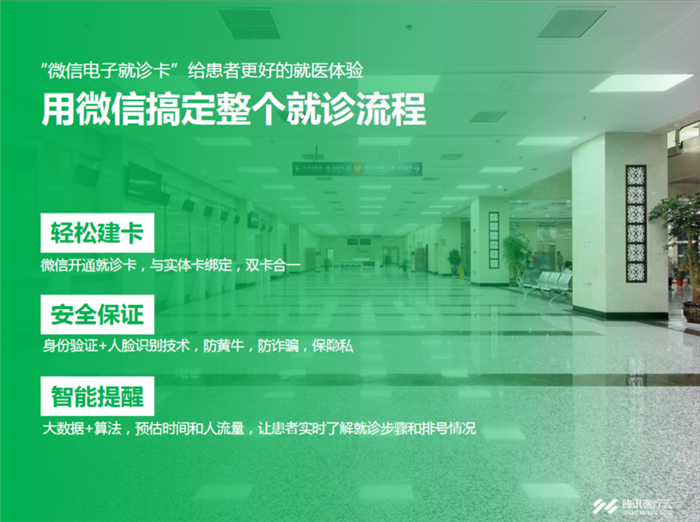
(WeChat Electronic Medical Card Consultation Process)
To address this issue, Fudan University Shanghai Cancer Center and Tencent plan to adopt the “WeChat Electronic Medical Card” to optimize the medical consultation process. Patients need only follow the hospital’s official WeChat service account, verify their identity using their national ID card, and create an “Electronic Medical Card.”With this "Electronic Medical Card," patients can access features such as online appointment registration, subscription to doctors' schedule updates (including cancellations), waiting room notifications, online payment, and report inquiries.
For out-of-town patients, the "Electronic Medical Card" enables online appointment registration from home, eliminating the need to obtain a physical card and register upon arrival at the hospital. Patients who already have a physical medical card can also apply for an "Electronic Medical Card" through the hospital’s WeChat service account by verifying their identity with their national ID card. The hospital information system will automatically link the electronic card to the existing physical card based on the ID information, enabling seamless integration of both cards. This allows patients to use either card interchangeably, avoiding the inconvenience of re-queuing at service counters due to loss or forgetfulness of the physical card.
For patients who need to inquire about blood test and ultrasound results, they can leave the hospital with peace of mind after the examination and wait for the results. The electronic reports will be sent directly via WeChat, eliminating the need to wait on-site. For non-Shanghai medical insurance patients who are queuing to pay, they can receive payment notifications through the electronic medical card and choose to pay via WeChat, thus avoiding the hassle of standing in line.
Preliminary assessments indicate that by leveraging internet-based solutions to replace unnecessary in-person queuing steps throughout the healthcare journey, patients save an average of 2.5 hours. This approach also alleviates the workload of hospital window staff and enhances outpatient efficiency. Furthermore, Tencent’s identity verification and security protection system has significantly curbed illicit activities such as appointment scalping and ticket reselling by “huangniu” (scalpers), thereby creating a safe and favorable medical environment for both patients and healthcare providers.
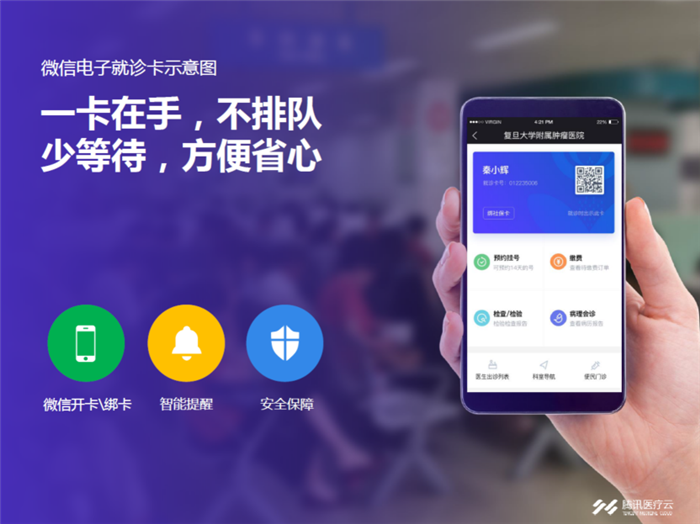
(Electronic Medical Card Schematic)
RowWeChat Waitlist Reminders, Business District Promotions, and a Wall-Free Waiting Hall
Many patients remain in the hospital waiting areas not solely due to mobility issues. Many patients and their families are unfamiliar with the hospital surroundings. Even after completing registration and payment, they often find themselves in overcrowded waiting areas with dozens of people ahead in line. Due to a lack of visibility into the physician’s consultation progress and fear of missing their turn, they have no choice but to wait anxiously outside the consultation room.
For Fudan University Shanghai Cancer Center, which has limited physical space, this situation has placed significant pressure on the maintenance of the outpatient environment.
On the one hand, patients are overly concentrated in the waiting area, sometimes even without seats to rest on, forcing them to sit on the floor and leading to significant dissatisfaction with the waiting environment. On the other hand, the congested and noisy outpatient environment makes it difficult for physicians to concentrate on consultations, often requiring them to assist nurses or administrators in maintaining order in the consultation area.
Jointly developed by the hospital and Tencent“WeChat Electronic Medical Card”“This also takes into account the resolution of this issue. First, by analyzing big data on physicians’ consultation efficiency, a fuzzy calculation formula for each physician’s consultation time is derived. Combined with real-time data from the on-site queue management system, patients can obtain estimated waiting times and current queue status via the hospital’s official WeChat account after registration. This allows patients to leave the waiting area with peace of mind and seek more comfortable spaces while awaiting their turn.”
Meanwhile, patients can access discounted payment options and round-trip transportation information for nearby commercial areas via WeChat. When estimated waiting times are long, patients can take advantage of convenient discounts offered by nearby hotels, cafes, and other merchants, allowing them to plan their time reasonably and effectively while enjoying better rest and services. By changing payment habits, we aim to transform waiting behaviors, turning the surrounding commercial districts into an “open-air waiting hall” for the Cancer Hospital, thereby enabling patients to experience the warmth and care of Shanghai’s hospitals.
Sustained Investment in Cutting-Edge Technology, Building a New Ecosystem for Hospital Services, and Serving as the Guardian of Public Health
Since 2015, the National Health and Family Planning Commission and the State Administration of Traditional Chinese Medicine have jointly launched the first three-year “Action Plan for Further Improving Medical Services.” The initiative focuses on addressing the issue of “three long waits and one short consultation”—namely, long registration times, long waiting times for consultations, and long medication dispensing times, coupled with short consultation durations—by transforming this pattern into “three short waits and one long consultation.” It aims to optimize healthcare processes and promote high-quality nursing care.
Fudan University Shanghai Cancer Center is about to launch in collaboration with Tencent"WeChat Electronic Medical Card", which is expected to further streamline the entire online medical consultation process at tertiary hospitals.
Wu Jiong, Vice President of Fudan University Shanghai Cancer Center, stated, “Enhancing the quality of medical services relies not only on advancing clinical medical expertise but also on continuously strengthening hospital management and service capabilities. We aim to leverage information technology to continually improve patients’ healthcare experience and boost the efficiency of outpatient services.”
“Especially for patients with major diseases such as cancer, improving the medical consultation process and environment through information technology is not only a reflection of the hospital’s emphasis on management but also an embodiment of its humanistic care for patients.”. We look forward to establishing a long-term partnership with Tencent, further strengthening our collaboration in artificial intelligence (AI) and medical imaging technologies, continuously improving the diagnosis and treatment of cancer, enhancing patients’ healthcare experience, and providing patients‘MoreTemperature’ services.”
Amid the trend of “Smart Healthcare,” Tencent’s strengths lie in its big data processing capabilities, information security protection, and social media platforms with a massive user base. Its collaboration with Fudan University Shanghai Cancer Center aims to promote the innovative application of cutting-edge technologies such as medical big data in China, thereby enhancing the quality and efficiency of healthcare delivery.
Tencent Vice President Ding Ke stated, “We are empowering hospitals with Tencent’s connectivity capabilities. This enables patients to understand the entire medical consultation process via WeChat, precisely connect with doctors, and enjoy convenient online services across all stages, including appointment scheduling, consultations, examinations, and multidisciplinary consultations.”
“In our collaboration with hospitals, we have also identified that Tencent can leverage big data and artificial intelligence technologies to deliver more efficient and precise services in areas such as long-term follow-up management for cancer patients, cancer prevention and screening, and health education for cancer patients.”Starting with the optimization of the medical care experience, hospitals are helped to gradually build a service ecosystem that includes in-hospital diagnosis and treatment, out-of-hospital follow-up, peripheral life services, and even medical consortiums.”