

How EpimAb Biotherapeutics Leverages Technology-Driven Innovation to Stand Out in the Bispecific Antibody Market

EpimAb Biotherapeutics
Developer of Tumor Bispecific Antibodies
Bispecific antibodies are a type of genetically engineered antibody that contain two distinct artificial antibody variable domains, enabling them to bind simultaneously to two different targets, such as target cells and effector cells. Therefore, compared with traditional monoclonal antibody drugs, bispecific antibodies can demonstrate novel therapeutic mechanisms, exhibit stronger cytotoxicity against target cells, and possess greater specificity, making them an emerging powerhouse in the field of antibody-based therapies for tumors, inflammatory diseases, and other related conditions.
Since 2014, pharmaceutical giants such as Roche, Johnson & Johnson, and Sanofi have continuously increased their investments in the bispecific antibody field. Amgen acquired Micromet for $1.16 billion to secure its bispecific antibody drug, representing a premium of 133%. In China, Livzon Group invested $3 million to acquire a stake in AbCyte, thereby entering the bispecific antibody sector. Meanwhile, companies like Innovent Biologics and Jiangsu Hengrui Medicine are also strategically positioning themselves in the bispecific antibody space, aiming to launch the first bispecific antibody on the domestic market.
In addition to pharmaceutical giants and leading companies placing their bets, a Shanghai-based startup has also drawn industry attention: it has entered into R&D collaboration agreements with WuXi AppTec and Kymab; licensed the rights to use its proprietary technology in the Chinese market to Innovent Biologics for $120 million; and secured $25 million in Series A financing after receiving the $120 million licensing fee.
Becoming an industry leader in less than three years, this company is worth a look.
Ten Years at Abbott, Well-Versed in Overseas Markets
Wu Chenbing, Founder and CEO of EpimAb Biotherapeutics, graduated from the University of Georgia in the United States, specializing in biochemistry and molecular biology. In 2000, after completing a three-year postdoctoral fellowship at Harvard Medical School, Wu joined Abbott to engage in the research and development of therapeutic antibodies.
Wu Chenbing candidly told VCBeat that his decade at Abbott was pivotal to his career. “It wasn’t just about gaining experience in biology; during the new drug development process, we also had to address numerous issues related to pharmaceutical research, industrialization exploration, and assessment,” Wu stated. This period of training and accumulation laid the foundation for his future path in new drug development.
Wu Chenbing, Founder and CEO of EpimAb Biotherapeutics
“I spent ten years at Abbott, half of which were dedicated to working with bispecific antibodies,” Wu Chenbing told VCBeat. The technology platform still in use at Abbott today is called DVD-Ig, which was invented by Wu back then.
In addition to technical advancements and improvements, the overseas R&D environment and industrial model have given Wu Chenbing a more comprehensive understanding of patent protection. Under global intellectual property protection, coupled with its inherent technological advantages, EpimAb Biotherapeutics is well-positioned to gain a competitive edge in future market competition.
Return to China and familiarize yourself with the domestic environment
EpimAb Biotherapeutics was founded in 2016, but Wu Chenbing had already returned to China as early as 2010.
In 2010, China’s biopharmaceutical industry was still in its early stage of generic drug production. At that time, the focus was on industrialization, and most returnee talents were more proficient in manufacturing processes. In 2010, research and development (R&D) of PD-1 inhibitors had not yet begun, and domestic companies engaged in new drug R&D were extremely rare.
Wu Chenbing was among the first wave of returnees to engage in new drug R&D. He revealed to VCBeat, “In fact, I didn’t have a clear entrepreneurial vision at the time. The gap between China and the United States was at least 20 years. My idea was simply to familiarize myself with the domestic environment, build up my capabilities, and then join a company.”
Upon returning to China, he first joined ChemPartner, a world-leading CRO company with new drug R&D departments in Europe, Shanghai, and Chengdu. It maintains collaborative relationships with Merck, Johnson & Johnson, as well as Chinese pharmaceutical companies Hengrui Medicine and Qilu Pharmaceutical. Prior to Wu Chenbing’s arrival, ChemPartner primarily provided outsourcing services for chemical drugs. Subsequently, under his leadership, the company established a dedicated biopharmaceutical division, growing its team to over 150 members.
In 2013, Wu Chenbing joined CITIC Guojian as Chief Scientific Officer and Dean of the Research Institute, where he oversaw the company’s end-to-end operations from early-stage drug discovery to clinical trial applications and built a research and development team of nearly 200 members.
During this process, Wu Chenbing gradually gained a deeper understanding and familiarity with the domestic environment; meanwhile, China’s innovation ecosystem continued to improve. He increasingly recognized this as an entrepreneurial opportunity: there were few first-in-class drugs in China, and antibody-based therapeutics were largely confined to monoclonal antibody products, making significant breakthroughs difficult. Consequently, there was substantial market demand for bispecific antibody technology platforms.
“The technical barriers in the bispecific antibody field are extremely high, and there are numerous patent hurdles. Without breakthroughs in this area, it will be difficult for next-generation bispecific antibody drugs to emerge in China,” Wu Chenbing told VCBeat.
On the one hand, there is such market demand; on the other hand, his experience at Abbott has allowed him to accumulate significant expertise in the field of bispecific antibodies. Wu Chenbing hopes to establish a company that can drive innovation and growth in the bispecific antibody industry.
“If I were to start a business, I would definitely need to identify a field that aligns with my strengths and meets market demand,” he stated.
Management Awareness and Internationalization Awareness
Stephan Lensky, who oversees business operations at the company, is a pharmaceutical industry veteran with over 20 years of experience. He previously served as Vice President and Global Head of Transactions and Alliances at Boehringer Ingelheim.
This individual is neither a colleague nor a classmate of Wu Chenbing, and their professional careers did not intersect even prior to their time at EpimAb Biotherapeutics. So, how did these two individuals come together and co-found a startup?
Wu Chenbing’s answer was, “By chance.”
For technology companies, business operations are just as indispensable as products and technology. At the time, the company had just been established, and Wu Chenbing hoped to find a seasoned professional with extensive experience in business operations. Through an introduction from an industry contact, he found Lensky.
“I am looking for a professional with an international background who has established influence and achievements on the global stage,” said Wu Chenbing.
Lensky holds a Ph.D. in chemistry. He began his career in R&D before transitioning to the business sector, where he served as an executive at international pharmaceutical giants such as Bayer and Boehringer Ingelheim. At the time, he was considering joining a startup to achieve a new breakthrough in his career.
The two met through a friend’s introduction. After exchanging a few emails and phone calls, they met in person for the first time in Boston, and Lensky promptly joined the company.
“After meeting Stephan, I never interviewed anyone else. With such passion for work, combined with both academic and business backgrounds, I felt no one could be more suitable than him,” recalled Wu Chenbing.
Bispecific Antibodies: 1+1>2
EpimAb Biotherapeutics focuses its research on bispecific antibodies. This novel class of second-generation antibodies features two distinct antigen-binding sites, enabling simultaneous binding to both target cells and effector cells, thereby enhancing the cytotoxic effect against multiple target cells. Compared with traditional monoclonal antibodies, the efficacy of bispecific antibodies is best described as “1+1>2.”
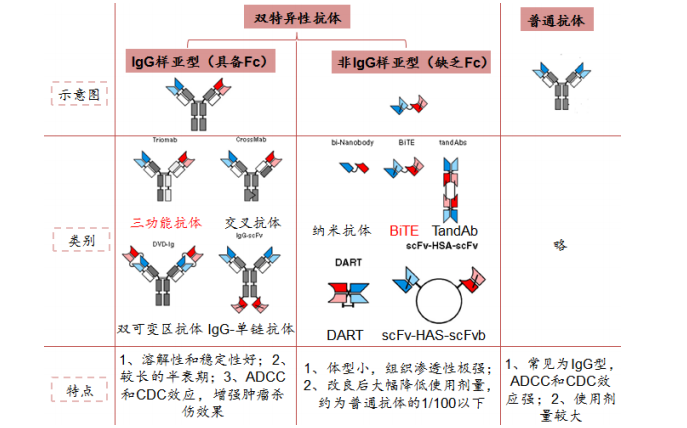
Chart from Zhongtai Securities
However, the development of bispecific antibodies has long been constrained by technical limitations, with the primary bottleneck being the stability of their molecular structure. Bispecific antibody molecules consist of two heavy chains and two light chains, which are highly prone to mispairing during the development process. Furthermore, while addressing the issue of chain mispairing, it is also essential to ensure the drug-like properties of the molecule and its scalability for large-scale manufacturing.
These three factors are akin to the three legs of a tripod; all conditions must be met to achieve industrialization of the product. However, many technologies can address only one or two of these issues, which has consistently posed technical bottlenecks in the development of bispecific antibody products.
Currently, only two bispecific antibodies are marketed worldwide. Among them, Amgen’s blinatumomab has a half-life of less than one hour and requires continuous intravenous infusion, which imposes significant limitations on its clinical use in patients.
Based on prior experience, the EpimAb Biotherapeutics team launched FIT-Ig, its proprietary bispecific antibody technology platform. FIT-Ig is currently the only bispecific antibody development platform worldwide that features no amino acid mutations or peptide linkers. By leveraging the modular structural characteristics of antibodies themselves, it enables spatial reassembly through cross-combination at the genetic level.
The ingenious structural design avoids the issue of heavy and light chain mispairing in bispecific antibody synthesis, while also overcoming bottlenecks in drug developability and large-scale manufacturing, thereby reducing both time and economic costs in subsequent production.
Technology-Driven Dual-Track Model
Leveraging such platform advantages, EpimAb Biotherapeutics has adopted a dual-pronged development strategy.
Regarding platform collaborations, FIT-Ig can serve as a solution to provide technical support to partner companies. For instance, under the technology licensing and collaboration agreement with Innovent Biologics, EpimAb Biotherapeutics has granted Innovent Biologics the rights to use FIT-Ig in the Chinese market. As a result, the Company will receive up to $120 million in payments, along with sales royalties on products post-launch. Should Innovent Biologics subsequently license or transfer the development and commercialization rights for markets outside China, EpimAb Biotherapeutics will be entitled to a specified share of the net proceeds from such transfers, as stipulated in the agreement.
In addition to securing funding through technology licensing, EpimAb Biotherapeutics can also engage in collaborative research and development of innovative products via cross-licensing arrangements. In 2016, EpimAb Biotherapeutics entered into such an agreement with the UK-based biopharmaceutical company Kymab.
Under the agreement, the two parties will leverage EpimAb Biotherapeutics’ proprietary FIT-Ig bispecific antibody technology and Kymab’s proprietary Kymouse fully human monoclonal antibody technology to develop innovative bispecific antibodies targeting the field of tumor immunology. EpimAb Biotherapeutics will hold the product development rights for the Chinese market, while Kymab will retain development rights for markets outside China. Both parties will also be entitled to receive milestone payments tied to market size and sales royalties from each other.
In terms of R&D strategy, as a start-up pharmaceutical innovation company, it is difficult for the company to advance all products to clinical trials. Therefore, EpimAb Biotherapeutics will select some early-stage products to cooperate with other enterprises for development through licensing.
Of course, the research and development of proprietary innovative projects is of paramount importance. For a pharmaceutical innovation enterprise, product development capability is undoubtedly the core competency. Leveraging its proprietary FIT-Ig platform, EpimAb Biotherapeutics has focused its R&D efforts on products that address significant unmet clinical needs. Supported by the aforementioned strategies, the company is able to secure greater funding and resources for the development of its internal innovative products.
“With a platform-based strategy, we can pursue both short-term and long-term strategies simultaneously,” Wu Chenbing revealed to VCBeat.
Innovative drug development is a long-term endeavor. For companies lacking a technological platform, there is only one path forward. If their products cannot be licensed or sold to other companies, or if they fail to successfully launch on the market, the company will face significant losses. Meanwhile, during the R&D phase, without a product pipeline or a technological platform, it is difficult for the company to generate cash flow through its own operations. However, with the support of a reliable technological platform, a company can not only derive multiple products from the platform but also secure more collaboration opportunities.
The model driven by technological advantages has attracted capital attention to EpimAb Biotherapeutics since its early establishment.
In April 2017, EpimAb Biotherapeutics secured a $25 million Series A financing round from international co-investors. The round was led by Yuanhe Yuandian, with participation from Decheng Capital, Bencao Capital, and Qushi Capital.
The company’s current product portfolio is primarily focused on oncology. Moving forward, the company will dedicate its full efforts to advancing existing products into clinical stages while actively pursuing early-stage development of other innovative drugs.
Wu Chenbing revealed to VCBeat that the company’s first product is expected to enter clinical trials in 2018. The company will conduct its Series B financing round in 2018, with the raised funds allocated to building a financial reserve for Phase II clinical trials and preparing for its international expansion.
Implications for Entrepreneurs
1. Selection of Entrepreneurial Direction: Leveraging Personal Strengths to Meet Market Demands
While Wu Chenbing is a novice when it comes to entrepreneurship, he is a 20-year industry veteran in the field of innovative drug development. His decade at Abbott allowed him to accumulate extensive experience in new drug R&D, making the research and innovation of bispecific antibodies undoubtedly his area of expertise.
In terms of market demand, the performance advantages of bispecific antibodies over traditional monoclonal antibodies are not a simple addition, but rather a “1+1>2” synergy. However, the development of this new generation of antibodies has long been constrained by technical challenges, and currently, only Amgen and Trion Pharma have products on the market.
To achieve the industrialization of bispecific antibodies, it is essential to first overcome technical bottlenecks. Currently, several foreign companies possess relatively mature technology platforms, such as AbbVie and Roche, whose products have entered Phase II clinical trials. However, these few companies are insufficient for the industry as a whole; therefore, technology platforms represent a critical necessity in this market.
2. Introduce complementary partners and target the international market
Wu Chenbing is a technology-focused expert. In most cases, it is difficult for one person to achieve excellence in both technological innovation and business operations. This underscores the need for a reliable partner.
On the other hand, today’s pharmaceutical innovation landscape is an international market. Introducing an investor with an international background will undoubtedly provide greater support for the company’s global expansion efforts.
However, drawing on years of experience in pharmaceutical R&D, Wu Chenbing understood that beyond technical prowess, a company also requires strong business operational capabilities. From its inception, EpimAb Biotherapeutics had set its sights on the international market. This strategic direction paved the way for Lensky’s joining.
In terms of clinical development, Wu Chenbing revealed that a renowned senior expert with over 20 years of experience in oncology clinical development at multinational pharmaceutical companies will soon join EpimAb Biotherapeutics to take full charge of the company’s strategy for translational medicine and clinical development.
3. Leveraging Patterns to Enhance Technology
Pharmaceutical innovation is a high-barrier field, and even more so, a technology-driven one. However, this does not mean that entrepreneurs should focus solely on technological and R&D innovation. Business model innovation driven by technology often adds significant value to projects and can bring greater resources and support to technological research and development.