

Shenzhou Dexin Leverages Geometric Algorithms to Differentiate Its 3D Medical Imaging Solutions in a Crowded AI Market
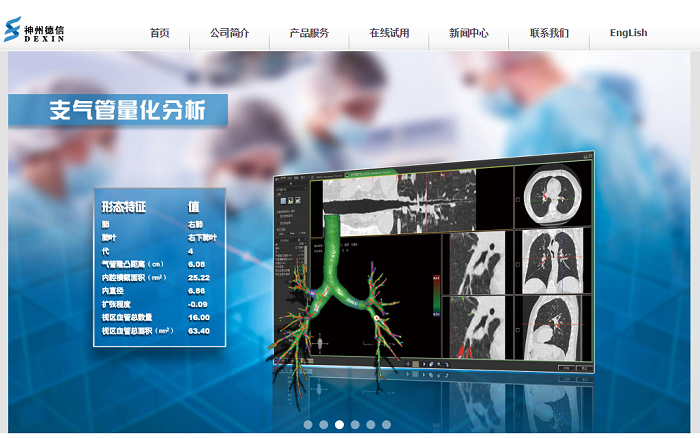
Upon first encountering Shenzhou Dexin’s products, I was struck by their distinct sci-fi aesthetic.
Unlike most AI-based medical imaging products, their solution quantifies lesions or organs and presents them in the form of 3D images.
Shenzhou Dexin is a medical imaging technology company. Unlike the current mainstream intelligent medical imaging companies that primarily rely on deep learning technologies, Shenzhou Dexin’s independently developed intelligent image analysis system integrates key technologies from diverse disciplines, including computer vision, computer graphics, differential geometry, and machine learning.
By leveraging numerous computer vision-based image analysis and detection technologies, the product quantifies pathological tissues or organs and presents them as 3D images, providing visualization solutions to support clinical decision-making, surgical planning, and assessment.
During its six-year development history, Shenzhou Dexin has not only developed solutions based on seven medical imaging systems, but its core products have also successively obtained CFDA and FDA certifications. The company currently collaborates with over 70 hospitals.
How have companies outside Beijing, Shanghai, and Guangzhou developed differentiated products that gained recognition from both regulators and the market?
Forward-Thinking and Team
In 2011, when smartphones had not yet achieved widespread adoption, Shenzhou Dexin had already embarked on research in the field of artificial intelligence plus medical imaging.
Meng Xin, Founder and Chairman of Shenzhou Dexin, graduated from Tsinghua University and engaged in interdisciplinary research at the intersection of biomedical science and computer science, as well as applied product development, at the University of Pittsburgh in the United States. Other team members and technical advisors maintain close collaborative relationships with major U.S. research institutions and medical centers, such as Stanford University and the University of Pittsburgh Medical Center (UPMC). Some team members have been working in intelligent medical image analysis since as early as 2005, while some collaborators are directly involved in frontline clinical practice.
With a team that closely follows scientific research and clinical applications, they have a profound understanding of many clinical issues, which is directly reflected in the design of the products themselves.
A Growth Process Marked by Adversity
In 2010, the Weinan Municipal Government approached Meng Xin, hoping that her cutting-edge research could lead to the development of products capable of empowering primary healthcare. A year later, Shenzhou Dexin Company was established, marking the beginning of its entrepreneurial journey.
Weinan is located in Weinan City, Shaanxi Province. Compared with Beijing, Shanghai, and Guangzhou, Weinan is situated in the typical “Great Northwest.” In such a relatively underdeveloped region, engaging in cutting-edge technical research that few can even conduct in Beijing, Shanghai, and Guangzhou first faces challenges in the availability and application of high-quality human resources.
At a time when no similar products had yet emerged in Beijing, Shanghai, or Guangzhou, the company launched its first product, “Digital Lung,” into the market. However, its technological foresight, innovativeness, and accuracy did not initially translate into a first-mover advantage. Far from being inundated with orders, the most frequent responses they received were labels such as “madmen” and “frauds.”
“At the time, many experts questioned how 2D images could possibly be used to calculate density, area, and volume, let alone other metrics,” recalled Wang Yabo. “However, with advancements in domestic technology, improvements in medical imaging techniques, and the rapid development of artificial intelligence over the past two years, these technologies have gradually gained widespread acceptance.”
Shifting the healthcare system’s perception of this new technology is an essential process. After analyzing various factors, the team concluded that geographical disadvantages had, to some extent, hindered market promotion, prompting them to focus their efforts on Beijing.
“This location offers more opportunities for international exchange, and any cutting-edge technologies are bound to enter China through this gateway. Compared with other regions, Beijing adopts a more open attitude toward new developments,” Wang Yabo told VCBeat.
Shenzhou Dexin adopted a top-down strategy. It first partnered with nationally renowned hospitals such as the Chinese PLA General Hospital, Tangdu Hospital of the Fourth Military Medical University, and the First Affiliated Hospital of Xi’an Jiaotong University. After gaining endorsement from medical experts at these major hospitals, it then expanded its reach downward.
“The reason we collaborate with these hospitals and experts is that medical safety, rigor, and efficacy must be guaranteed above all else. The endorsement of such prestigious hospitals and leading experts is crucial for enterprises like ours, which rely on cutting-edge technologies and innovative business models,” said Wang Yabo.
During the market-oriented promotion process, they gradually gained a deeper understanding of the current clinical landscape, driven by the recognition of China’s prevailing emphasis on hardware over software. To address concerns regarding data and medical information security, Shenzhou Dexin achieved an integration of hardware and software in its products, developing solutions compatible with major current virtual reality equipment in accordance with expert requirements.
Goals Consistent with Industry Peers
Like most of its peers, Shenzhou Dexin has recognized the polarization of medical resources in China and aims to leverage technological solutions to extend the capabilities of large hospitals to primary care institutions.
China has a large number of doctors, but an even larger population. “China’s doctor-to-patient ratio may rank beyond 100th globally, which is relatively backward,” said Wang Yabo, the company’s key executive. “High-quality medical resources are largely concentrated in tertiary hospitals (Grade A), but from the perspective of patients’ essential needs, the demand for medical services at primary care institutions is greater.”
Primary care facilities face a “shortage of physicians, but not of medicines.” Whether in primary care hospitals or tertiary Grade A hospitals, access to medications is relatively straightforward. While pharmaceuticals can be distributed through pharmacies and hospital channels, it is difficult to achieve substantial improvements in the quality of medical services at the primary care level.
“Technology changes life”—this is the original aspiration of most artificial intelligence companies; “Technology changes healthcare”—this is the shared goal of AI enterprises in the medical industry.
The clinical capabilities of primary care physicians indeed fall short of those of medical specialists at tertiary hospitals. By leveraging technology to extend the expertise of tertiary hospitals to the primary care level, although it may not fully replicate the diagnostic and treatment capabilities of tertiary hospitals, it can significantly enhance the competencies of primary care physicians, thereby benefiting a broader population.
Amidst the flood of big data, several models of medical artificial intelligence have emerged: lightweight online consultations, healthcare informatization, and clinical diagnostic assistance. It is fair to say that the integration of AI into healthcare is both an inevitable trend and a critical necessity.
A Different Path from Mainstream Products
Currently, mainstream medical imaging diagnostic products on the market primarily focus on detecting pulmonary nodules. In contrast, Shenzhou Dexin’s approach involves detecting, segmenting, quantifying, and classifying various tissues and lesions visible in the images. It further digitizes and visualizes both the results and the original images in 3D format, thereby providing detailed characterization of tissue features.
“We are more akin to emulating the diagnostic and treatment approaches of medical experts, learning from and synthesizing their clinical reasoning and methodologies,” said Zhao Xuyan, Vice President of Marketing. “This is more akin to the inheritance of medical expertise; artificial intelligence serves as a tool within the healthcare process and constitutes an integral part of our overall system.”
For Shenzhou Dexin, deep learning is merely one component of its product ecosystem. In the development of its core technologies, the company extensively employs advanced techniques such as computer vision and computational geometry to describe and analyze medical images, thereby enabling in-depth interpretation of both the images and the biological tissues they depict.
Seven Major Products for AI-Assisted Imaging Diagnosis
Shenzhou Dexin has currently launched seven AI-based imaging assisted diagnostic products, namely: Lung Cancer Assisted Diagnosis System, Digital Lung System, FACT Lung Volume Reduction Surgery System, FACT Quantitative Lung Function System, FACT Minimally Invasive Surgery System for Pulmonary Nodules, and Bronchial Endoscope.
Through a PACS/RIS-based computer-aided diagnosis system, the product can seamlessly interface with imaging equipment and PACS to perform automated computer detection, segmentation, and three-dimensional modeling of various pulmonary and systemic vascular tissues.
The system will perform high-precision quantitative analysis of structural abnormalities and their spatial distribution patterns, track their temporal evolution, and provide three-dimensional visualization. This assists physicians in accurately assessing disease progression and treatment efficacy, thereby facilitating the formulation of appropriate, standardized treatment plans.
Meanwhile, for online data processing services targeting CT images, the system also supports remote batch data transmission, automatically processing results and providing timely feedback to users.
The company obtained CFDA and FDA certifications in 2013 and 2015, respectively; filed for two core technology patents in 2014; and secured multiple software copyright registration certificates.
Although Shenzhou Dexin has encountered numerous challenges during its growth, as mentioned earlier, the company has established collaborations with nearly all of the top ten hospitals in China, bolstered by its technological advantages and certifications from the CFDA and FDA.
With both products and technology in place, the company plans to further penetrate the market and accelerate the maturity of its existing offerings, while also developing auxiliary diagnostic products for other organs.
It is understood that the company's Series A financing round is currently underway.