

How Can Primary Care Clinics Overcome Operational Challenges? Information Management Offers a Promising Solution
With the rapid development of the internet, information technology (IT) has increasingly permeated the healthcare industry. For clinics, digitalization presents both opportunities and challenges: the access to a broader patient base constitutes an opportunity, while the effective application of new models to retain these patients poses a challenge.
With the establishment of grassroots chain clinics, information technology has become a valuable assistant for daily operational management. Faced with the vast amount of patient data at the grassroots level, how does Wanjia Cloud Clinic leverage customized development to transform the monotonous “hospital-style information systems” and make clinic management easier? What problems are they addressing?
Customized System Development Based on Clinic Scenarios
Wanjia Cloud Clinic is a professional clinic workflow platform based on the SaaS model. It establishes end-to-end clinical processes to achieve standardized, one-stop clinic management, covering the entire standard patient journey including appointment registration, front-desk reception, physician consultation, electronic medical records (EMR), prescription dispensing, and billing.
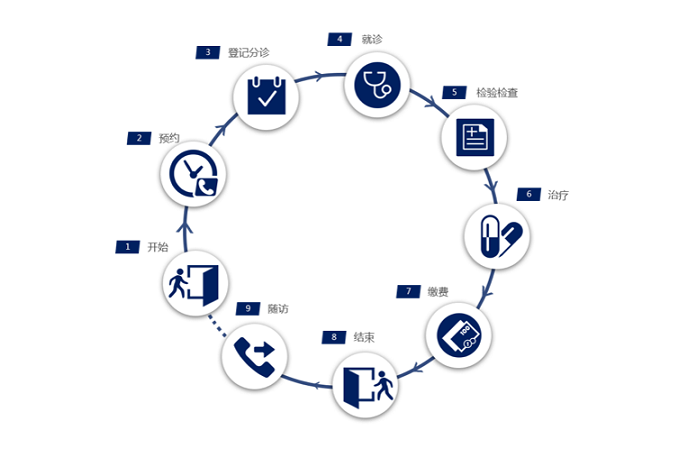
Currently, the majority of clinic software solutions on the market are modified versions of hospital information systems. As a result, these systems often fail to align with the actual operational scenarios and user habits of most clinics, leading to poor usability and inefficient clinic operations.
Built on standardized and regulated clinic operations, Wanjia Cloud Clinic is tailored to the specific development scenarios of clinics, making clinic management easier. By leveraging the Cloud Clinic system to scientifically manage the entire diagnosis and treatment process, it not only provides internal operational support but also robustly enhances pre-consultation and post-consultation services, truly enabling clinics to achieve internet-based management.
Addressing Three Major Pain Points in Clinic Operations: Cost, Management, and Time
As a daily operational management tool for clinics, Wanjia Cloud Clinic aims to leverage its system to address three major pain points faced by primary care clinics: cost, management, and time.
1. Paperless Efficiency in Office Work, Unlocking Data Resources
By adopting a fully digitalized workflow, primary care clinic staff can perform their duties in a more organized manner and consistently maintain high-quality performance. Structured electronic medical records (EMRs) feature a library of professional templates, enabling physicians to document clinical notes with ease. They can also instantly access patients’ historical medical records and prescription information, thereby enhancing diagnostic efficiency. An intelligent knowledge base further assists clinicians in making faster and more accurate diagnoses. Patient data is captured into the system at every stage of the visit, truly achieving a “paperless clinic” and comprehensively improving the work efficiency of healthcare professionals.
“Paperless Clinic” is not merely about digitizing records; it enables access to patient information anytime and anywhere, facilitating the retrieval of necessary data, enhancing customer management and services, comprehensively reducing operational costs, and maximizing clinic profits. Through the data analytics capabilities of Wanjia Cloud Clinic, the medical history of each patient can be accurately reviewed. Patient information management begins from the moment they step into the clinic for their visit.
According to a clinic practitioner’s experience, by leveraging a patient’s data, physicians can analyze how to conduct appropriate follow-ups and communicate treatment plans from the initial consultation onward, ultimately securing the patient’s acceptance of a comprehensive dental implant plan valued at over RMB 100,000. The system records detailed and transparent information, including which physician first attended to the patient, how the physician initially communicated with them, and subsequent data such as electronic medical records, appointment schedules, telephone follow-ups, and billing details. This transparency leads to higher patient acceptance of the proposed treatment plan.
Based on this data, clinic owners can understand how and why each patient churns, as well as their satisfaction with the treatment. Compared to traditional clinics that must sift through piles of paper records to find patient cases, modern system-based data analysis provides clear insights at a glance, easily accomplished with just a few mouse clicks.
In addition to operational costs, clinic operations entail certain risk-related costs. According to legal provisions, if a medical appraisal cannot be conducted due to a healthcare institution’s concealment or refusal to provide medical records, the resulting consequences shall be borne by the healthcare institution. Many medical disputes arise from information asymmetry between healthcare institutions and patients, leading to losses for both parties.
Standardizing diagnosis and treatment processes and making reasonable use of electronic medical records can mitigate risks and prevent doctor-patient disputes. This is one of the core objectives of Wanjia Cloud Clinic: to provide clinics with maximally convenient, clear, and documented process management while minimizing risk exposure.
2. Standardize the management system and improve management efficiency
To run a clinic successfully, it is not enough to merely improve clinical care standards; a clinic also functions like a “small company” and faces similar management challenges. Leveraging a management information platform to support internal operations is a highly effective approach.
Wanjia Cloud Clinic provides comprehensive management of every task and operational workflow across all platforms—from front desk, clinical care, finance, and HR/administration to executive leadership—effectively enabling clinics to monitor quality and achieve efficient management of their operational systems.
Meanwhile, the system can provide management with scientifically grounded analytical data, helping operators predict market and customer demand, thereby facilitating evidence-based decision-making. Additionally, the information platform enables internal communication and interaction, significantly enhancing team collaboration and improving the overall operational efficiency of the clinic. For chain clinics, a shared information management platform can further reduce labor and time costs.
3. Appointment Management to Enhance Patient Satisfaction
From the patient’s perspective, Wanjia Cloud Clinic can enhance patient satisfaction in two aspects:
First, the appointment feature of Wanjia Cloud Clinic enables patients to schedule visits with a single click, eliminating the need to queue for registration. By facilitating time-slot-based consultations, it addresses the previous issue of patient overcrowding and prolonged waiting times in consultation rooms, thereby reducing patient wait times. Meanwhile, medical staff can review the number of scheduled patients in advance, estimate their workload, and provide more efficient and effective reception and diagnostic services.
Second, paperless archiving effectively protects patient privacy and facilitates medical visits. Wanjia Cloud Clinic can automatically archive patients' visit records through patient health management, helping clinics better manage user health; it integrates user information through membership management and follow-up management, enhances customer relationships, standardizes efficient follow-up plans, and improves patient retention rates; meanwhile, it supports multi-platform message interaction and online consultations, enabling doctor-patient communication via chat, voice, video, and other channels.
Conclusion
There are no inherently superior clinics, only those that align with the times. In an era of rapid development, clinics must adapt to changing circumstances. Today, as the nation vigorously promotes the decentralization of medical resources to the grassroots level, primary care clinics are shedding their past image of being small, disorganized, and substandard. Consequently, the "Internet + Clinic Management System" model has become a critical pathway for the transformation of grassroots clinics. It is imperative for these facilities to embrace new operational models, starting with standardized management.