

Mass Spectrometry Emerges as a New Frontier in Precision Molecular Diagnostics: QLife Launches Shanghai Clinical Mass Spectrometry Application Center
Recently, the “University of Missouri China Tour (Shanghai Stop) and Precision Medicine and Diagnostics Themed Salon,” jointly organized by Zhongshan Hospital Affiliated to Fudan University and Pinsheng Medical, was held at Zhongshan Hospital Affiliated to Fudan University. Overseas experts from the United States and the United Kingdom gathered with leading medical professionals from Beijing and Shanghai to discuss new trends in precision medicine as well as the latest research findings and applications of health big data.
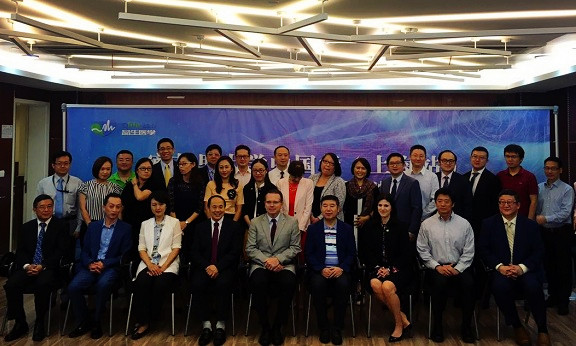
Group Photo of Guests
Academician Ge Junbo, Chairman of the Chinese Society of Cardiology under the Chinese Medical Association, delivered the opening address. Stephen Roberts, Vice President of the University of Missouri, attended the conference and gave a speech. Subsequently, Professor Ma Yinfa, Dean of the Institute for Precision Medicine and Diagnostics at the University of Missouri; Professor Wang Yanzhong, Director of the Centre for Health Data Science at King’s College London; and Professor Zhu Yusheng, Director of the Clinical Laboratory at Penn State Health Milton S. Hershey Medical Center, each delivered outstanding keynote addresses.
In his remarks, Ma Yinfa outlined the advantages of metabolomics in the development of molecular biomarkers for diseases, emphasizing that urine metabolomics offers non-invasiveness, a simple matrix, and low cost in disease diagnosis and treatment. He also highlighted the critical role of mass spectrometry as an analytical technique in metabolomics research and applications. Based on mass spectrometry technology, more biomarkers will undoubtedly be discovered for use in disease diagnosis, prognosis, and prediction.
Wang Yanzhong is an expert in health big data. At the conference, he shared his article published in a Lancet subsidiary journal, in which he established a dynamic model that more accurately predicts the mortality risk of patients with acute liver failure through data analysis. Wang Yanzhong affirmed the significant value of clinical mass spectrometry big data, and his research demonstrated that numerous diagnostic and predictive application models can be developed based on clinical mass spectrometry data.
“In the United States, mass spectrometry has been applied in drug monitoring, toxicology, endocrinology, newborn screening for metabolic disorders, nutrition, and microbiology. In the future, it will be utilized in areas such as functional genomics and mass spectrometry imaging (exemplified by the detection of colorectal cancer liver metastases).” Zhu Yusheng elaborated on the current status of mass spectrometry applications in clinical laboratory testing from the perspective of a clinical chemist and expressed optimism about its future prospects.
If genetic testing is about predicting what may happen in the future, then mass spectrometry testing provides a quantitative assessment of what is currently occurring.
“Genetic testing represents a higher-level regulatory mechanism; genetic-level analysis does not encompass epigenetic aspects. How proteins are expressed following genetic regulation, and the metabolic differences among individuals with varying health statuses under identical conditions, require quantitative analysis through mass spectrometry of small molecules,” stated Guo Xin, Chief Medical Officer at Pinsheng Medicine. “Molecular diagnostics for precision medicine is the future direction. Small molecules are biologically active and serve as critical signals in disease pathogenesis. By evaluating human health status through these metabolism-derived small molecules, we can construct a more comprehensive molecular diagnostic system for precision medicine.”
Dr. Cheng Xiaoliang, a member of the Board of Curators of the University of Missouri and Chairman of Pisheng Medicine, stated that his more than ten years of accumulation in the field of mass spectrometry have allowed him to recognize the significant potential of mass spectrometry technology in medical diagnostics. Consequently, he returned to China to establish the country’s first high-throughput clinical mass spectrometry molecular diagnostic platform. Pisheng Medicine will continue to focus on its clinical mass spectrometry testing platform, leverage its technological advantages, and collaborate with renowned domestic medical institutions on scientific research, thereby further promoting the widespread adoption of mass spectrometry testing in clinical practice and enhancing healthcare standards.