

Weighing Only 0.39 Grams: This Novel Array Electrode Finally Solves the Long-Standing Challenge of Multi-Brain-Region Experiments in Mice

HUST
China's Top Comprehensive Research Universities
EEG signal acquisition and electrical stimulation are core methods for analyzing brain diseases such as epilepsy and Parkinson's disease.
For a long time, researchers aiming to simultaneously observe and stimulate multiple brain regions in mice have had to repeatedly perform surgeries and implant electrodes in stages. This cumbersome process is not only time-consuming and labor-intensive but also prone to causing trauma to the experimental animals, posing a persistent challenge for the field.
Addressing these pain points, Professor Du Huiyun's team at Huazhong University of Science and Technology has delivered an impressive solution. This lightweight electrode features an ingenious design, enabling simultaneous multi-region, multi-depth recording with a single-step implantation, thereby flexibly accommodating diverse experimental requirements.
Recently, Huazhong University of Science and Technology has licensed an invention patent titled "A Flexible Array Electrode for Electrical Stimulation and Recording Across Multiple Brain Regions and Depths" to Chongqing Houde Zaifu Technology Co., Ltd. for a transaction amount of RMB 50,000 and a license term of 5 years.
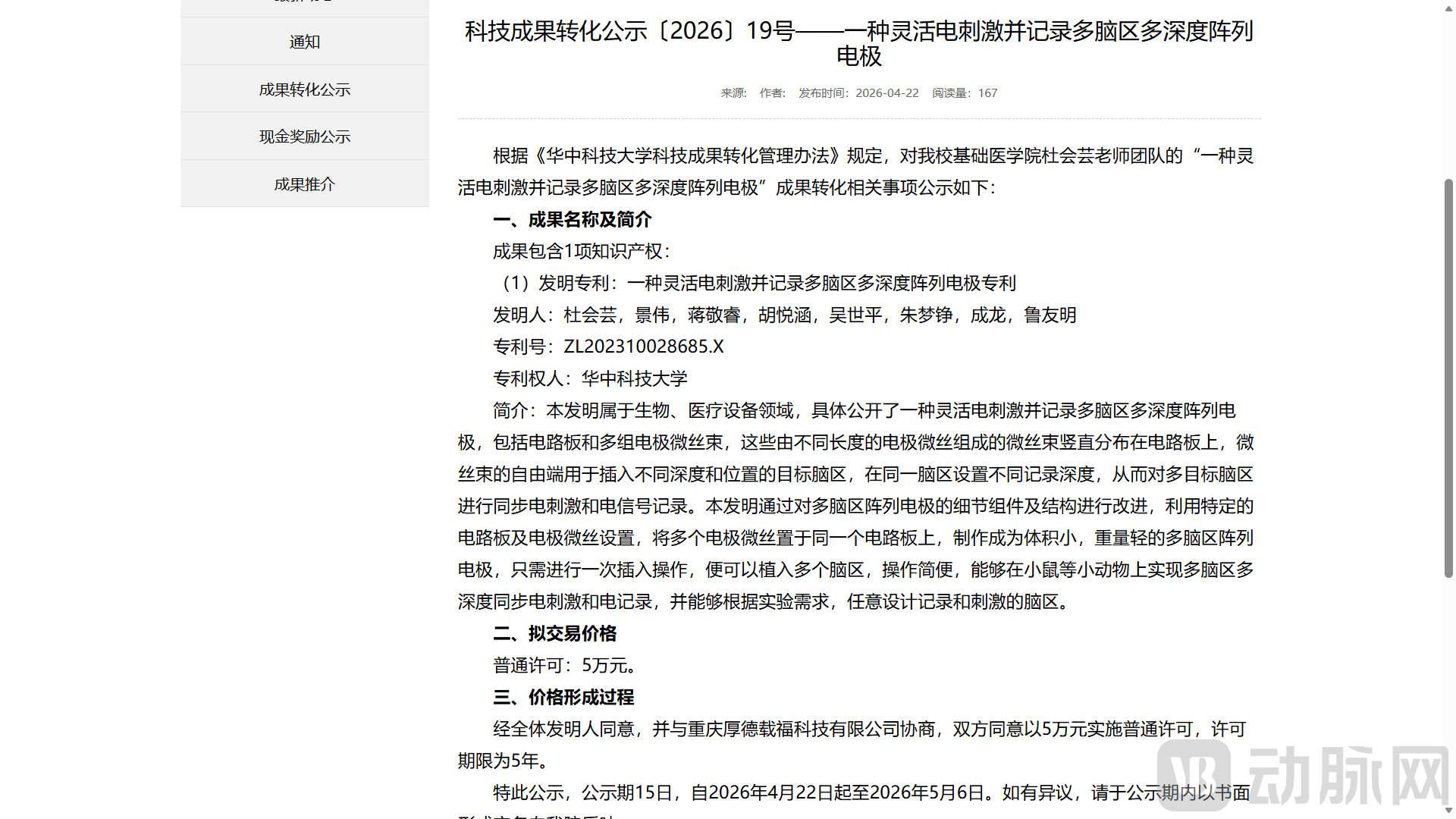
Image source: Official website of Huazhong University of Science and Technology
First, we need to introduce a commonly used clinical method for studying brain diseases—acquisition of central nervous system electrical signals and synchronized electrical stimulation. This method is a core approach in neuroscience research and in elucidating the mechanisms of brain disorders such as epilepsy and Parkinson's disease.
Simply put, it helps us identify abnormal connections within the brain's internal network or functional disruptions at specific nodes by recording and intervening in the electrical activity across multiple brain regions. This provides a critical basis for achieving early diagnosis, precise intervention, and assessment of therapeutic efficacy for brain disorders.
Currently, the mainstream approach for multi-brain-region electrophysiological recording and stimulation in laboratory animals still relies on independent electrode implantation in a single or a few brain regions. Therefore, if simultaneous recording and stimulation across multiple distributed brain regions are desired, several surgical procedures are often required to implant electrodes, which are then secured with cranial screws. This traditional approach indeed has numerous limitations:
1. The surgery is complex and highly invasive: Repeated implantation is not only time-consuming but also inflicts significant trauma and infection risks on experimental animals, directly reducing postoperative survival rates and experimental success rates.
2. Bulky size makes it difficult to fit small animals: Traditional electrodes are relatively large and have a high center of gravity, making them difficult to use in small animals such as mice. In particular, dense implantation is impossible in brain regions that are small and closely spaced.
3. Excessively high customization costs: Multi-region brain recordings typically require personalized customization, and their high commercial costs make it difficult to meet the demands of large-scale, standardized research.
4. Limited spatial coverage: Traditional electrodes mostly adopt a "multi-recording sites at the same location" design. Although they can easily capture single-cell firing, their coverage is too narrow to simultaneously achieve distributed acquisition and stimulation across multiple brain regions and depths.
5. Low preparation precision: Many electrodes still require manual adhesive bonding, resulting in insufficient positioning accuracy and precluding high-precision mass production, which makes it difficult to support large-sample, multicenter studies.
As neuroscience research continues to advance toward the analysis of brain networks and cross-regional modulation, there is an urgent need in both clinical and basic research for a novel type of array electrode.
This invention directly addresses the technical pain points of traditional array electrodes, demonstrating significant advantages through comprehensive innovations in structural design, positioning methods, and fabrication processes.
First, it structurally integrates multiple sets of electrode microfilaments of varying lengths onto a lightweight circuit board. Each bundle of microfilaments targets different depths within the same brain region, while multiple bundles enable coverage of multiple brain regions. This design allows for simultaneous multi-target electrical stimulation and signal recording with a single implantation, significantly simplifying the procedure, reducing operational time, and minimizing trauma to experimental animals.
Secondly, in terms of performance, the electrode is compact and weighs only 0.39 g, with a positioning accuracy as high as 20 μm. It is well-suited for small animals such as mice, effectively minimizing motion-induced signal interference, thereby ensuring more stable recordings and higher animal survival rates.
Moreover, the electrode offers considerable flexibility in use, allowing for the free design of three-dimensional coordinates of microfilaments to precisely match irregularly distributed brain regions, thereby eliminating concerns about errors arising from repeated positioning. Meanwhile, the stimulation and recording channels can be flexibly switched to accommodate various research scenarios.
Overall, this technology overcomes multiple limitations associated with multi-brain-region studies in small animals, offering advantages such as high precision, minimal invasiveness, and high efficiency, thereby providing a powerful new tool for neuroscience research.
The assignee of this patent transfer is Chongqing Houde Zaifu Technology Co., Ltd. Its core business encompasses technology transfer, promotion of scientific research equipment, and medical devices and rehabilitation services. The newly acquired patent for multi-brain-region, multi-depth array electrodes aligns closely with the company's business, offering clear market prospects and competitive advantages.
Currently, the global market for research-grade implantable electrodes is dominated by products such as Neuropixels and Blackrock's Utah arrays. Most existing domestic and international counterparts are largely limited to targeting single or few brain regions, and exhibit significant constraints in terms of compatibility with small animals, ease of implantation, and mass production. These limitations result in complex solutions, high levels of customization, and prohibitively high costs for widespread adoption.
This patented technology, by virtue of its lightweight integrated design, enables simultaneous recording and stimulation across multiple brain regions and depths with a single implantation. It offers greater flexibility and more efficient fabrication, effectively addressing the shortcomings of existing products in conventional research settings.
Leveraging the company's existing distribution channels and technology commercialization capabilities, this patent can be rapidly converted into standardized research-grade electrode products, providing stable and reliable electrophysiology research tools for universities, hospitals, and R&D institutions.
Meanwhile, its ease of use, efficiency, and scalability enable it to offer differentiated complementarity to mainstream products on the market. In the long run, this technology can also extend into areas such as neuromodulation and rehabilitation devices, providing strong support for the company to expand new business lines and enhance its core competitiveness in the fields of neural engineering and general health.