

Yitu Technology Launches China's First AI-Powered Bone Age Assessment System in Collaboration with Zhejiang Provincial Children's Hospital to Establish National Diagnostic Standards

YITU
Provider of Full-Stack Intelligent Healthcare Product Solutions
VCBeat (WeChat ID: vcbeat) News. 9Month25Recently, YITU Medical and the Children's Hospital of Zhejiang University School of Medicine (hereinafter referred to as "Zhejiang Provincial Children's Hospital") officially announced a strategic partnership based on an intelligent auxiliary diagnostic system for pediatric bone age assessment.Joining HandsPromote the Establishment of Bone Age Interpretation Standards for Chinese Children and Adolescents.
“Bone age” is the abbreviation for skeletal age. It refers to the developmental age derived by comparing the level of skeletal development in children and adolescents with standard bone development criteria. Compared to chronological age, height, and weight, bone age more precisely reflects the degree of physical maturity, providing a more accurate assessment of an individual’s growth and development status and maturation level.
In developed countries,Bone Age Assessment Has Long Been Incorporated as a Key Component of Health Checkups for Adolescents and Children, and China has not yet established a bone age database for healthy children. The bone age assessment methods currently used in clinical practice each have their own drawbacks and fail to meet clinical requirements.
YITU Medical has integrated massive amounts of clinical imaging data with authoritative medical knowledge, and based on deep learning technology, launched China’s first AI-assisted diagnostic product for bone age assessment. This system supports intelligent diagnosis for children of both sexes, ranging from neonates to adolescents, in order toTrained on bone age samples from Chinese children across different regions, is the AI bone age product that best understands Chinese children,It is currently in clinical application at the Children's Hospital of Zhejiang University School of Medicine.
“We need to integrate such artificial intelligence with medical practice to address real-world clinical problems and deliver tangible clinical value. We also plan to leverage AI technology in the future to extend the bone age diagnosis expertise of specialists at Zhejiang Children’s Hospital to primary care hospitals across China, thereby alleviating the shortage of pediatric healthcare resources at the grassroots level and improving the bone age diagnostic capabilities of primary care pediatricians,” said Dr. Shu Qiang, President of Zhejiang Children’s Hospital, at the press conference.
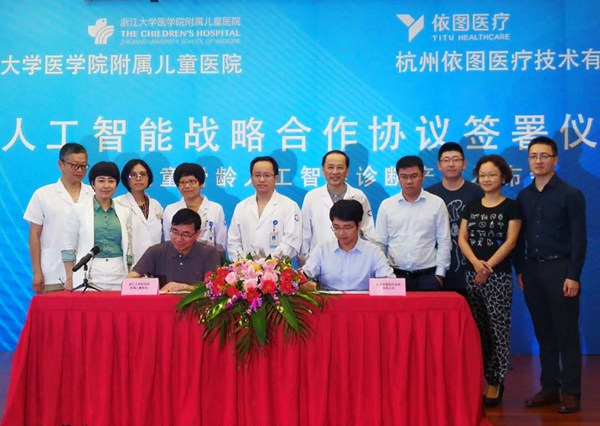
Shu Qiang (left), President and Deputy Secretary of the Party Committee of the Children's Hospital, Zhejiang University School of Medicine; Ni Hao (right), President of YITU Medical
YITU AI Drives the Establishment of Standards for Bone Age Assessment in Chinese Children
The latest "Report on the Nutrition and Chronic Disease Status of Chinese Residents (2015)," released by the National Health and Family Planning Commission, shows that the obesity rate among children and adolescents aged 6–17 in China exceeds 6%. Precocious puberty, short stature, and pediatric obesity have become the three most common endocrine disorders in children in China. Precocious puberty can shorten the period available for growth. As bone age advances, height ceases to change once the epiphyseal plates close; therefore, early intervention for short stature should be initiated at a younger age.
Clinically, bone age assessment is used to determine a child's biological age. The discrepancy between biological age and chronological age is utilized to evaluate developmental status, understand trends in sexual maturation, and predict adult height, among other applications. This method is widely employed in the therapeutic monitoring of diseases affecting pediatric growth and development and provides significant assistance in the diagnosis of certain pediatric endocrine disorders.
Currently, the GP atlas method, which is the most widely used in clinical practice in China, is simple and rapid., but the growth charts currently in use have been employed for 20 years and were developed based on samples of European white children; although the internationally recognized TW3 scoring method is accurate, its testing procedure is complex. With societal progress, parents are placing increasing emphasis on children’s growth and development, leading to a substantial rise in the volume of clinical assessments."Clinical radiologists are often overworked."
YITU Medical’s independently developed AI-assisted diagnostic system for pediatric bone age assessment leverages deep learning technologies and adheres to standards such as TW3 and GP to perform rapid, intelligent bone age evaluations. By analyzing the features of each hand bone, the system minimizes diagnostic errors.The detection accuracy can reach 0.1 years, with an error of less than six months compared to the bone age values calculated by doctors.
The traditional TW3 scoring method requires 10–15 minutes for a single image assessment. In contrast, the YITU Children’s Bone Age Intelligent Auxiliary Diagnosis System can output AI-derived bone age results and TW3 bone age within 5 seconds after image input, significantly improving detection efficiency and stability while ensuring the accuracy of bone age assessment.
Human skeletal growth and development are influenced by multiple factors, including genetics, nutritional status, dietary habits, geographical environment, and sociocultural context. Consequently, the development of adolescents and children across different ethnicities and regions may exhibit varying degrees of advancement or delay. Therefore, it is essential for different regions to establish bone development assessment standards tailored to their specific ethnic and regional populations, and to update these standards in a timely manner as society progresses.
For a long time, China has lacked large-scale, longitudinal data on bone age and height, and a bone age database for healthy Chinese children has not been established. With the implementation of YITU’s AI-assisted pediatric bone age diagnostic system at the Children’s Hospital of Zhejiang University School of Medicine, YITU will collaborate with the hospital to jointly promote the establishment of bone age interpretation standards for Chinese children and adolescents.
Ni Hao, President of YITU Medical, stated that with the implementation of YITU’s AI-assisted diagnostic product for bone age assessment, YITU will collaborate with China’s top pediatric hospitals, including the Children’s Hospital of Zhejiang University School of Medicine (Zhejiang Provincial Children’s Hospital), to jointly establish a large-scale database of bone age data for healthy Chinese children. The ultimate goal is to develop an efficient, intelligent, and accurate bone age diagnostic standard that aligns with the skeletal development characteristics of contemporary Chinese children.
Currently, Yitu Healthcare has applied advanced artificial intelligence technologies to various medical fields, including medical imaging, textual case records, medical evidence, and literature. Notably, the Yitu Intelligent Imaging Platform has been integrated into the clinical workflows of dozens of Grade A tertiary hospitals across China, helping physicians improve diagnostic efficiency and accuracy, thereby promoting more efficient and precise clinical diagnosis and treatment.