

Dr. Yunqiang Chen, Former Top R&D Expert at Siemens and Qualcomm, Joins 12Sigma as Chief Scientist
From September 25 to 27, 2017, GTC China 2017 was grandly held at the Beijing International Hotel Convention Center. TomoDeep stood out among more than 1,750 high-tech startups and was named one of the Top 5 Startups. Dr. Chen Yunqiang, who recently joined TomoDeep as Chief Scientist, delivered a speech titled “Opportunities and Challenges of Artificial Intelligence in Medical Image Analysis” on behalf of the company for the first time at the conference.
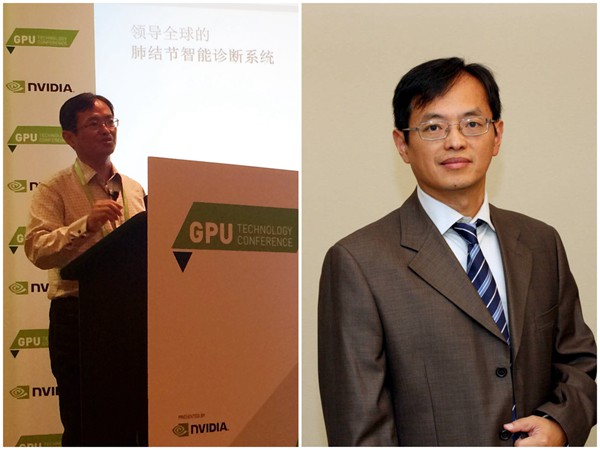
Dr. Chen Yunqiang rose to prominence at a young age. At 17, he was admitted to Tsinghua University’s Biomedical Engineering program without taking the national college entrance examination, having won first place in the Guangxi Division of the National Physics Competition. After graduation, he joined the Institute of Automation of the Chinese Academy of Sciences, China’s premier natural science research institution, where he specialized in artificial intelligence under the supervision of Professor Ma Songde, former Vice Minister of the Ministry of Science and Technology of the State Council.
In 1998, he enrolled in the Ph.D. program in the Department of Electrical and Computer Engineering at the University of Illinois at Urbana-Champaign, becoming a direct doctoral student of Professor Thomas S. Huang, a world-renowned master. As a preeminent figure, Professor Huang was a member of the U.S. National Academy of Engineering, a Foreign Member of both the Chinese Academy of Sciences and the Chinese Academy of Engineering, thereby holding three of the highest academic honors in the scientific communities of China and the United States. Renowned globally by the IT industry as the “Father of Computer Vision,” he made pioneering contributions to image processing, pattern recognition, and computer vision, including the design and testing of multidimensional digital filters, digital holography, document and image compression technologies, 3D modeling, analysis, and visualization of faces, hands, and torsos, multimodal human-computer interfaces, and multimedia databases.
Professor Thomas S. Huang and Dr. Yunqiang Chen’s paper was presented at the premier computer vision conference CVPR, where it received the “Outstanding Paper Award,” and was subsequently published in TPAMI, the most influential journal in the global computer vision community. To date, Dr. Yunqiang Chen has authored dozens of widely cited papers and patents in the fields of computer vision, artificial intelligence, and medical imaging, including publications in top-tier AI conferences such as CVPR and ICCV, as well as in the prestigious journal TPAMI.
Dr. Yunqiang Chen previously served as a Senior R&D Scientist at Siemens Corporate Research in the United States and at Qualcomm Inc. He possesses over ten years of extensive experience in artificial intelligence and medical imaging product development. During his tenure at Siemens, he led projects on image enhancement and reconstruction algorithms that delivered superior high-quality images, successfully replacing the algorithms from Sweden’s ContextVision AB and thereby helping Siemens eliminate its dependence on third-party vendors.
These R&D projects cover Siemens’ globally dominant high-end imaging products, including CT (Sensation series, Definition Dual-Source, Flash, Force), MR (Essenza, Avanto, Skyra), and DSA (Aris Zee, Artis Zeego, Artist Q, Artist Q Zen). They empower these products with competitive features such as unique vascular and cardiac imaging enabled by dual-source dual-energy algorithms, dynamic visualization of coronary stents during cardiac interventional procedures, enhanced recognition of bone and soft tissue in DR radiography, and significant improvements in MR and ultrasound image quality.
In September 2017, Dr. Chen Yunqiang joined Tumai Shenwei as Chief Scientist. He has long been attentive to the development of artificial intelligence in China and has personally experienced the imbalance of medical resources in the country since his university years. Currently, AI in China is in a period of explosive growth, developing more rapidly than in other countries. What attracted Dr. Chen Yunqiang to join Tumai Shenwei?
Dr. Chen identified three points of alignment:
First, founders Zhong Xin and Gao Dashan are both Tsinghua University alumni. They propose that technology serves to help people solve problems, alleviate suffering, and achieve happiness—a philosophy that has consistently remained unchanged for Dr. Chen as well. Integrating deep learning into intelligent healthcare has become the bond linking the shared values of these three Tsinghua affiliates.
Second, Tumor Deepwise has established excellent collaborative relationships with dozens of Grade A tertiary hospitals in Beijing, Shanghai, Guangzhou, and Shenzhen. This provides a favorable development environment for creating AI-powered products tailored to the Chinese context and beneficial to the general public, thereby enabling Dr. Chen Yunqiang to most effectively realize his aspiration to serve his country.
Third, the current AI sector is plagued by a sense of impetuousness, with many companies failing to engage in diligent product development and instead rushing immature products to market. In contrast, Tuma Shenwei has maintained its composure, focusing on product excellence and clinical utility. This commitment was the key factor that persuaded Dr. Chen Yunqiang to join Tuma Shenwei.
Dr. Chen Yunqiang’s addition will serve as a supercharged R&D engine for Turing Deep Vision. His strong background in computer vision and deep learning, combined with his R&D experience in image processing for Siemens’ ultra-high-end medical equipment, aligns perfectly with Turing Deep Vision’s development in the field of AI-based medical imaging. Turing Deep Vision will not only further enhance and refine its pulmonary nodule product, Discover Lung, but also continuously develop new products in areas such as coronary arteries, the central nervous system, the skeletal system, abdominal organs, and pathological diagnosis. This move provides significant momentum to Turing Deep Vision’s corporate strategy of deepening its presence in China’s healthcare sector and covering the full spectrum of hospital imaging diagnostics.