Valley Insights Releases '2017 Healthcare Big Data and AI Industry Report': Introducing the Bowtie Industry Model and AI-in-Healthcare Hype Cycle
VCBeat’s 2017 Flagship Report—“2017 Report on the Big Data and Artificial Intelligence Industry in Healthcare》was released on September 16 at the Forum on Big Data in Healthcare and AI Industry Practices. Spanning 100,000 words, the full report was compiled by VCBeat Research over the course of one month, drawing on more than a million words of reference materials and interviews with senior executives from dozens of artificial intelligence companies. This represents VCBeat’s most systematic review to date of the AI in healthcare sector, providing a detailed account of the foundational technologies underpinning medical big data and AI enterprises, nine subsectors of medical AI, and the current landscape of medical AI companies, while featuring case studies of more than 60 domestic and international firms.
Meanwhile, VCBeat·VBInsight attempts to use its own methodology to objectively describe the development status of various sub-sectors in AI + Healthcare. We have reviewed the investment and financing activities of a total of 193 medical AI enterprises both domestically and internationally, and for the first time, we have mapped out the Hype Cycle for emerging technologies in the sub-fields of AI healthcare for industry professionals’ reference.
Subject Definition:This report focuses on artificial intelligence (AI) enterprises in the global healthcare sector. The criterion for determining whether a company qualifies as an AI enterprise is whether one or more AI algorithms are utilized in its business processes.
Data Source:This report is based on information derived from interviews with industry experts, the VCBeat database, Crunchbase, academic literature, and relevant industry reports. VCBeat’s Eggshell Research Institute has not independently verified the existing information or the information provided to it, and makes no express or implied representations or warranties regarding the accuracy or completeness of such information. The analyses and conclusions contained in this report are based on the aforementioned information.
Research Methods:This study employs a concurrent approach combining desk research and fieldwork, with the development and implementation forms of artificial intelligence (AI) technology as the central theme. It explores the expansion of AI into related industries, aiming to delineate the process by which industries are redefined as this key technology gradually evolves and transforms economic operational models.
Key Research Findings:
Artificial Intelligence Has Weathered Two Troughs and Is Now Riding the Third Wave
With Computing Power and Algorithms in Place, AI+Healthcare Awaits the Explosion of Medical Big Data
Medical Data Acquisition Channels Are Diverse, Warranting National Regulations to Standardize Data Use
China Leads the World in AI Academic Research
# Severe Imbalance Between Supply and Demand for AI Talent
Significant Agglomeration Effects in Individual Subsectors
AI + Healthcare: Entrepreneurial Threshold Rises to Millions
Mapping the Bowtie Industry Model in Medical Big Data and Artificial Intelligence
Mapping the Hype Cycle for AI + Healthcare Technologies
Bowtie Industry Model
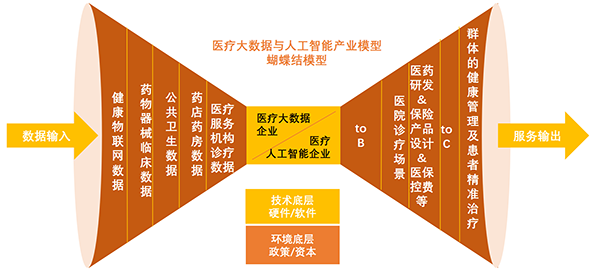
Medical big data refers to data generated through health-related activities. Based on data sources arising from birth, immunization, physical examinations, outpatient visits, hospitalizations, and other activities, such data can be categorized into three types: the Electronic Health Record (EHR) database, the Electronic Medical Record (EMR) database, and the Population-Level Individual Case Database.
Population Database: Primarily contains demographic information, with data sourced from interactive sharing among major departments (including the National Health and Family Planning Commission, public security, civil affairs, statistics, human resources and social security, education, etc.).
Health Records Database: Primarily includes periodic or non-periodic health examination records, various service records generated during healthcare delivery, pharmacy and drugstore data, specialized health data, public health data, and disease survey records. Data sources include health examination institutions, hospitals, and primary care facilities.
Electronic Medical Record Database: Primarily comprises original records of the entire hospital diagnosis and treatment process. Sourced from hospitals, it holds the highest commercial value.
In addition to the three traditional sources mentioned above, medical big data also encompasses data collected through the “Internet of Things” (IoT)—health data gathered by medical devices, as well as continuous clinical IoT health data provided by mobile applications, remote monitoring systems, and sensors. Cloud-based clinical data enable physicians to conveniently access patient information from as far as 100 kilometers away and facilitate remote collaboration with other clinicians.
Medical BigThe value of data depends on the users and application scenarios. From the perspective of user groups, the applications of big data in health and healthcare primarily involve three main stakeholders.
First, to serve physicians by enhancing their clinical practices and optimizing diagnostic and treatment decisions.
Second, it serves hospital administrators by helping them conduct cost accounting and supporting hospital decision-making.
Third, serving patients. By establishing health models and integrating patient genomics data, hospitals can develop disease prediction models and intervention strategies for various conditions, thereby providing patients with guidance on healthy behaviors.
Once aggregated within enterprises, these medical big data assets are fully leveraged through the integration and application of artificial intelligence.Medical big data services have become the data gateway for medical artificial intelligence. Supported by underlying hardware and software, and guided by policy and capital, they ultimately deliver B2B and B2C service outputs.Blockchain, machine learning, the Internet of Things (IoT), and other big data analytics domains converge into seamless, interoperable, and trustworthy powerful tools, providing the healthcare industry with a wide range of highly feasible insights and ensuring high-quality patient care services.
By integrating artificial intelligence and healthcare big data through the bowtie model, we can reimagine medicine.
For example, computers can predict a patient’s risk of adverse drug events, stroke, or heart attack by analyzing imaging, genomic, laboratory, health history, and other data; analyze thousands of data points constituting an individual patient’s disease profile to predict disease trajectory and deliver targeted treatments; employ sophisticated analytical methods to monitor heart rates in premature infants, detecting subtle changes that may signal the onset of infection; and leverage big data applications to automatically generate graphical scales and monitoring results, allowing healthcare teams to devote more time to patient care.
None of the above are fantasies of the future; they are reality.
Artificial Intelligence + Healthcare Technology Maturity Curve
Investment and financing data for AI+healthcare companies indicate that this sector has begun to flourish. Early AI startups primarily focused on foundational research, building machine learning platforms, algorithms, and algorithmic frameworks. Shortly after their research outcomes emerged, they were acquired by major corporations, such as DeepMind and Wit.ai. The second wave of AI enterprises concentrated on technical research, improving accuracy in areas like speech recognition and image recognition. The third wave of AI companies has begun launching products at the application level across various fields.
The booming development of AI-plus-healthcare enterprises demonstrates that the commercial application of artificial intelligence is gradually approaching success. However, there are various application models for AI in healthcare, with significant differences in the development status across different sub-sectors. So, how substantial are the differences in market applications among these sub-sectors? What is the level of technological maturity? VCBeat Eggshell Research Institute attempts to assess this using the Hype Cycle technology maturity curve.
In the field of information technology, a well-known Hype Cycle is used to assess the maturity of emerging IT technologies, helping professionals make proactive and forward-looking decisions. The curve delineates five distinct phases: the Innovation Trigger, the Peak of Inflated Expectations, the Trough of Disillusionment, the Slope of Enlightenment, and the Plateau of Productivity. These stages, combined with the axis representing public expectations of technology, serve to pinpoint the position of new technologies on the curve.
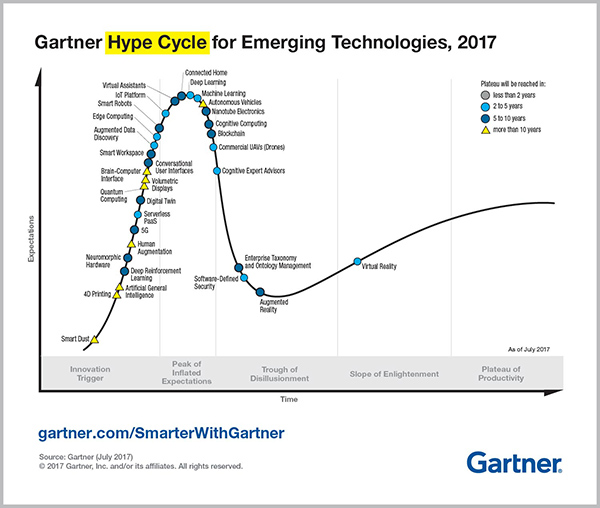
Gartner's 2017 Hype Cycle
1. Innovation Trigger (Technology Embryonic Phase): With the emergence of new technologies and increasing attention from the industry and media, expectations for these technologies continue to rise among both the general public and industry professionals. At this stage, user needs and products are often immature, yet significant capital flows into the sector.
2. Peak of Inflated Expectations: Public expectations reach their peak, with a small number of users beginning to adopt the technology.
3. Trough of Disillusionment (Trough of the Bubble): A gap exists between inflated expectations and product maturity, leading to declining public expectations and negative evaluations.
4. Slope of Enlightenment: Vendors and related technology suppliers continuously refine their products, while clearer user needs drive maturation in product design and usage scenarios, leading to the emergence of best practices.
5. Plateau of Productivity (Stable Phase of Industrialization): The benefits and potential generated by new technologies are recognized by the market, and price competition among products begins to emerge.
In the 2017 Gartner Hype Cycle, numerous artificial intelligence-related technologies were featured. Early-stage foundational research areas such as autonomous driving, machine learning, deep learning, virtual assistants, intelligent robots, and augmented data mining had matured and were undoubtedly positioned at or near the peak of inflated expectations. Emerging AI technologies, including artificial general intelligence (AGI), neuromorphic hardware, deep reinforcement learning, quantum computing, and brain-computer interfaces, were in the phase of rapid ascent.
VCBeat’s VBInsight attempts to use its own methodology to objectively describe the development status of various sub-sectors in AI + Healthcare. The relevant computational indicators for assessing technology maturity are as follows:
1) Average financing amount of companies in this sub-sector.
2) The number of enterprises in this sub-sector.
3) Industry fragmentation in this niche sector.
4) Number of hospitals with commercial deployments in this subsector.
Finally, based on our own analysis, we have outlined the following distribution of AI + healthcare technology maturity.
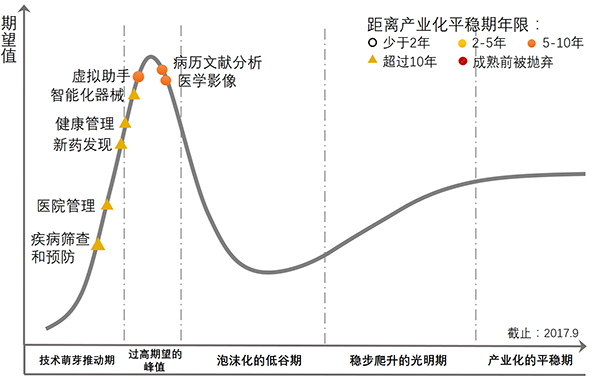
VCBeat’s 2017 Hype Cycle for AI + Healthcare Technologies
Medical imaging companies, which are the most numerous, and medical record/literature analysis companies, which have the highest average financing amount, rank first and second in terms of maturity.
So, where should medical imaging and medical record/literature analysis, which rank first in maturity, be positioned on the curve? This is how VCBeat thinks.
First, VCBeat has previously compiled statistics on the number of partner hospitals for AI healthcare companies and the current status of clinical application of their products. In terms of the number of hospitals adopting medical imaging solutions, nearly all large hospitals in China with strong research capabilities and leading medical standards have already initiated relevant clinical trials with these enterprises. The activity level of the initial cohort of seed users has reached its peak.
Second, large-scale media coverage in related fields emerged around 2015–2017 and is currently at a stable peak.
Third, negative reports began to emerge in 2017 regarding the split between IBM Watson, an AI benchmark company involved in both medical imaging and medical record/literature analysis, and MD Anderson Cancer Center, casting doubt on the effectiveness of artificial intelligence in healthcare. However, other negative reports were rare.
Therefore, we believe that medical imaging is positioned slightly past its peak on the technology adoption curve. Investors and entrepreneurs should also exercise caution; in the current landscape where AI-powered medical imaging startups are densely clustered, securing a viable market niche is a critical consideration. With algorithms and technologies in this field already mature, the primary bottlenecks for companies lie in acquiring sufficiently rich medical imaging datasets, ensuring accurate annotation, and achieving profitability.
Other types of AI+healthcare companies are mostly still in the rapid growth phase following the technology’s inception. Disease screening and prediction rank last due to their high difficulty, algorithmic complexity, and substantial data requirements. Most of the cases cited in the report remain at the research stage within universities and research institutions, so their last-place ranking aligns with their current market performance.
However, regardless of the stage of technological development, leading players continue to emerge. Financing remains a critical factor in a company’s success; we analyzed the top-funded enterprises in each sector and summarized key insights.
First, while our primary focus is on enterprises in the healthcare vertical, success is more readily achieved by conducting in-depth research at the foundational and technological layers. For instance, possessing robust technical expertise in image recognition, speech recognition, and semantic understanding positions a company as a technology provider for artificial intelligence.
Second, companies with sufficiently strong innovation capabilities are either industry challengers or creators of new demand, falling into the category of “innovators.”
Third, greater focus on the upstream segment of the value chain, replacing existing solutions once technologies and products have matured.
Fourth, in addition to data volume, collecting and processing new data streams that existing enterprises do not possess helps establish industry barriers.
How to Obtain the Full Report:Scan the QR code below to become an official member of VCBeat and receive 《2017 Medical Big Data and Artificial Intelligence Industry Report》Full electronic version.