

China Abolishes Approval for Internet Pharmaceutical Trading Platform License (Type A)
VCBeat (WeChat ID: vcbeat), September 30 – Recently, the State Council issued the “Decision on Canceling a Batch of Administrative Licensing Items.”Approval for Third-Party Internet Drug Transaction Service Enterprises Has Been Cancelled, this qualification is commonly known in the pharmaceutical e-commerce industry as the "A License."
Earlier this year, the State Council issued an administrative order to abolish the approval requirements for Class B and Class C licenses in pharmaceutical e-commerce. With the recent cancellation of Class A license approvals, the regulatory barriers to entry for pharmaceutical e-commerce have been further dismantled.
However, the cancellation of approval does not mean the removal of regulation. After canceling the approval requirement for Certificate A, the State Council emphasized three key points:
1. Formulate relevant management regulations, requiring local food and drug regulatory authorities to include platform websites within the scope of supervision and inspection, clarifying that only enterprises and medical institutions with licenses for drug production and operation are permitted to conduct activities through the platforms, and ensuring the implementation of the platforms’ primary responsibilities.
2. Establish a monitoring mechanism for online drug sales, ensure unobstructed channels for complaints and reports, and implement a “blacklist” system.
3. Intensify supervision and inspection efforts, strengthen oversight of online drug sales, and severely crack down on illegal online drug-selling activities.
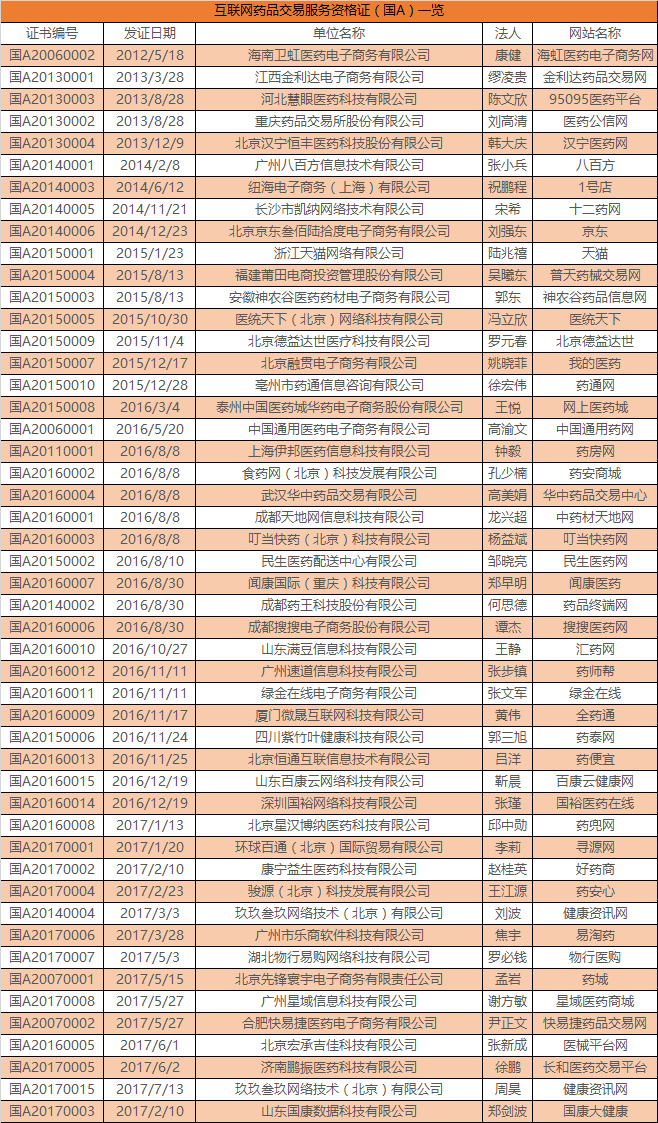
According to previous statistics from VCBeat,As of August 20, there were 48 enterprises with Class A certification.. Prior to the cancellation of the B License earlier this year, there were already over 400 enterprises holding such licenses; following its removal, the number of companies entering this sector may have increased. Combined, these factors suggest that the total number of players in the B2B pharmaceutical e-commerce sector could exceed 500.
Table 1: Overview of Enterprises Holding License A
Since 2016, B2B pharmaceutical platforms such as 360 Health, Drug Terminal Network, Weiming Penguin, Yao Pianyi, and Yaoshibang have secured multiple rounds of financing, with cumulative funding exceeding RMB 1 billion. Investors include prominent firms such as Matrix Partners China, Chengwei Capital, GGV Capital, Ivy Capital, Fosun Pharma, and SoftBank China.
Companies that secure such financing are typically internet platform companies. In addition to these, traditional distribution enterprises have built their own platforms, and e-commerce giants have entered the fray, making the entire B2B pharmaceutical sector “highly dynamic.”
In terms of scale, according to the "2016 Statistical Analysis Report on the Pharmaceutical Distribution Industry" issued by the Ministry of Commerce,In 2016, the total sales volume of pharmaceutical e-commerce enterprises under direct reporting reached RMB 61.2 billion.Among them,B2B (business-to-business) sales reached RMB 57.6 billion,accounting for 94.2% of the total sales in the pharmaceutical e-commerce sector;B2C (Business-to-Consumer) business sales reached RMB 3.6 billion, accounting for only 5.8% of the total sales volume in the pharmaceutical e-commerce sector.
From a business perspective, current B2B pharmaceutical e-commerce platforms have expanded beyond their core trading functions to include"Data Services" and "Supply Chain Finance"and other services, aiming to create more growth opportunities and strategic focus areas for B2B pharmaceutical e-commerce.
Industry insiders previously told VCBeat that supply chain finance and data services are natural extensions for B2B pharmaceutical e-commerce platforms, as both are built upon the foundation of B2B pharmaceutical e-commerce. Once companies facilitate transactions and generate cash flows, they will naturally offer supply chain finance services; once platforms accumulate sales data, they can leverage it as a reference for marketing strategies. However, when B2B pharmaceutical e-commerce enterprises develop these two innovative services, they must be careful not to put the cart before the horse. These services should maintain synergy with their core business operations, ensuring high-quality delivery and willingness among client enterprises to pay for them.
Based on a comprehensive analysis, B2B pharmaceutical e-commerce platforms should currently focus on building marketing networks. However, in the future, B2B platforms should center their strategies on how pharmacies can sell products to consumers. This is because community clinics and pharmacies will increasingly assume more medical service functions, such as managing chronic diseases for local populations and providing medical and pharmaceutical services that do not require hospital visits. As a service platform, B2B must pay attention to this shift by providing tools that meet customer needs, helping pharmacies acquire and retain customers. In the coming years, the pharmaceutical e-commerce industry will trend toward integration, with the boundaries between B2B, B2C, and O2O becoming less distinct. “Industry leaders will simultaneously possess all these capabilities.”