

Specialized Medical Consortium Industry Review: 27 Types Established Nationwide, Pediatric Consortia Lead and Concentrate in Developed Cities
By Luo Mei and Li Xia
On October 9, Premier Li Keqiang of the State Council presided over an executive meeting of the State Council, where he heard reports on the progress of comprehensive reforms in public hospitals and the development of medical consortia. The meeting emphasized optimizing resource allocation through deeper healthcare reforms to safeguard public health. It also deployed measures to further advance the nationwide networking of basic medical insurance and enable direct settlement for cross-regional medical care, thereby alleviating public concerns and delivering greater benefits to the people.
The meeting pointed out that, with the improvement of supporting policies, all tertiary public hospitals should participate in the construction of medical alliances by the end of October, and private hospitals and other social medical institutions, as well as rehabilitation and nursing institutions, are encouraged to participate.
Previously, the development of medical consortia across China primarily focused on general practice attending physicians and general hospitals; currently, specialized medical consortia are also flourishing nationwide.
VCBeat (WeChat ID: vcbeat) has compiled an overview of specialized medical consortia across China, analyzing their types and models based on publicly available information.
According to incomplete statistics from VCBeat, 27 types of specialized medical consortia have been established across China, including pediatrics, otolaryngology, rheumatology, gynecology, maternal and child health, hepatology, orthopedics, respiratory medicine, and laboratory medicine. Among these, pediatrics has the highest number of departments, followed by mental health, stomatology, and pain management specialties. As shown in the figure:
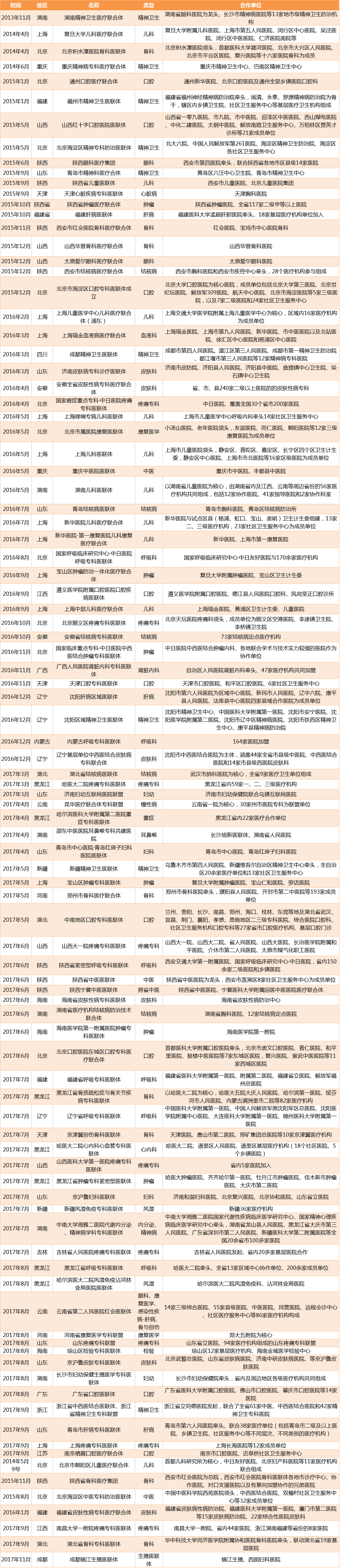
Specialized Medical Consortiums are one of the four models of medical consortiums. Most operate as cross-regional alliances, placing greater emphasis on advancing medical technical expertise and talent development within specific specialties, thereby providing homogeneous services and standardized diagnosis and treatment protocols across the consortium. Core hospitals and member hospitals can further collaborate through professional alignment to categorize diseases and unify diagnostic and therapeutic standards. Formed with specialized collaboration as the binding link, these consortiums center on the distinctive specialties of one medical institution while integrating similar specialty capabilities from other institutions. This structure establishes several regional centers of excellence for specific specialties, enhancing the capacity to manage and treat major specialized diseases and fostering a complementary development model.
Because specialized medical alliances have effectively connected the key nodes of tiered diagnosis and treatment, numerous such alliances have emerged across China, increasingly becoming a prevailing trend. During their development, however, differences in traditions, systems, and management models among medical institutions at various levels have led to unique characteristics across departments, leaving no fixed or mature model to follow.
Furthermore, medical institutions at all levels have their own vested interests. If these inter-institutional relationships are not effectively coordinated, it will be difficult to establish specialized medical consortia; even if they are established under duress, they will struggle to fulfill their intended role of “managing minor illnesses in the community, treating major illnesses in hospitals, and returning patients to the community for rehabilitation.”
The development of specialized medical alliances should adopt a point-to-area approach, selecting precise breakthrough points to achieve initial success and drive broader progress. This ensures that all member institutions, healthcare professionals, and patients within the alliance benefit, thereby effectively implementing tiered diagnosis and treatment.
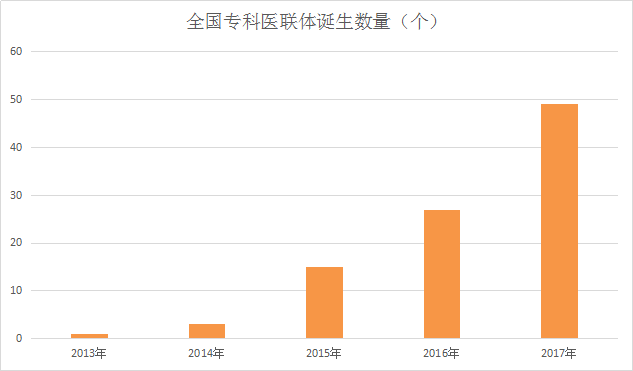
From the perspective of the establishment dates of specialized medical consortia across various regions, the number of such consortia has increased year by year since 2013. Notably, 15 were established in 2015, five times the number established in 2014; the figure rose to 27 in 2016 and further increased to 50 in 2017.
This is primarily driven by policy initiatives. Since the 1980s, eleven provinces and municipalities, including Beijing, Shanghai, and Zhejiang, have established nearly a thousand medical collaboration consortia of various types and forms.
Following the new round of healthcare reform, medical consortia have once again come into the spotlight, emerging as a new model of healthcare reform and entrusted with significant responsibilities in the new era.
During this period, all regions introduced policies on medical consortia. First,On April 23, the General Office of the State Council issued the “Guiding Opinions on Promoting the Construction and Development of Medical Consortia” (hereinafter uniformly referred to as “Medical Consortia”).The Opinion states that the development of medical consortiums is a crucial step and institutional innovation in deepening healthcare reform. It facilitates the adjustment and optimization of the structural layout of medical resources, promotes the shifting of focus and resources in healthcare services to the grassroots level, and enhances primary care capacity. Furthermore, it enables better vertical integration of medical resources, improves the overall efficiency of the healthcare service system, and supports the effective implementation of tiered diagnosis and treatment to better meet the public’s health needs.
By the end of June 2017, all provinces (autonomous regions and municipalities) were required to formulate work plans for advancing the development of medical consortia, specifying the objectives and timelines for such initiatives within their respective jurisdictions; by the end of October 2017, all tertiary public hospitals were required to initiate the development of medical consortia.
By 2020, building on the experience gained from pilot programs, China will comprehensively advance the development of medical consortia and establish a relatively robust policy framework for them. All secondary public hospitals and government-run primary healthcare institutions shall participate in medical consortia.
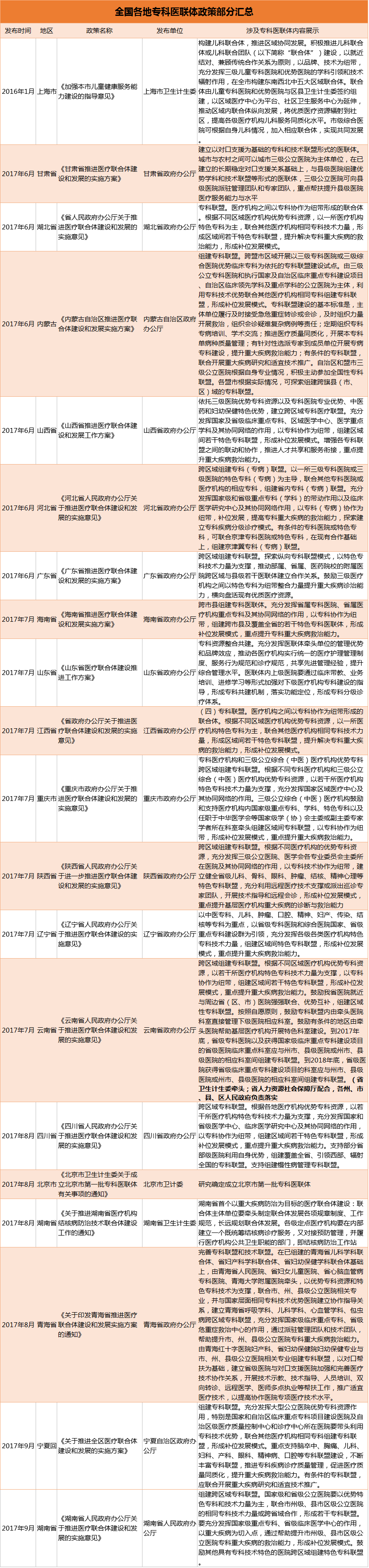
Subsequently, various regions have introduced policies to promote specialized medical consortia, including Shanghai, Gansu Province, Hubei Province, Inner Mongolia Autonomous Region, Shanxi Province, Hebei Province, Guangdong Province, Hainan Province, Chongqing Municipality, and Sichuan Province. The specific dates of issuance are as follows:
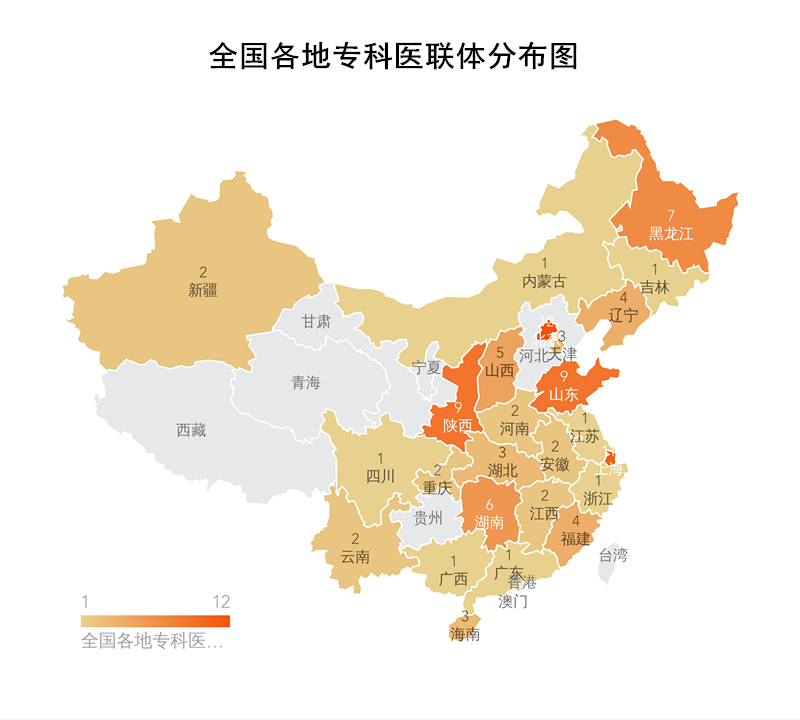
As shown on the map of China, the establishment of specialized medical consortia is most concentrated in first-tier cities such as Beijing and Shanghai, with Beijing having 12 specialized medical consortia and Shanghai having 11. Because Beijing not only possesses high-quality municipal medical resources but also hosts most of the top-tier hospitals affiliated with national ministries and commissions as well as the military, the capital has earned the title of “National Center for Medical Care.”
According to research statistics and sample estimates by the National Health and Family Planning Commission, in 2013, tertiary hospitals in Beijing received 30.36 million visits from non-local patients, with a daily average of approximately 700,000 mobile patients seeking medical care from outside the city.
Currently, there are nine specialty medical consortiums established in Beijing, covering pediatrics, orthopedics, stomatology, mental health, rehabilitation medicine, respiratory medicine, pain management, oncology, and traditional Chinese medicine.
Pediatrics is also the specialty with the largest number of specialized medical consortiums established across many cities. The relaxation of the two-child policy has placed additional pressure on pediatric care, which was already strained by limited resources. According to data from the White Paper on the Current Status of Pediatric Resources in China (Basic Data), released in May 2017, there were approximately 100,000 pediatricians in China serving 260 million children aged 0 to 14 years, resulting in a shortfall of more than 200,000 pediatricians.
If a pediatric medical consortium is established, high-quality medical resources can be extended across China, unrestricted by region. Through specialized counterpart assistance, the diagnostic and treatment capabilities of specialty departments in primary care hospitals will be enhanced. Meanwhile, more complex and difficult cases can be referred upward to large tertiary hospitals, thereby achieving effective coordination among departments within the consortium.
The specific approach involves selecting a medical institution with strong specialized technical capabilities to take the lead, helping primary healthcare institutions enhance their diagnostic and treatment capacities for specialized diseases, and assisting them in building “permanent local medical teams,” thereby transforming traditional “assistance” into long-term collaboration. For example, Beijing Children’s Hospital has improved the comprehensive capabilities of its affiliated group hospitals by conducting academic exchanges, establishing research platforms, implementing co-developed departments, providing remote consultations, and dispatching expert teams for touring diagnoses and surgeries across various regions. This initiative has driven overall improvements in pediatric care nationwide, enabling patients to access top-tier diagnostic and treatment services without leaving their provinces.
Previously, the specialized medical consortium comprised only nine member institutions; it now encompasses more than 700. As the largest cross-provincial healthcare collaboration network in China, its members are primarily distributed across North, South, Southwest, and Central China. By facilitating six areas of resource sharing among group members—expertise, clinical care, scientific research, teaching, management, and prevention—and by establishing a telemedicine consultation center, the consortium aims to achieve the goal of “keeping patients stationary while bringing experts to them.”
VCBeat extracted outpatient visit data from 2014 to 2015. In 2014, Beijing Children’s Hospital recorded 3.37 million outpatient visits, which decreased by approximately 200,000 in 2015. This indicates that the cross-regional specialized medical consortium established by Beijing Children’s Hospital has achieved preliminary results.
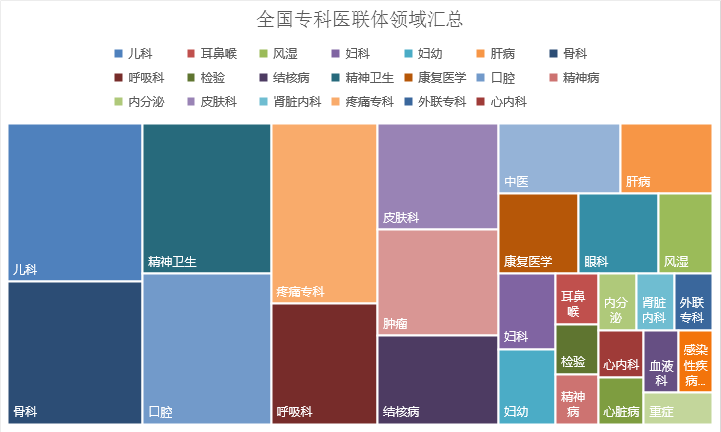
Among various departments, the specialties most commonly selected for establishing specialized medical consortia across China include mental health, rehabilitation medicine, stomatology, psychiatry, endocrinology, and dermatology. Of these, pediatrics is the most prevalent, followed by stomatology, mental health, and pain management.
The surge in pediatrics is driven by the relaxation of the two-child policy, while the rapid expansion of pain management departments stems from the advent of an aging society, where age-related osteophyte pain, various neuropathic pains, and cancer-related pain are becoming increasingly prevalent. Consequently, there is substantial demand for pain management services across healthcare institutions at all levels, presenting unprecedented opportunities for development. In recent years, supported by national policies, the establishment of pain management departments in hospitals at all levels has been booming. However, challenges remain, including uneven development standards, insufficient talent reserves, and an urgent need for training and skill enhancement among practitioners.
On April 17, 2017, the Specialty Medical Consortium of the Pain Management Department at China-Japan Friendship Hospital was established. According to Professor Fan Bifa, Head of the Pain Management Department at China-Japan Friendship Hospital and President of the Pain Medicine Branch of the Chinese Medical Doctor Association, the establishment of this specialty consortium aims to promote tiered diagnosis and treatment as well as the exchange of medical technologies in the Beijing area. The most fundamental function of the consortium is two-way referral, with a highly efficient “green channel” in place within the pain management specialty consortium. On one hand, patients with complex and refractory pain conditions can be referred from primary healthcare institutions to tertiary hospitals for multidisciplinary consultations. On the other hand, once the etiology is clearly diagnosed, many patients can be referred back to primary healthcare facilities for ongoing treatment.
Currently, nearly 30 medical institutions in the Beijing area have joined the Pain Specialty Medical Consortium, including tertiary hospitals (such as Peking University Third Hospital and PLA General Hospital [301 Hospital] as collaborative units) and secondary hospitals (such as Jiangong Hospital and Miyun District Hospital as partner units).
When it comes to pediatric medical alliances, the Shanghai Pediatric Medical Alliance must be mentioned; it is part of the five major regional pediatric medical alliance initiatives, promoting coordinated regional development.
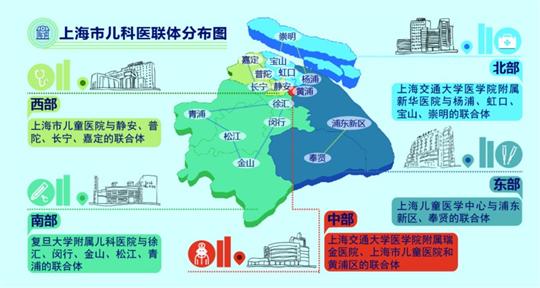
Image sourced from the internet
On September 20, 2016, the Central Shanghai Pediatric Medical Consortium, jointly established by Ruijin Hospital, the Huangpu District Health and Family Planning Commission, and the Children’s Hospital, was officially launched. With this, the construction of pediatric medical consortia in all five major regions of the city—east, west, south, north, and central—has been initiated.
The rationale for establishing pediatric medical consortia in Shanghai stems from the persistent surge in pediatric patient volumes in recent years. At individual hospitals, the maximum average daily outpatient and emergency visits can exceed 8,000, often requiring patients and their parents to queue for five to six hours. Physicians’ working hours are frequently extended to 10 or 12 hours, sometimes even lasting overnight until 3 a.m. the following day. To alleviate difficulties in accessing pediatric care and optimize the allocation of pediatric talent and resources, Shanghai launched the construction of pediatric medical consortia last year. Centered on the “Big Four Pediatric Institutions”—Shanghai Children’s Hospital, Children’s Hospital of Fudan University, Shanghai Children’s Medical Center, and the Department of Pediatrics at Xinhua Hospital—the initiative leverages technical support and radiating influence to drive improvements in the development and service levels of pediatrics at other healthcare institutions within the region, thereby meeting clinical service demands for common and frequently occurring pediatric conditions.
Taking the suburban areas, where pediatric resources are most scarce, as an example, after the establishment of the medical consortium, the core leading institutions provided targeted support to suburban pediatric departments. The aim was to build trustworthy pediatric services close to patients’ homes, offering a more comfortable and convenient experience for pediatric diagnosis and treatment. Yu Guangjun, President of the Children’s Hospital, introduced that with the support of the Children’s Hospital, departments such as the Neonatology Department at Jiading District Central Hospital, Anting Hospital, and Jiading District Maternal and Child Health Hospital have each developed their own distinctive features. This year, leveraging the Municipal Health and Family Planning Commission’s “Pediatric Demonstration Outpatient Clinic” construction project, Nanxiang Hospital was selected as a pilot site to advance the standardization of pediatric signage, staff uniforms, consultation processes, clinical practice guidelines, and pediatric medication protocols.
In April 2014, the Children’s Hospital established the city’s first pediatric medical consortium, which has initially demonstrated positive outcomes in Jinshan District. Statistics from Jinshan Hospital in 2015 showed that the volume of pediatric outpatient and emergency visits increased by 16.7% compared to the same period in 2014; the number of pediatric infusion cases decreased by 40.7% from 2012 to 2015; the antibiotic usage rate dropped from over 70% to approximately 40%; and no pediatric medical disputes or incidents occurred throughout the year.
In terms of talent development, the Pediatric Medical Consortium places greater emphasis on providing professional training for existing pediatricians. Through the “Mobile Clinical Online” app, information on participating physicians is readily accessible. The app features courses such as “Disinfection and Infection Control for Emerging and Imported Infectious Diseases” and “2016 Blood Transfusion Safety Training,” which are regularly pushed to users. The consortium promotes the standardization of clinical protocols, hospitalization criteria, and referral guidelines across all member institutions, thereby achieving homogenization of medical services within the Pediatric Medical Consortium.
Experts now conduct monthly consultations in local communities. Initiatives that were previously difficult to implement are now gaining active support from residents, many of whom are willing to seek medical care close to home. This approach not only provides convenience for residents but also alleviates the burden on pediatricians at tertiary hospitals.
From the case of the Shanghai Pediatric Medical Consortium, we can observe that specialized medical consortia serve the following functions:
First, it facilitates patient diagnosis and treatment while alleviating the financial burden on patients. Within the consortium, any hospital can recommend that patients receive care at an appropriate general or specialized hospital based on their condition; furthermore, patients can be referred to different hospitals as their condition evolves. This approach ensures that patients receive effective treatment at a lower cost.
Second, hospitals at all levels will benefit from this arrangement. The leading hospital within the consortium assumes responsibilities such as formulating bylaws and technical standards, as well as conducting personnel training. As the technical capabilities of other member hospitals improve within the consortium, they will attract more patients, thereby alleviating the burden on the leading hospital and enabling it to better serve patients with critical conditions and complex, refractory diseases.
Third, the nation stands to benefit. Whether under urban employee basic medical insurance or the New Rural Cooperative Medical Scheme, higher patient expenditures translate into greater fiscal burdens for state reimbursement. The two-way referral mechanism within the medical consortium reduces patients’ diagnosis and treatment costs, thereby generating substantial savings for the state.
Fourth, medical consortiums help achieve a win-win situation for both doctors and patients, alleviate doctor-patient conflicts to a certain extent, and contribute to social stability and unity.
However, large-scale replication still presents certain challenges. Specialized medical consortia can also be established based on diseases with high regional prevalence. For instance, a tertiary hospital-led oncology medical consortium can be formed to implement whole-course management for specific types of cancer. By fostering talent development, discipline construction, and resource sharing, semi-close or close-knit alliances can be established without disrupting existing interest structures. This approach minimizes unnecessary constraints, facilitates the implementation of tiered diagnosis and treatment, achieves effective tiered care for specific specialized conditions, and promotes team growth while making healthcare more accessible to the public. If this model gains acceptance from all stakeholders, it can be replicated across other specialized diseases.