

IoT-Driven Connected Health Market to Reach Tens of Billions: Dell Outlines Four Strategic Pillars for Building Personalized Healthcare
In recent years, the focus of digital health has gradually shifted from Mobile Health (mHealth) to Connected Health (cHealth). In short, this represents an evolution from data collection using various wearable devices to a focus on data integration, analysis, and interoperability, thereby enabling data-driven clinical decision-making and personalized healthcare services.
As a globally renowned computer equipment manufacturer, Dell Inc., founded in 1984, also operates in the markets for servers, data storage devices, and networking equipment.
Recently, Dell launched its major "Connected Care Report," providing a detailed analysis of the current landscape of connected care, including its scope, impact, challenges, and response strategies, while offering recommendations for healthcare institutions building connected care systems. VCBeat (WeChat: vcbeat) has extracted the key highlights from the report; see below for details.
Although there is currently no unified definition for connected healthcare, it is widely recognized that “Connected Health” encompasses more than just wearable devices or one-on-one telemedicine consultations.It is a smart network for communication and actionable information sharing, designed to improve patient health outcomes.; it is realized through a technical architecture in which personnel, processes, and equipment can work together.
Put simply, we can view connected healthcareDefined as connecting physicians to data, patients to healthcare providers, and medical practices to the network, to achieve better and more comprehensive care and medical outcomes.
Although connected healthcare is built upon the foundation of mobile health and telemedicine solutions, which have decades of development experience, it has another important driving force, namelyThe rapidly developing Internet of Things (IoT), where smart sensors, devices, software, and networks on the internet are interconnected.. Companies across various industries are racing to leverage the Internet of Things (IoT) ecosystem to provide a range of new apps, products, and services for tracking, analysis, and coordinated action.
In the healthcare industry, terms such as “Internet of Medical Things” have been widely used to refer to IoT architectures that enable connected healthcare.
According to previous reports by MarketResearch.com,By 2020, the output value of the Medical Internet of Things (IoMT) is projected to reach $117 billion., the mobile health division will also continue to reshape care delivery services, with an expected growth of $59.15 billion by 2020.
Although skeptics maintain that the healthcare industry is unlikely to undergo rapid, transformative change in the short term due to the slow adoption of information technology, various powerful drivers and catalysts are converging, making such change imminent.
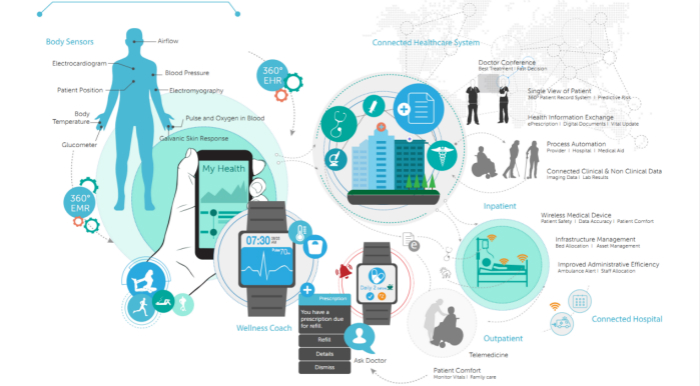
The interconnected healthcare ecosystem leverages innovations in sensors, devices, connectivity, and applications to enable a new model of care that is data-driven, patient-centered, and empowering for patients.It is not limited to the content of outpatient follow-ups, but can continuously and comprehensively collect medical records and data over time., benefiting patients, caregivers, hospitals, the population, and policymakers.
Interconnected Healthcare Solutions Are Urgently Needed
There is a growing consensus within the industry that the healthcare sector urgently needs to leverage connected health to address thorny challenges related to access, quality, and cost.
Among the drivers mentioned above, the two most notable arePopulation Aging and Chronic Diseases, both of which have consumed substantial medical resources.
In the United States, up to 75% of healthcare expenditures are allocated to chronic disease management, and two out of every three Medicare beneficiaries suffer from at least two chronic conditions. Hospital readmissions due to preventable health issues cost approximately $17 billion annually. Pressure on medical relief systems will continue to grow with population aging. It is estimated that over the next 15 years, approximately 10,000 new patients will enroll in Medicare each day.
Connected healthcare holds promise for improving the health outcomes of patients with chronic diseases. For instance, combined solutions involving remote monitoring and telemedicine have been shown to reduce hospital readmission rates by more than half among high-risk patients with congestive heart failure (CHF).
Furthermore, enabling patients with chronic diseases to engage in more frequent video interactions with their primary care physicians can help them maintain a healthy lifestyle. More affordable and user-friendly devices, such as wireless scales and heart rate and blood pressure monitors, can extend the benefits of connected healthcare to a broader population of patients with chronic conditions.
Data-Driven Decision Making
Medical suppliers, patients, and decision-makers all require more evidence-based insights. The key to the success of connected healthcare lies in its necessity toCapable of analyzing more data from diverse sources and delivering the right data at the right time. If this is achieved, it holds significant potential to improve healthcare outcomes while reducing medical costs. For example:
1. Identify trends and patterns by analyzing richer and more continuous patient data streams;
2. Improve workflows by analyzing real-time location and performance data, thereby helping to identify bottlenecks and gaps in processes, make informed decisions on arrangements such as role restructuring, training, and staffing, integrate appropriate technologies in a suitable manner, and create more meaningful incentives;
3. Reduce costs and risks by tracking pharmaceuticals and other inventory in real time, thereby minimizing errors and eliminating waste and theft.
Patient Engagement
Today, purchasing products and services online has become the primary choice for most consumers. Many patients and their families hope that the healthcare industry can also deliver the convenience, variety, simplicity, and price transparency enjoyed when shopping online in many other sectors.
With the proliferation of wearable devices such as Fitbit and the exponential growth in the use of mobile fitness applications, an increasing number of people are pursuing optimized “wellness.”Namely, by tracking various bodily trends, more personalized healthcare can be achieved.. Moreover, such products also reflect the level of comfort with which various body-connected devices collect personal health data.
Many healthcare systems are responding to consumer demands by providing patients with access to their electronic health records (EHRs) and clinical data through patient portals, aiming to enhance the patient experience. Other initiatives include offering SMS services, email, real-time chat, and video consultations for care delivery, as well as making physicians’ outpatient schedules available online to allow patients to schedule appointments at their convenience.
Tech Catalyst
Meanwhile, various technological innovations and maturation are also driving the realization of connected healthcare. For example:
1. Digitization of Medical Data:Regulations such as HITECH, ARRA, and ACA have all compelled healthcare providers to digitize their medical data and accelerate the adoption of EHRs;
2. Device Innovation:This includes sensors, devices, mobile and embedded systems, such as radio-frequency identification (RFID) chips, wearable devices, personal emergency response systems (PERS), and real-time location systems (RTLS). Global market opportunities, competition, and economies of scale are reducing the cost, complexity, and size in this field, while driving innovation in reliability, battery life, and connectivity;
3. Interconnectivity:Ubiquitous network access, bandwidth, and coverage (RFID, Wi-Fi, Bluetooth, M2M wireless services) and device connectivity can link billions of physical objects to the Internet, enabling data collection, transmission, and sharing anytime, anywhere;
4. Yun:Cloud computing offers advantages such as lower costs and seamless, scalable incremental expansion. By leveraging hybrid cloud and managed hosting, vendors can achieve greater flexibility and security, enabling them to enhance internal computational capacity as data and devices grow.
5. Big Data/Analytics:By analyzing structured and unstructured data from multiple sources in real time, it is possible to advance from simple binary algorithms at the device level to more complex, multi-layered predictive analytics and machine learning. For instance, intelligent medical imaging devices can “learn” to highlight anomalies or deviations from prior scan results, facilitating further clinical evaluation. Furthermore, the aggregation of cross-population data enables data-driven policy decisions and disease management.
To achieve interconnected healthcare, people must clearly recognize the following challenges.
Laws, Regulations, and Reimbursement Challenges
The slow pace of IT adoption in the healthcare sector is often attributed to stringent regulatory policies. This is understandable, as decisions and actions in this field are matters of life and death, necessitating a cautious approach.
For example,Physicians and other healthcare providers are prohibited from providing telemedicine services across state lines.. Lagging reimbursement policies have also slowed the adoption and innovation of telemedicine.
Recently, the Centers for Medicare & Medicaid Services (CMS) has begun reimbursing face-to-face telehealth services between patients with multiple chronic conditions and their healthcare providers. In most states, CMS does not provide payment for store-and-forward applications, such as apps used for transmitting images of skin lesions and conducting remote assessments.
Reimbursement standards for telemedicine costs under Medicaid vary by state. There is no single, widely accepted standard for private payers and patients, who often require prior authorization. Furthermore, the U.S. Food and Drug Administration (FDA) has elevated consumer-grade devices to medical-grade status by requiring the submission of 510(k) premarket notification documents.
Emerging Safety and Liability Issues
The healthcare industry has long struggled to protect patient privacy and meet the stringent requirements of the Health Insurance Portability and Accountability Act (HIPAA).
As connected healthcare advances, the threat of security vulnerabilities grows increasingly severe. In fact, the core value of “connectivity” indeed expands the risks of disclosing or stealing private health information, as well as manipulating devices and procedures both within and outside healthcare institutions. Wearable and implantable devices connected to the internet are particularly vulnerable, as hackers may gain control over these devices and alter their commands.
In light of this, some cardiac patients have chosen to opt out of remote monitoring of their pacemakers by physicians. In 2015, the U.S. Food and Drug Administration (FDA) issued its first alert regarding cybersecurity risks associated with specific medical devices. In addition to expanding regulatory oversight of networked clinical devices, the alert clarified that addressing cybersecurity vulnerabilities is a shared responsibility involving both device manufacturers and the computer networks of healthcare institutions.
Difficult to Synthesize Conclusions from Massive Data
In theory, the greater the variety of combinable data and data sources available, the more robust the insights and conclusions that can be drawn. However, as the volume of longitudinal data from connected devices continues to grow, it becomes increasingly challenging to derive meaningful conclusions from all this information in a timely manner. This is particularly true for internists and other clinicians, who are often overwhelmed by an excess of information while facing stringent demands regarding the timing of therapeutic interventions.
Lack of Integration and Interoperability
The Healthcare Information and Management Systems Society (HIMSS) defines interoperability as “the extent to which systems and devices can exchange data and interpret the shared data. For two systems to be interoperable, they must be able to exchange data and subsequently present that data in a manner understandable to the user.”
In the era of connected healthcare, long-standing challenges in medical IT interoperability and data integration have become even more severe. Hospitals have previously struggled to manage disparate technologies from various vendors; now and in the future, they will face an influx of diverse sensors, devices, gateways, controllers, routers, and databases.
Government, policy, and industry leaders are overcoming various barriers to connected healthcare by combining policy reforms with technological initiatives, thereby reducing the complexity and security risks associated with connected healthcare.
Policy and Process Reform
The confluence of legacy and emerging challenges has impeded the full realization of the vision for connected healthcare. Reforms encompass value-based reimbursement models and new regulatory guidelines for medical devices.
1. Readjust reimbursement and incentive policies
Connected healthcare, with its ability to aggregate and analyze large datasets, will itself play a role in objectively determining the “value” of service delivery, thereby facilitating the implementation of value-based reimbursement and incentive policies.
Even with limited reimbursement, telehealth consultations under Medicare have increased by more than 25% year-over-year over the past decade. In early 2016, the Centers for Medicare & Medicaid Services (CMS) added two Current Procedural Terminology (CPT) codes for telehealth services for the first time. During the same period, the U.S. Congress passed legislation, supported by more than 40 medical associations including the American Medical Association (AMA), that expanded the use of telehealth and remote patient monitoring services under Medicare.
Furthermore, insurance companies are increasingly recognizing the value of connected healthcare and have begun to reimburse a broader range of telemedicine services. Consequently, the global telemedicine market was projected to reach a valuation of $66 billion by 2021.
With the conclusion of the Obama-era “Meaningful Use” (MU) incentive program, the Centers for Medicare & Medicaid Services (CMS) is shifting its focus toward specific technologies and healthcare outcomes. It will grant healthcare providers greater flexibility to tailor objectives for new market entrants and ensure a level playing field. The agency requires “open APIs to allow applications, analytics tools, and connected technologies to securely import and export data from electronic health records (EHRs),” placing “significant emphasis on interoperability.”
2. Regulatory Guidelines
The FDA is playing an increasingly important role in the regulation of connected health technologies. Currently, the FDA requires a unique device identification (UDI) for each medical device and model listed in its public database. The FDA has also launched a patient feedback website for medical devices, issued draft guidance on medical device safety, and recently clarified and expanded its definition of UDI compliance.
Reduce Technical Complexity and Risk
A range of technical methods and initiatives are currently in place, aimed at reducing the complexity and risks associated with connected healthcare.
1. Architecture and Services
Integrating open standards and service-oriented architecture (SOA) into existing frameworks can facilitate collaboration among devices, data, and applications from multiple sources.
1. EHR API: EHR vendors have begun to open up their products by releasing application programming interfaces (APIs) for data import and export.
2. Health Information Exchange (HIE): HIE is an architectural framework that establishes standards for the exchange, integration, sharing, and retrieval of health information. For example, the Chesapeake Regional Information System for our Patients (CRISP) is a regional HIE designed to enable healthcare providers in Maryland and the District of Columbia to more easily establish systems that facilitate collaborative care.
3. Fast Healthcare Interoperability Resources (FHIR): FHIR is a vendor-neutral Health Information Exchange (HIE) framework developed by HL7. It is establishing global standards for the development and deployment of interoperable and usable data solutions among healthcare providers and vendors.
4. Integration Platform as a Service (iPaaS): iPaaS leverages cloud services to further advance integration by helping healthcare organizations develop, execute, and manage integration flows. This enables the consolidation of hybrid cloud and on-premises data combinations without the need for software, appliances, or coding, thereby simplifying the complexity of interoperability between applications. Compared with traditional system integration projects, healthcare institutions can significantly reduce the costs and workload associated with middleware licenses, Master Data Management (MDM), and API management solutions.
2. Patient-Centric Data Repository
Patient-centric databases facilitate the integration of data from diverse sources and provide a longitudinal view of each patient’s medical history. A master patient index aggregates data for individual patients across different clinical institutions—even in the absence of interoperability between these facilities—while backend integration of structured and unstructured data, images, and forms delivers a comprehensive 360-degree view.
3. Data Analysis and Decision Support
Entrepreneurs are striving to bridge the gap between device data streams and electronic health records (EHRs). Some are focusing on developing new user interfaces and dashboard applications to integrate, analyze, and present data collected from both devices and EHRs. Others are leveraging layered data integration and analytics platforms to display meaningful insights within existing EHR applications. Additionally, some are developing virtual digital assistants designed to collaborate with physicians in locating information within EHR systems.
Developers both within and outside healthcare organizations also leverage various business decision support technologies to develop clinical decision support tools. These tools utilize high-performance computing, intuitive interface design, appropriate security layers, and advanced data modeling and predictive analytics capabilities to filter and present relevant data and identify patterns and trends.
4. New Approaches to Safety and Data Management
People need new technologies and tools that can consistently stay ahead of risks to better protect patients, devices, systems, and data.
Innovative approaches, such as new access-layer security methods, proactive security analytics, and 360-degree security dashboards, have successfully established intelligent security safeguards among endpoints, networks, users, and applications. These validated practices include identity and access management, data encryption, next-generation firewalls, and application vulnerability management.
Biometrics, identification, proximity, smart cards, and single sign-on technologies can streamline secure access for authorized users. Furthermore, security can be enhanced by eliminating multiple complex passwords. When combined with a secure “portable” workspace, this approach enables access across different devices and locations, significantly improving workflow efficiency.
Another innovation that helps strengthen and simplify security is the intelligent gateway at the network edge. Edge gateways serve as intelligent, secure bridges between traditional systems, sensors, and all types of connected devices. These gateways can apply encryption, provide hardware-level security, and perform analytics and complex event processing at the edge.
They can also validate data (ensuring that the data is neither corrupted nor compressed, and that it is provided by its corresponding device) and aggregate data from multiple sources. After the gateway analyzes and validates edge information, the data undergoes further screening for viruses and other anomalies in the backend firewall before being stored in the data center or the cloud.
In the field of connected healthcare, technology plays a more critical role than ever before. Chief Information Officers (CIOs) and their teams must take an active role, collaborating closely with clinical, operational, and financial experts to seize opportunities and develop solutions.
Although achieving interconnected healthcare is a long-term and arduous task, healthcare organizations can begin to gradually build the necessary infrastructure now.
Start with small projects and focus on return on investment.
Healthcare organizations can attempt to gain experience and achieve success through small-scale projects, leveraging their existing technology and infrastructure to identify use cases that are patient-centered and offer a clear return on investment (ROI). For instance, many healthcare organizations may already be using digital devices in emergency departments, tele-ICUs, or telestroke services, but the data from these devices may not yet be interconnected, collected, or analyzed. Brainstorming sessions with cross-functional teams can help healthcare organizations determine which small investments will yield measurable returns in terms of providing better care, improving health outcomes, and reducing costs. Once the value of connected healthcare solutions is established, organizations can expand them to other areas.
Architecture Analysis
When designing solutions, teams should start by identifying areas with the greatest lack of insight or intelligence and map out the necessary data flows to bridge these gaps. Teams need to determine what data they require, identify the data sources, clarify who will use the information and how, and establish which protocols and tools can facilitate the seamless integration of additional data and analytics in the future.
Safety Design
Healthcare organizations must always prioritize security. They need to constantly ask themselves: What are the data management and security requirements? Which users, applications, and devices have access? How are identity authentication and verification managed? Security experts can begin by assessing existing security measures before evaluating the impact of new solutions. These experts can guide healthcare organizations in designing and deploying multifaceted security measures through identity management, access management, encryption, proactive security analytics, and cybersecurity.
Selecting Appropriate Partners
Healthcare institutions should abandon the mindset of operating in isolation and instead seek appropriate partners to jointly build an interconnected healthcare ecosystem. In addition to integrating open, standards-based, technology- and device-agnostic architectural frameworks with top-tier healthcare solutions, healthcare organizations should also seek collaboration with technology partners that possess firsthand experience in converging healthcare information technology with the Internet of Things (IoT), security, networking, and information management.
Partners with relevant experience in other industries can help healthcare institutions save time, effort, and money. For instance, database solutions from the manufacturing sector can assist healthcare organizations in building patient-centric data repository models, while retailers’ expertise in securing transactions in wireless environments can also provide valuable insights for related developments in the healthcare industry.
Translation:Chen Xin
References:Dell-Connected-Health-Whitepaper-final.pdf