

Ruijie Networks' Smart Infusion System Boosts Nurse Efficiency by 80% at Zhongshan Hospital: A Healthcare IoT Case Study
Those who have received intravenous (IV) infusions are likely familiar with this scenario: In infusion rooms and hospital wards, patients’ calls and bell rings occur one after another. Accompanied by responses such as “Please wait a moment; I’ll be right there,” nurses shuttle back and forth between the medication preparation room and the wards... By the end of the day, even the most resilient “angels in white” are physically and mentally exhausted.
Sometimes, patients may adjust the infusion rate controller themselves in an attempt to finish the infusion earlier. However, since each fluid is administered according to specific medical orders, an excessively rapid infusion rate can easily pose safety risks.Day after day, nursing staff are exhausted, not only preventing improvements in care quality but also potentially leading to doctor-patient disputes for the hospital due to safety incidents.
Can Nursing Quality Be Improved Through Information Technology? Driven by Demand, Medical IoT Technology Has Come into the Hospital Sector’s View.
Highly Scalable IoT Solutions
In 2014, Ruijie Networks officially launched its Healthcare IoT solution. Behind the project was a development team of nearly 200 people.
Driven by hospital work scenarios, Ruijie Networks’ original intention in developing its medical IoT solutions is to enhance patient experience, standardize hospital management processes, improve operational efficiency, and help hospitals achieve a transition toward deriving benefits from informatization.
Ruijie Networks’ IoT solution spans all layers, including the perception layer, access layer, network layer, platform layer, and application layer. Ruijie Networks provides the underlying sensor network, developed in collaboration with its partners.
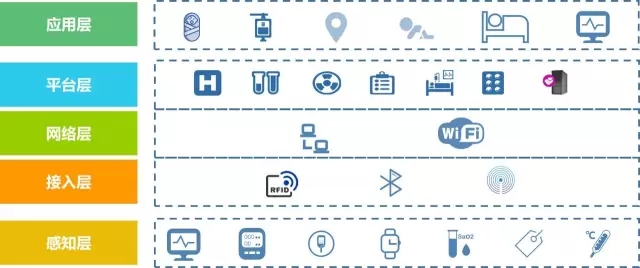
Ruijie Medical IoT Solution Architecture Diagram
The most prominent features of Ruijie Networks’ RG-IOP-WA IoT base station are its loose coupling and strong scalability. Common solutions in the industry currently involve adding IoT protocols by expanding card slots on IoT access points (APs); however, the number of compatible IoT protocols is limited by the number of card slots, with a maximum support of two IoT protocols simultaneously. In contrast, Ruijie’s IOP IoT base station comes with three built-in IoT protocols and, through two additional expansion card slots, can support up to five IoT protocols simultaneously.
Ruijie Networks can deploy IoT base stations (as required by specific applications) and a hospital-wide ISCP management platform within patient wards, leveraging the existing wireless network infrastructure regardless of brand. The ISCP management platform forwards data from various applications to their corresponding application systems. As a result, hospitals need only deploy a single IoT transmission platform to enable connectivity for multi-vendor IoT applications, thereby reducing costs and facilitating future scalability.
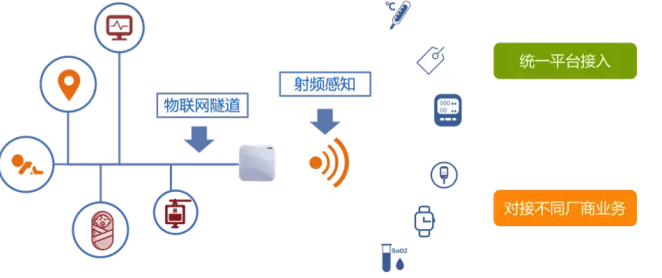
Ruijie Medical IoT Open Platform, Capable of Expanding Diverse Business Operations
Furthermore, the RG-IOP-WA IoT base station features built-in antennas, offering not only low power consumption but also flexible surface-mount deployment. With integrated antennas, there is no need for external antennas or splitters during installation, resulting in a compact and aesthetically pleasing design. Its low-power architecture ensures safe and energy-efficient operation, making it ideal for deployment in dense, confined spaces such as patient rooms.
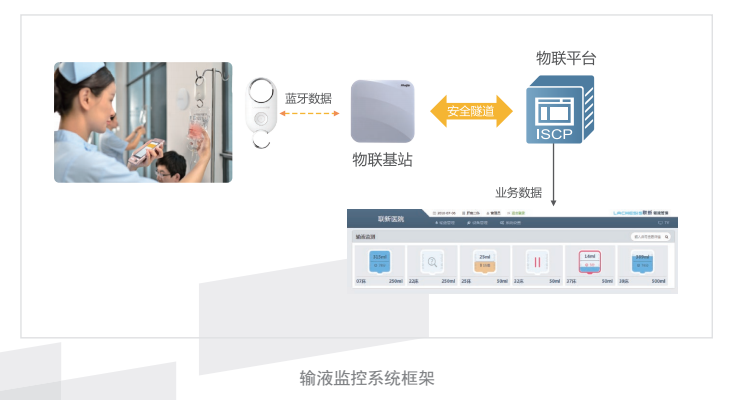
Zhongshan Hospital's Infusion System
Xiamen University Zhongshan Hospital (hereinafter referred to as “Zhongshan Hospital”) was the first tertiary A hospital to deploy Ruijie Networks’ infusion monitoring solution.
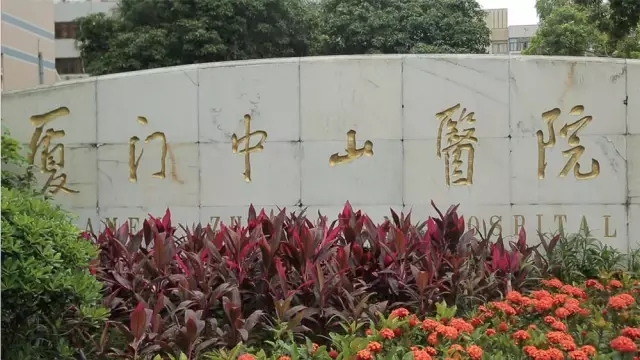
As a research-oriented affiliate hospital of a national key university, Zhongshan Hospital handles over 2.8 million outpatient and emergency visits annually and admits 60,000 inpatients. This enormous patient volume places significant service pressure on the hospital’s medical and nursing staff. In response, the hospital seeks to leverage Internet of Things (IoT) technology to help nurses reduce their workload. During the bidding process, Ruijie Networks stood out among numerous competitors due to the excellent compatibility of its products.
Personnel from the Information Department of Zhongshan Hospital stated, “We evaluated numerous solutions but found that they either required separate deployment of business operations or mandated bundling with specific brands of medical software, which would undoubtedly further complicate the future management of hospital information systems. We aimed to build an IoT platform that is simple to deploy and vendor-agnostic regarding business software, capable of stably supporting business systems while seamlessly integrating with existing wireless networks. After a comprehensive evaluation and comparison of solution performance, we ultimately selected Ruijie Networks.”
To address Zhongshan Hospital’s primary needs, the full closed-loop infusion management system within Ruijie Medical’s IoT solution was the first to be deployed. By leveraging smart infusion monitors, indoor IoT base stations, and an IoT platform, the system achieves end-to-end closed-loop management of the hospital’s infusion processes.
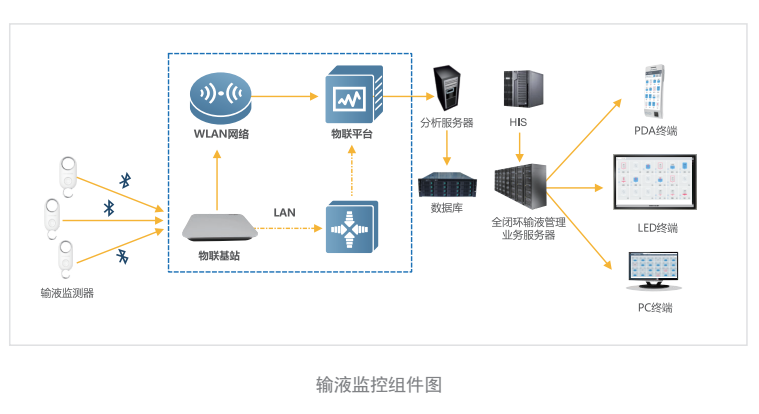
As this system can monitor the remaining infusion volume in real time, medical staff can prepare medications and change infusion bags in advance based on the displayed volume. In the event of an excessively rapid infusion rate for any patient, the system will automatically trigger an alarm, enabling healthcare providers to monitor the drip rate in real time and ensure infusion safety.
In this regard, the Director of the Nursing Department at Zhongshan Hospital stated, “In the past, we had been continuously seeking effective methods to enhance nursing quality and safety. The implementation of Ruijie Networks’ closed-loop infusion management system has not only reduced the time nurses spend on infusion-related tasks but also significantly mitigated medical risks, thereby effectively improving patient satisfaction with their healthcare experience. Nowadays, our workload is much lighter, call bells ring far less frequently, the wards are quiet, patients are more satisfied, and everything has become well-ordered.”
Currently, in addition to Zhongshan Hospital, Ruijie Networks’ IoT solutions have been deployed in dozens of hospitals across China, including well-known institutions such as Shanghai Pulmonary Hospital and Donghai County People’s Hospital.
Asset Management Using Current Tags
Beyond medical services, the utilization efficiency of medical equipment has long been a blind spot for hospitals. Hospital administrators are concerned about equipment utilization rates, whether current equipment inventory is adequate or insufficient, and the reasonableness of requests from clinical departments for additional equipment. The equipment management department focuses on how to allocate medical devices to clinical departments with maximum efficiency amid increasing patient volumes. Clinical departments, meanwhile, are concerned with equipment utilization efficiency, how to quickly locate available devices, and how to submit more rational equipment requisitions.
Every year, the hospital’s Equipment Department conducts a comprehensive asset inventory across the entire institution. Currently, a common challenge faced by hospital equipment departments is the regulatory oversight and maintenance of mobile devices such as ventilators and electrocardiogram (ECG) monitors. Typically, tertiary hospitals have hundreds to thousands of such mobile devices, which constitute a significant portion of the hospital’s assets, with individual unit costs ranging from tens of thousands to hundreds of thousands of yuan.
Previously, asset management companies could only track the quantity of hospital equipment, but were unable to analyze information such as equipment utilization efficiency and departmental usage frequency.
To address this situation, Ruijie Networks has developed a current-sensing tag. By simply connecting it to the power outlet of medical equipment, the hospital’s equipment department can monitor all operational states—including power-on, power-off, and standby—thereby improving equipment utilization efficiency.
In addition, the current tag features built-in positioning capabilities, enabling it to detect the device's location even after movement.
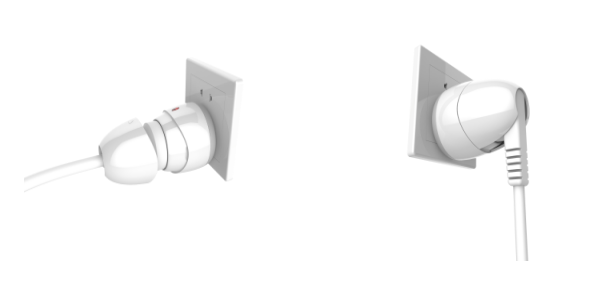
Ruijie Networks Current Label
By monitoring the current draw of products, the hospital’s Equipment Department can track the operating hours of all devices in each department, thereby analyzing equipment utilization efficiency.
Barriers to the Implementation of the Medical Internet of Things
At present, tertiary hospitals have a strong demand for the implementation of the Internet of Things (IoT). To address these needs, Ruijie Networks offers a relatively comprehensive end-to-end IoT solution.
Meanwhile, for secondary hospitals with strong operational performance and a proactive stance toward new technologies, Ruijie Networks provides more conventional solutions, such as wireless coverage.
According to Xu Wei, Deputy General Manager of the Medical Systems Division at Ruijie Networks, “Hospitals currently do not allocate substantial budgets for IoT initiatives, with investments typically ranging from several hundred thousand to one or two million yuan. As many hospitals have low levels of informatization and have yet to achieve comprehensive network coverage, they do not prioritize IoT applications.”
Furthermore, the implementation of IoT in hospitals requires collaborative coordination between the Information Technology Department and other clinical and administrative departments.
“Generally speaking, the IT department only cooperates to fulfill requirements when other departments submit requests to it. For instance, if the nursing department of a certain clinical division needs an IoT solution, it must first submit a request to the Information Center. The Information Center will then source solutions from various enterprises. Once a suitable solution is identified, the enterprise will ultimately collaborate with the clinical department to implement the solution in practice,” said Xu Wei.
Therefore, if the Information Center takes the lead in promoting the implementation of an information technology project within a specific department, it is often difficult to ensure its effective execution.
Currently, due to limitations in technologies such as sensors, IoT products are not yet capable of providing management coverage across the entire patient lifecycle. Applications can only be piloted and implemented in certain auxiliary departments within hospitals or in non-critical scenarios.
Regarding whether IoT products require CFDA approval, Xu Wei stated, “If IoT is applied to hospital operational workflows, then generally speaking, CFDA approval is not required. For example, asset tracking does not directly or indirectly participate in the medical diagnostic process. However, temperature monitoring requires CFDA approval, as it indirectly reflects human body temperature characteristics and directly impacts physicians’ diagnostic processes.”
Overall, the Internet of Medical Things (IoMT) is a gradual process. At this stage, the primary focus remains on enhancing hospital operational efficiency and addressing security concerns, such as personnel positioning and asset management; it has not yet entered the realm of medical diagnosis.