

Zhangshang Tangyi Secures Over RMB 100 Million in Series B1 Funding to Accelerate Hospital-Focused SaaS Platform and Build AI-Powered Clinical Decision System
Recently,VCBeat (WeChat ID: vcbeat)It is reported that Zhangshang Tangyi completed its Series B1 financing round in early 2016, with participation from CDH Investments, IDG Capital, Matrix Partners China, and Ping An Ventures, for a total investment exceeding RMB 100 million.
This marks the third round of financing publicly announced by Zhangshang Tangyi. As the largest digital platform for chronic disease management in China, the project’s total valuation has exceeded RMB 1 billion. The vision of providing full-cycle, data-driven management for chronic disease patients—from hospital to home—has become a reality, and capital is once again betting on “digital health.”
From 2015 to 2017, Zhangshang Tangyi achieved a fivefold increase in its user base and a tenfold surge in revenue, with annual revenue approaching RMB 200 million. Behind these figures lies a robust on-the-ground team. Currently, Zhangshang Tangyi has completed deep integration of its new product—the hospital informationization SaaS platform “Yihui”—at nearly 500 hospitals across China, entering the new frontier of hospital information technology.
Hospital Side: Addressing Major Pain Points for Hospitals to Achieve Fully Digitalized Diagnosis and Treatment
Zhangshang Tangyi, founded in 2014, has consistently aimed to enhance the efficiency and effectiveness of diagnosis and treatment for end-users. The app is positioned as a health service management platform based on diabetes data.
Patients record their health data and receive health guidance on Tangyi, gradually improving their health conditions. Hospital teams on the platform can leverage visualized big healthcare data to provide more efficient and precise disease management guidance and treatment plans for patients. However, in 2016, during outreach efforts, hospital ground promotion teams discovered significant pain points in the diagnosis, treatment, and management of diabetic patients within hospitals.
“First, in traditional hospitals, communication and operational instructions among doctors, nurses, and patients are very primitive, largely relying on paper records. This results in low efficiency and a lack of data documentation—not to mention the challenges of synchronizing and tracking data for critically ill patients after they return home,” said Kuang Ming, CEO of Zhangshang Tangyi (Pocket Diabetes Care). After identifying this issue, his team made a determined entry into the main battlefield of chronic disease management—hospitals—to tackle this unavoidable “hard nut to crack.”
Why Is It a “Tough Nut to Crack”? CTO Mu Tang, Who Led the Transformation Effort, Has the Most Authority to Speak: “The Level of Informatization Is Too Low!”
From grappling with archaic Windows 95 systems and navigating various versions of Hospital Information Systems (HIS) and Laboratory Information Systems (LIS) with disparate data formats, to maneuvering through hospitals’ complex internal workflows, the technical team at Tang Doctor has successfully completed platform adaptation for hospitals in East China after overcoming one unexpected challenge after another. “It’s safe to say that we have encountered every conceivable problem!”
Modular and customizable hardware and software pave the way for smooth hospital adoption
Currently, the Hospital SaaS Open Platform of Palm Sugar Doctor leverages a modular and customizable architecture to accommodate the diverse needs of different medical institutions. The system allows for customized permission modules tailored to each hospital’s workflow, installation of bespoke functionalities, and compatibility with glucose meters from various specified brands. It achieves multi-mode data interconnectivity management and shared definitions, ranging from single departments to entire hospitals, from individual facilities to tiered diagnosis and treatment consortia (medical alliances), and from standalone systems to integration with hospital Information Systems (HIS). This systematically enhances overall diagnostic, therapeutic, and management efficiency.
For example, after the hospital installs the “YiHui” SaaS system by Palm Sugar Doctor, it can adapt to designated cooperative brand blood glucose meters (Palm Sugar Doctor supports mainstream blood glucose meters used in the hospital market and completes their intelligent transformation and integration). Doctors can then assign tasks such as blood glucose measurement to nurses via the system. After nurses complete the tasks and collect the data, the system will automatically synchronize and present the results in a structured format to help doctors make efficient diagnoses.
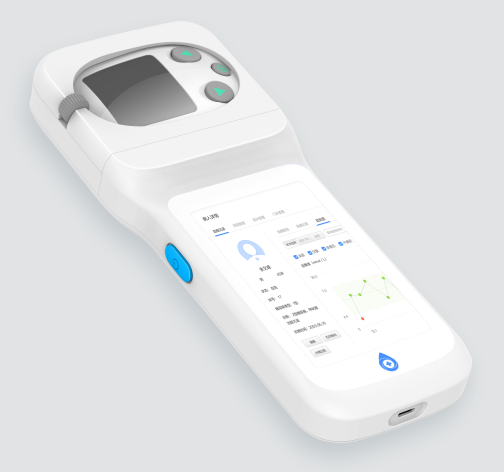
Touchscreen Smart Blood Glucose Monitoring Device
Throughout this process, clinical diagnosis and treatment have become increasingly standardized, digitized, intelligent, and streamlined. With the aid of visual data analytics, hospitals can continuously improve diagnostic and therapeutic outcomes for individual patients as well as overall care quality, while significantly enhancing physicians’ daily work efficiency. To date, nearly 500 hospitals have adopted this system, which processes tens of millions of data records per month.
“Only by collecting comprehensive medical data, analyzing big data through unique algorithms, and providing auxiliary decision-making information to hospital administrators, doctors, and nurses can healthcare institutions fundamentally improve their medical outcomes, patient safety, cost optimization, and operational efficiency,” said Kuang Ming, CEO of Zhangshang Tangyi.
Home Side: Link hospital data to complete follow-up tracking
The pain points of hospitals have been addressed, but the process of digitalization is far from over.
The ideal scenario is that, after discharge, patients only need to upload new monitoring data in real time from home to enable remote physician monitoring. In the event of a critical situation, timely alerts can be issued to prompt critically ill patients to take necessary measures or return to the hospital for care. Currently, Zhangshang Tangyi is actively working to extend its services from the hospital setting to the home environment.
Kuang Ming stated that the current patient retention data from hospitals to home care is quite promising, which indirectly reflects patients’ recognition of the product and the strong demand for it among healthcare providers. In regions with high market penetration, Zhangshang Tangyi’s overall business has already achieved positive cash flow.
Continuously optimize Yihui SaaS and further strengthen efforts in the B2B sector.
Next, Palm Sugar Doctor will continue to optimize the hardware devices for the Yihui SaaS open platform. Meanwhile, as cooperation with traditional blood glucose meter manufacturers deepens, the system’s deployment in hospitals will accelerate significantly, further enhancing the compatibility and data processing capabilities of this open-source in-hospital management system.
The team will expand from the Jiangsu-Zhejiang-Shanghai region to multiple other areas, including Central, North, and Northeast China. In 2018, it is expected to cover 1,500 hospitals, particularly a large number of top-tier hospitals. “The northern region is an even more critical battleground.”
With a stable source of massive data, Zhangshang Tangyi’s ambitions in AI-driven healthcare have become even more pronounced. Kuang Ming stated that the vast amount of data collected through its SaaS business is being applied to machine learning by the team, and an “AI-assisted diagnostic system” has been initially developed.
“Previously, doctors had to review four to five charts before reaching a conclusion. Now, with structured and interconnected data, the associated disease outcomes are generated directly, allowing physicians to finalize the diagnosis with simple confirmation,” said Kuang Ming. “We aspire to become the lifelong intelligent data platform for China’s more than 400 million patients with chronic diseases and all healthcare providers managing these conditions. The application of artificial intelligence in real-world clinical practice will soon become a reality.”
An investor in Palm Sugar Doctor stated: “Palm Sugar Doctor possesses industry-leading technological advantages and a clear strategic development roadmap. After rapidly accumulating a large base of consumer-end users, the company was able to promptly expand into higher-barrier medical scenarios. By leveraging its SaaS system to address efficiency pain points within hospitals, it has enhanced the efficiency of diagnosis and treatment systems, achieved scaled expansion among partner hospitals within one year, and established a robust B-end moat. This business expansion has further raised the ceiling for the company’s growth potential.”