

Domestic Medical AI Companies Accelerate CFDA Submissions with Real-World Clinical Data
By Wang Xiaoxing, Huang Bangyu
On September 4, the CFDA released the new version of the "Medical Device Classification Catalog," adding categories corresponding to AI-assisted diagnosis.
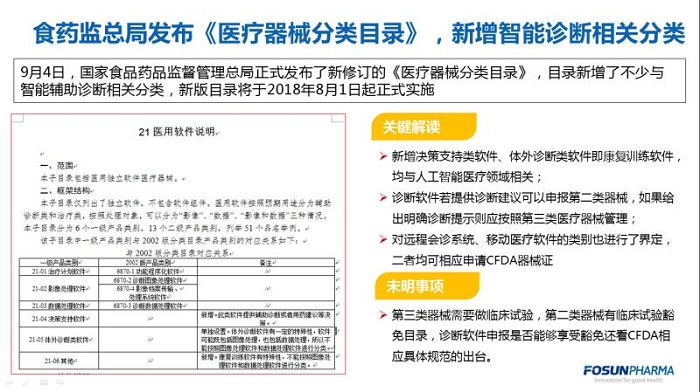
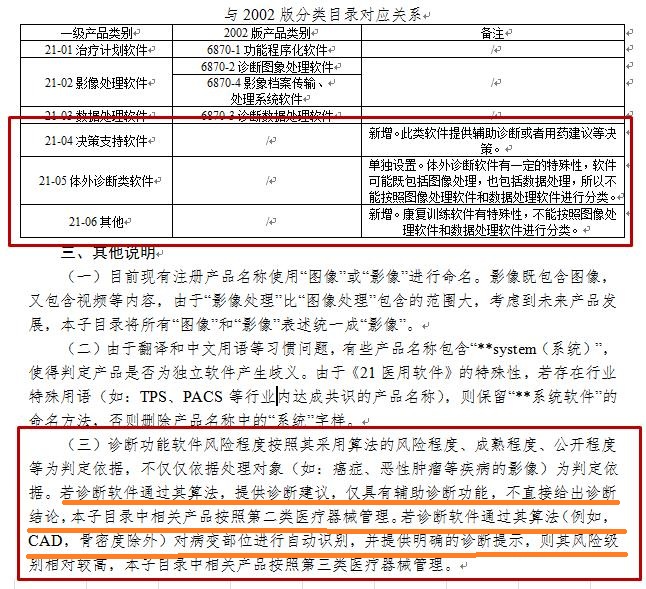
“Medical Device Classification Catalog” issued on September 4, 2017, compiled by Fosun Pharma
According to the latest classification regulations, if diagnostic software provides diagnostic recommendations through algorithms, serving only an auxiliary diagnostic function without directly issuing a diagnostic conclusion, it shall be registered as a Class II medical device. However, if it automatically identifies lesions and provides explicit diagnostic prompts, it shall be regulated as a Class III medical device.
It is worth noting that Class III medical devices are required to undergo clinical trials, while Class II devices have a catalog of exemptions from clinical trials. The China Food and Drug Administration (CFDA) has not yet issued specific regulations on whether diagnostic software applications can qualify for such exemptions.
This specification will take effect on August 1, 2018. For medical AI companies seeking to enter hospital procurement channels, obtaining certification from the China Food and Drug Administration (CFDA) is mandatory. If a company seeks Class III medical device certification, or if its diagnostic software does not qualify for exemption, extensive real-world clinical application data will significantly support its application. To this end, VCBeat has compiled clinical data from major medical AI companies to assess their current development status.
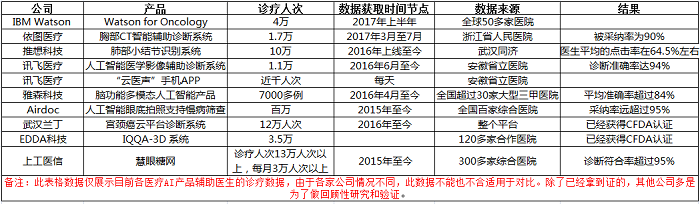
The data in the table above presents specific clinical decision support metrics for products from various medical AI companies deployed in hospitals. As most of these companies have not yet obtained certification from the China Food and Drug Administration (CFDA), some of the data derive from retrospective studies and validations conducted within hospital settings, aimed at further refining and optimizing their products.
Artificial intelligence has seen the most extensive application in medical imaging. In the field of pulmonary nodule screening, many companies have accumulated over 10,000 cases of computer-aided diagnosis and treatment data, which has significantly facilitated their applications for approval by the China Food and Drug Administration (CFDA).
Infervision
In September 2017, Dr. Fang Cong, Vice President of Yitu Healthcare, told VCBeat that Zhejiang Provincial People’s Hospital, as one of the first partner hospitals of Yitu Healthcare, has, since its launch,The AI system assisted physicians in reviewing images of 17,000 patients, with an adoption rate of 90%.The 10% of reports that were not adopted were primarily generated in the early stages, when the system was still in its infancy and had room for improvement.
Furthermore, Gong Xiangyang, Director of the Department of Radiology at Zhejiang Provincial People’s Hospital, stated that the intelligent auxiliary diagnostic system for chest CT is primarily integrated into the physical examination workflow of hospitals. The process is as follows: physicians first review the nodules identified by the AI product, then re-examine all images. If no new nodules are detected, they accept the AI’s diagnostic findings.
Nowadays, physicians are held accountable for the reports they issue and bear liability for missed diagnoses; therefore, they cannot rely 100% on artificial intelligence (AI), as AI systems occasionally fail to detect certain findings. The team is currently analyzing the specific circumstances under which nodules are missed. Overall, AI is highly beneficial to physicians, most importantly by enhancing their diagnostic confidence.
Infervision
Chen Kuan, CEO of Infervision, stated that the company’s mature product, the pulmonary nodule detection system, has already been successfully deployed and integrated into GE Healthcare’s equipment for clinical use. Under the premise of fully voluntary adoption by physicians, the average click-through rate among doctors stands at approximately 64.5%. Xia Chen from Infervision once remarked at a conference thatWuhan Tongji Hospital performs approximately 48,000 CT diagnoses per month, with 40% being chest CT scans. Since its launch last October, AI-assisted screening at Tongji Hospital has exceeded 100,000 cases.
iFlytek Healthcare
In June 2016, Anhui Provincial Hospital collaborated with iFlytek to develop an AI-based medical imaging computer-aided diagnosis system. As of August 2017,The system has assisted physicians in the CT Department of Anhui Provincial Hospital in interpreting approximately 11,000 cases of CT imaging data, achieving a diagnostic accuracy rate of 94%.
Following the initial phase of integration and debugging, the AI-assisted diagnostic platform, interfaced with Anhui Province’s “Medical Imaging Cloud” and the Teleconsultation Platform of the Medical Consortium of Anhui Provincial Hospital, will officially commence operations on August 20.
This platform can provide intelligent auxiliary diagnosis and quality control services for chest CT and mammography images to 41 county-level hospitals. During the trial operation and debugging phase,The platform has conducted quality control on approximately 1.5 million chest CT images from over 10,000 patients, issuing quality control recommendations in more than 500 cases.
iFlytek also stated that it will explore and promote the “AI Medical Assistant Project” for primary care general practitioners across the province, expanding its service coverage from 41 counties to 105 counties.
The People's Hospital of Shannan Prefecture in Tibet, which receives paired assistance from Anhui Provincial Hospital, has also been connected to this platform.
As research continues to deepen, the platform’s level of intelligence and service capabilities will continue to improve, and its scope of services will continue to expand. Currently, the platform has been trained on 20,000 mammography images and approximately 200,000 cranial magnetic resonance imaging (MRI) scans, showing promising potential for assisting in the diagnosis of breast cancer and facilitating clinical research on Alzheimer’s disease.
Through collaborative research and development with iFlytek, artificial intelligence voice technology has been widely applied in various scenarios at Anhui Provincial Hospital, including medical rounds and ultrasound examinations. The entry of patient information data, which previously took tens of minutes or even hours to complete, can now be conveniently accomplished through dictation.
Currently, doctors at Anhui Provincial Hospital use the "Cloud Medical Voice" mobile app nearly 1,000 times per day, accessing electronic medical records, laboratory tests, and other functional pages approximately 5,300 times.
As a National Demonstration Center for the Application of Gene Testing Technology, Anhui Provincial Hospital has conducted over 250,000 gene testing screenings for various diseases, including colorectal cancer, cervical cancer, leukemia, hereditary deafness, and hepatitis, as well as nearly 2,000 pharmacogenetic tests. Leveraging gene testing technology, it is capable of performing genetic diagnoses for more than 1,000 types of monogenic hereditary disorders.
Tumashenwei
Wang Dongjian, Vice President of Tumavis, told VCBeat that from the perspective of retrospective studies and validation,Tumavis has analyzed over 50,000 chest CT scan cases. After screening, approximately 23,000 cases were selected and annotated for machine learning, of which about 10% had postoperative pathological confirmation.Therefore, TumorDeep can initially provide an analysis of the benign or malignant nature of nodules.
Yasen Technology
Since April 2016, Yason has collaborated with Beijing Xuanwu Hospital, Peking University People’s Hospital, and Peking Union Medical College Hospital to develop and launch a multimodal artificial intelligence product for brain function assessment. By analyzing data from MRI, PET, SPECT, EEG, and other modalities, this system can be applied to the quantitative analysis, diagnosis, and prediction of various brain functional disorders, including Alzheimer’s disease, epilepsy, Parkinson’s disease, and hemophagocytic syndrome. To date,This system has been deployed in more than 30 large Grade-A tertiary hospitals across China, with a cumulative total of over 7,000 case analyses completed and an average accuracy rate exceeding 84% across various disease types.This system is also the first artificial intelligence system in China to provide multimodal analysis for specific diseases, marking a significant step forward in assisting clinicians with diagnosis and treatment.
Airdoc
During the more than one year since Airdoc’s AI-powered remote retinal image reading system for fundus diseases was put into use, it has assisted doctors at hospitals of all levels and across various departments in providing a large volume of diagnostic services for fundus diseases.Currently, there are over 300 partner hospitals, with 2,000 patient visits per day and a data volume exceeding 8 million records.. For example, in its first month of operation, the artificial intelligence system at Huaibei Miner General Hospital conducted fundus disease screenings for hundreds of elderly individuals aged 65 and above. The future goal is to leverage the hospital’s medical consortium to screen the entire elderly population of several hundred thousand across the city for fundus diseases using the AI system. Similar large-scale community-based fundus disease screening projects will be rolled out in many provincial capitals and medium-to-large cities, with an expected capacity to effectively screen millions of individuals over the next few years.
Beyond ophthalmology, AI systems have also been adopted in the endocrinology departments of many tertiary hospitals. For instance, within the Hebei Endocrinology Alliance, advanced AI-enabled remote interpretation of fundus images has facilitated regular fundus examinations for hundreds of diabetic patients. This technology helps endocrinologists rapidly assess retinal status, thereby enabling effective monitoring of diabetes progression and enhancing chronic disease management.
The adoption rate of Airdoc’s remote fundus disease image reading system far exceeds 95%., particularly well-received by endocrinology experts, it has thoroughly resolved the issue of endocrinologists’ inability to effectively master fundus image interpretation techniques.
Wuhan LANDING
Over the past 15 years since its establishment, Wuhan Landing has accumulated more than five million screening cases. Since the launch of its Cervical Cancer Cloud Platform Diagnostic System in 2016, it has screened 120,000 individuals. According to VCBeat, Wuhan Landing obtained Class II certification from the China Food and Drug Administration (CFDA) in 2016, thereby facilitating a relatively smooth marketization process.
EDDA Tech
To date, the IQQA-3D system has been utilized in over 35,000 cases worldwide, covering major diseases affecting soft-tissue organs in the thoracic and abdominal regions, including the liver, biliary tract and pancreas, lungs, and kidneys. EDDA Technology’s products have largely obtained Class II certifications from both the China Food and Drug Administration (CFDA) and the U.S. Food and Drug Administration (FDA). The more than 120 partner hospitals have acquired usage rights to these products through procurement.
ShangGong Medical Information
Shanggong Yixin’s “Huiyan Tangwang” product has achieved a diagnostic concordance rate of over 95% and has been deployed on a large scale for commercial use. Currently, the platform covers more than 20 provinces across China, with nearly 300 hospitals having adopted it for clinical application, including over 100 tertiary hospitals, 17 of which are among the top 100 hospitals in the country. More than 250,000 fundus images have been uploaded to the AutoEye database, with the volume growing at a rate of over 60,000 images per month.
IBM Watson
The business scale of Watson for Oncology is continuously expanding, currently covering more than 50 hospitals across five continents. In the first half of 2017, Watson served nearly 40,000 patients and physicians, a figure projected to reach 100,000 by year-end. Based on the current scale of partner hospitals, Watson for Oncology already possesses the revenue potential to cover millions.
Watson for Oncology has not yet received FDA approval. Although this has raised questions, VCBeat understands that Watson’s services operate within the legal framework.
Discrepancies Between Clinical and Laboratory Results
Six months ago, when AI-powered medical products were first introduced from the laboratory, many systems boasted accuracy rates exceeding 90%, inspiring considerable confidence. However, their performance in clinical practice has often been underwhelming. This discrepancy stems partly from differences in data and application contexts; for instance, while these systems deliver impressive results in screening high-risk healthy populations, their accuracy tends to decline in complex clinical settings.
On the other hand, laboratory research has focused solely on sensitivity, resulting in a high false-positive rate. However, in clinical practice, although physicians still prioritize sensitivity, an elevated false-positive rate increases their subsequent workload. When physicians demand a reduction in the false-positive rate, sensitivity inevitably declines. Additionally, some hospitals require systems to incorporate functionality for distinguishing between benign and malignant conditions, which necessitates the integration of pathological information and complicates the analysis. Consequently, although most vendors have been iterating their systems on a biweekly basis over the past six months, clinical accuracy remains the primary concern.
To ensure high sensitivity, reduce false-positive rates, and enhance generalizability, many companies are continuously expanding the sources and volume of their database data. This improvement in generalizability lays the foundation for future applications to the China Food and Drug Administration (CFDA) for artificial intelligence systems.
The threshold for implementing AI applications in other areas of healthcare is lower.
Compared to the application of artificial intelligence (AI) in medical imaging, the barriers to implementation are relatively lower in areas such as voice entry, data structuring and secondary applications of structured data, and drug research and development. In these scenarios, AI technology serves merely as a tool. Voice entry and data structuring do not require certification from the China Food and Drug Administration (CFDA). Meanwhile, in the field of new drug development, well-established approval processes are already in place, with AI simply accelerating drug discovery and clinical trials. Therefore, the deployment of AI is comparatively easier in these domains.
According to VCBeat, most companies applying artificial intelligence technology in these fields serve B-end clients as their primary payers. As CFDA certification is not required and operational efficiency can be significantly improved, their profitability models are relatively easy to implement.
Public information indicates that among current medical artificial intelligence enterprises, only Wuhan Landing and EDDA Technology have obtained certification from the China Food and Drug Administration (CFDA). As a result, both companies have moved beyond the free trial phase, requiring all customers to pay for their services. They can either sell their systems directly to healthcare institutions or establish cloud platforms to provide services to a broader range of hospitals, thereby generating revenue while delivering these services.
Therefore, at this stage, as classification catalogs emerge, medical AI companies should accelerate the CFDA certification process while developing their products. This will enable them to collaborate with device manufacturers and healthcare institutions on relatively equal terms during commercialization. By ensuring profitability, they can safeguard their brands from becoming subordinate to others.