

Tongxin Medical Alliance Builds a Unique Imaging Consortium with AI Team and Offline Imaging Centers

Sophmind
Internet Medical Examination Platform
The following two figures illustrate how Sophmind, leveraging its imaging center, operates based on the national policy of tiered diagnosis and treatment and the principles of the sharing economy.+ Imaging Medical Consortium Built on a Cloud Platform Model:
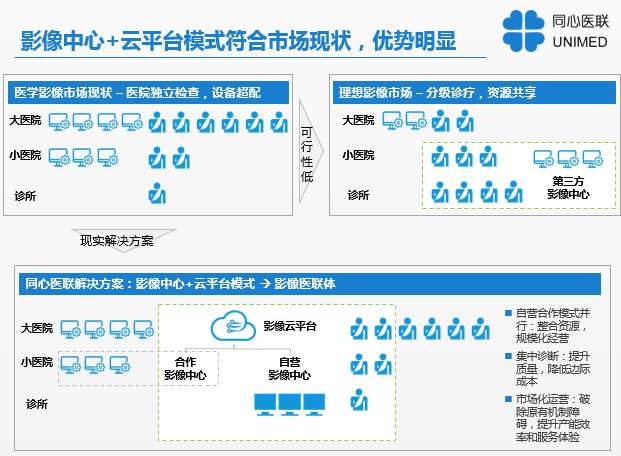
Primary healthcare institutions, constrained by limited diagnostic capabilities and low patient volumes, prioritize patient retention to build a stable patient base; collaborating with higher-tier hospitals represents an effective strategy. Mid-tier hospitals, facing low patient volumes, underutilized medical equipment, and suboptimal operational efficiency, seek to enhance patient inflow and service capacity through third-party trusteeship models.
The siphon effect of large hospitals has led to patient volumes exceeding capacity. Meanwhile, certain personalized needs of clinicians remain inadequately addressed. Taking scientific research as an example, physicians at large hospitals are typically required to undertake research projects; however, due to their already heavy clinical workloads, they often lack the energy and time to achieve meaningful research outcomes. The provision of service support by third-party enterprises offers hope for improving this situation.
Demand follows the market.
From the online imaging cloud platform to offline imaging centers, Sophmind is a rare enterprise capable of achieving a closed-loop imaging business model. The Sophmind team currently comprises over 80 members with diverse backgrounds, including product and technical staff, market development personnel, and medical professionals. During a one-hour conversation with Liu Weiqi, CEO of Sophmind, VCBeat gained a clear understanding of the company’s unique approach to its medical imaging product portfolio.

Liu Weiqi, CEO of Sophmind Medical Alliance
Service Process and Benefit Distribution
Medical consortiums are not a novel concept; many hospitals have attempted to establish them in the past, but with limited success. The core reasons lie in two key issues:
First, how are medical services coordinated? When patients seek care across different hospitals, coordination of service processes inevitably becomes an issue. This is particularly challenging within the public hospital system, whereas enterprises find it relatively easier to address. Sophmind not only integrates information systems but also streamlines medical service workflows, with dedicated personnel providing operational support and managing the entire patient journey.
Second is the issue of interests. Since direct negotiation and pricing among public hospitals are inconvenient, utilizing third-party enterprises facilitates the distribution of benefits in medical consortium collaborations among healthcare institutions.
According to Liu Weiqi, to achieve collaborative cooperation among medical institutions of different levels, Sophmind has done three things:
First, integrate the underutilized imaging capacity of certain hospitals into the imaging center.
Second, establish self-operated imaging centers.
Third, the two are integrated through an imaging cloud platform. This approach enables scaled operations that combine high- and low-acuity care, while facilitating centralized diagnosis via imaging centers, thereby reducing labor and marginal costs for each hospital. Small hospitals can deliver high-quality medical care without requiring top-tier specialists, thus promoting the implementation of tiered diagnosis and treatment.
Self-operated Partnership: Establishing Offline Imaging Centers
According to Liu Weiqi, “The equipment cost for an independent third-party imaging center is approximately RMB 30 million. However, if favorable site-related policies can be secured and the imaging equipment is acquired through financial leasing, the initial startup costs would be significantly lower.”
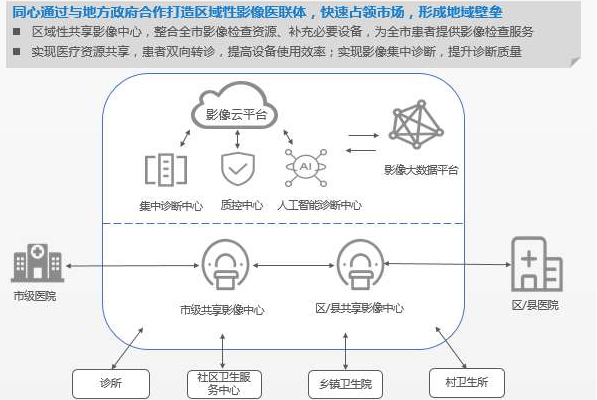
Sophmind has signed agreements with local governments in cities such as Tai’an and Yantai in Shandong Province to establish imaging centers and medical consortia. For its online operations, Sophmind provides an imaging cloud platform and an imaging big data platform, which include a centralized diagnostic center, a quality control center, and an AI-assisted diagnostic center.
Currently, the imaging center of Tongxin Medical Alliance is staffed by full-time physicians and multi-site practice physicians. Full-time physicians are responsible for drafting imaging diagnostic reports. Experts engaged in multi-site practice, most of whom hold associate senior professional titles or above at tertiary Grade A hospitals, conduct report reviews—serving as secondary quality control—before finalizing and issuing the reports. This model not only ensures report quality but also avoids the need to employ an excessive number of radiologists as the hospital expands its scale in the future.
For partnered imaging centers, Tongxin Medical Alliance leverages its cloud-based imaging platform to refer patients requiring diagnostic examinations to hospitals, thereby increasing hospital revenue. For self-operated imaging centers, Tongxin Medical Alliance adopts an independent operational and management model. In terms of site selection, Tongxin Medical Alliance typically chooses locations in first- and second-tier cities with high population density and abundant medical resources. Additionally, it considers grassroots cities with substantial patient flow and regions where collaborations with other healthcare institutions are established.
“Even third-party independent imaging centers must integrate with local medical resources. Although operating costs are higher in densely populated areas, choosing an overly remote location would make it difficult for patients to access care, rendering the center meaningless.” The imaging center established by Sophmind in Tai’an is located adjacent to the new campus of the local Central Hospital, enabling the two entities to form a genuine synergistic relationship.
Sophmind’s imaging service matrix enables equipment sharing within a region and optimizes the allocation of hospital medical resources through collaborative bidirectional referrals within medical consortia, thereby alleviating patients’ difficulties in accessing medical care. Furthermore, it facilitates centralized diagnosis via medical consortia, effectively extending high-quality medical resources from Beijing, Shanghai, and Guangzhou to grassroots healthcare facilities.
Offline Imaging Centers + Online Imaging Cloud Platform: A Closed-Loop Business Model
Currently, the hospitals partnering with Sophmind are primarily Level II Grade A hospitals and private hospitals with relatively strong operational performance.
For its online operations, Tongxin Medical Alliance’s Imaging Cloud does not enter hospitals through traditional software sales; instead, it generates revenue through remote diagnosis and platform service fees. For services such as online patient appointments and remote diagnostics, Tongxin Medical Alliance receives a portion of the patient examination fees.
In the offline segment, Sophmind collaborates with local governments and hospitals to jointly establish imaging centers. In addition to direct purchases, Sophmind partners with equipment manufacturers through financial leasing arrangements, sharing in the subsequent revenue. This approach significantly reduces the company’s upfront capital expenditure.
According to Liu Weiqi, the Imaging Center primarily serves patients from nearby primary care hospitals, including those referred through the medical consortium’s referral mechanism due to the lack of diagnostic capabilities at their originating facilities.
Three Major Processes and Eight Key Modules for Imaging Center Development
For the development of Tongxin Medical Alliance, Liu Weiqi has outlined three phases. The first phase focuses on industrial R&D and market expansion. This involves collaborating with hospitals in first-tier cities such as Beijing, Shanghai, and Guangzhou to establish expert teams in medical imaging and clinical practice. It also includes the independent development of systems such as RIS, PACS, and remote consultation platforms, as well as mobile applications for both physicians and patients.
Phase 2.0: Scaled Operations Stage. Collaborate with resource partners to rapidly penetrate the market. Partner with imaging equipment suppliers and distributors to swiftly capture offline imaging center entry points in grassroots cities, thereby enhancing the brand influence of Sophmind.
Phase 3.0: Building the Medical Consortium Ecosystem. Establish over 1,000 partnered imaging centers and more than 50 self-operated imaging centers. Build China’s largest medical imaging case database to lay the foundation for intelligent medical diagnosis. Vertically extend the industry chain by collaborating with physician groups specializing in oncology, orthopedics, neurology, and rehabilitation to enhance the clinical capabilities of primary care and private hospitals. Partner with third-party testing laboratories and pharmaceutical e-commerce platforms to provide a support platform for physicians’ freelance practice.
Currently, Sophmind is in its second stage of development, namely the phase of scaled operations. Leveraging its accumulation in major cities such as Beijing, Shanghai, and Guangzhou, Sophmind has expanded to other second- and third-tier cities. By co-establishing imaging medical consortia with channel partners such as equipment manufacturers and local governments, it has captured a portion of the offline imaging center market.
Furthermore, in operating its imaging centers, Tongxin Medical Alliance has established its own standardized operational procedures. The company divides the development of imaging centers into three major processes and eight key modules. The three major processes include project selection, project preparation, and project operation. The eight key modules encompass brand (marketing + certification), traffic (online + offline), examination services (acquisition + storage + interpretation + consultation + post-processing), service (clinicians + patients), personnel (sales + operations + experts), finance (reconciliation + risk control), assets (appearance + equipment + consumables), and systems (external + internal).
Based on this comprehensive set of standardized SOPs, Tongxin Medical Alliance can rapidly expand its business operations across China.
Deploying AI to Seize Opportunities in AI-Driven Healthcare Scenarios
In August 2017, Sophmind co-founded Shanghai Gaishi Medical Imaging AI with an AI team from Silicon Valley, USA, thereby strengthening its strategic layout in the medical imaging sector. The team comprises deep learning experts from the United States and possesses strong R&D capabilities.
In Liu Weiqi’s view, Sophmind’s AI represents more of a long-term strategic layout, as it has the potential to genuinely address the imbalance between medical supply and demand. The education and training of physicians is a long-term process. In the future, algorithms will not constitute a core barrier; rather, what will truly shape the industry are backend computational capabilities and frontend application scenarios. “How to better apply technology in practice is crucial. Currently, the core focus of Sophmind’s AI efforts lies in building out these application scenarios.”