

National Standard for Senior Care Service Quality on the Horizon, Featuring Multiple 'Firsts' to Upgrade Elderly Care Needs
Five years after the initial release of the National Basic Standards for Elderly Care Institutions in 2012, the Ministry of Civil Affairs issued a draft for public comment on the National Standard “Basic Specifications for Service Quality in Elderly Care Institutions” (hereinafter referred to as the “Draft for Comment”) on October 17, soliciting feedback from the general public.
Prior to the release of these national-level standards, relevant regulations had already been introduced in provinces and municipalities such as Beijing, Hubei, and Shaanxi. Amid the increasingly diversified business models in the elderly care industry, there is an urgent need for standardized guidelines. The issuance of sector-specific regulations signifies that services in this area have been incorporated into top-level design frameworks.
Therefore, in this draft for public comment, one can inevitably discern echoes of the past and indications of future trends.
I. Development of Standards for 11 Services
In this draft for public comment, the Ministry of Civil Affairs specified 11 applicable targets and definitions, as follows:
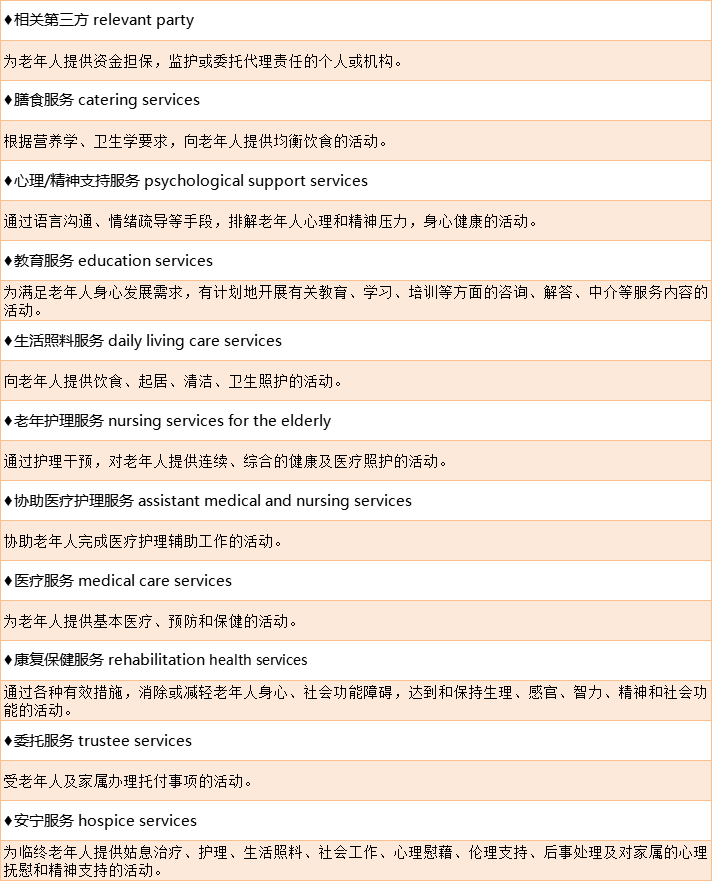
Compared to the 2012 "Code," which provided only brief definitions—defining elderly care institutions as various organizations providing comprehensive services such as daily living assistance, meals, rehabilitation, nursing, and medical healthcare; and relevant third parties as individuals or organizations providing financial guarantees, guardianship, or entrusted agency responsibilities for the elderly—the current version features a significantly higher level of service detail.
Beijing’s local “Specifications,” issued as early as 2008, are more detailed. The standard covers 29 items in terms of applicable subjects and definitions, which can be broadly categorized into: service recipients—various types of elderly individuals (such as those who are fully independent in activities of daily living, those who are partially dependent, and those who are completely dependent); service institutions—including senior apartments, nursing homes, and skilled nursing facilities; and service items—comprising 21 categories such as elderly nursing services, safety protection services, leisure and entertainment services, assisted medical nursing services, healthcare services, and in-home personal care services. It can be said that this specification, released by Beijing nine years ago, imposes strict regulations on all aspects of these services.
Hubei Province’s local *Specifications*, issued in 2010, applied to and defined a greater number of categories than Beijing’s, totaling 37 items. Among these, three new types of service institutions were added: elderly care stations, community-based elderly service centers, and home-based elderly care service centers, with detailed regulations established for institutions that are closely integrated with communities and serve broader populations.
Meanwhile, standardized rehabilitation training services for elderly individuals with various disabilities—such as functional training garments, gait training, hearing and speech therapy, and limb rehabilitation—have been incorporated into the service offerings. This development also highlights the substantial demand for geriatric and disability-focused rehabilitation services.
A comprehensive comparison of the target populations covered in the above four documents reveals that the current draft for public comment highlights a clear focus on three key service areas: integrated medical and elderly care, rehabilitation, and nursing care.
II. Clearly Specify Qualification Requirements and Quality Control Requirements
With the imminent release of the new regulations, we observe that qualification requirements are increasingly centered on risk mitigation mechanisms established through various agreements and licenses.
To address potential risks associated with certain outsourced services, the "Draft for Comments" stipulates that elderly care institutions should enter into agreements with qualified outsourcing service providers and establish supervision and exit mechanisms. Meanwhile, it requires elderly care institutions to establish an assessment mechanism for older adults based on their needs, provide corresponding services according to the assessment results, and develop individualized service plans.
Among the qualification requirements, the most critical aspect is the explicit stipulation of institutional qualifications and management requirements. Specifically, elderly care institutions must hold a Permit for the Establishment of Elderly Care Institutions and a Food Operation Permit. If an internal medical institution is established, it must hold a Medical Institution Practice License.
In terms of personnel management, it is stipulated that all service providers must hold valid certifications as required by laws, regulations, and industry standards, and possess the corresponding knowledge and skills. Furthermore, professional technical personnel shall establish professional technical files and participate in continuing education on a regular basis.
At the same time, the quantitative requirements previously found in various detailed service provisions have been elevated to overarching quality standards, requiring elderly care institutions to meet the following:
a) 100% service delivery completion rate;
b) Service satisfaction rate ≥ 80%;
c) Record qualification rate ≥85%.
If the “three licenses” stipulated in the current Draft for Comments are implemented, elderly care institutions integrating medical and eldercare services will face approval procedures involving a greater number of administrative departments. Whether the “delegation, regulation, and service” reforms can be effectively implemented has become a major challenge, and various “licenses” have also become a significant barrier to entry in the elderly care service industry.
III. Emergence of Multiple “Firsts,” Upgrading Demand for Elderly Care Services
The Draft for Comments proposes that elderly care institutions should be staffed with full-time or part-time dietitians/nutritionists; personnel providing dietary services shall possess relevant skills and hold a valid health certificate.
Dietary content requires that meal plans be developed in consideration of the physiological characteristics, health status, and ethnic and religious customs of older adults, featuring low salt, low fat, low sugar, and a combination of refined and whole grains.
Nutritional meal planning should be diverse, with a reasonable balance of proteins, fats, carbohydrates, vitamins, and minerals to achieve nutritional equilibrium.
This content appears for the first time in two local standard specifications observed by VCBeat and in the 2012 "Specifications." It is evident that nutritional dietary services specifically tailored for the elderly are poised for development.
In terms of communication services, the service scope shall include, but not be limited to, providing communication conveniences for the elderly. Elderly care institutions are required to be equipped with communication devices, including but not limited to telephones and internet access, so as to meet, to a certain extent, the needs of the elderly population for internet connectivity.
Furthermore, both consultation services and daily living care services emphasize the protection of elderly individuals' privacy. Given the unique vulnerabilities of the elderly population, information leaks are highly susceptible to exploitation by malicious actors, potentially leading to fraud against seniors. Therefore, the inclusion of privacy protection measures represents a significant improvement.
IV. Proposed Development of Relevant Service Standards for Rehabilitation and Health Care Services
In Beijing, Hubei Province, and the service items outlined in the 2012 National "Specifications," rehabilitation and healthcare services were not explicitly listed. As China’s aging population continues to grow, with over 70 million elderly individuals requiring rehabilitation services, it is imperative to establish standardized guidelines in light of this substantial demand.
The Draft for Comments points out that the content of rehabilitation services includes, but is not limited to: providing basic fitness equipment and rehabilitation assistive devices suitable for the needs of older adults, and guiding them in their use; conducting non-pharmacological cognitive rehabilitation training for older adults with dementia.
Clear requirements will also be established for the qualifications of rehabilitation therapists, supporting facilities in rehabilitation areas, rehabilitation assessments, treatment modalities, and rehabilitation equipment.
As elderly rehabilitation services become standardized, the market imbalance between supply and demand in the rehabilitation sector is expected to be correspondingly addressed, with rehabilitation emerging as a critical component of elder care services.
The enormous potential demand for elderly care has led to a mushrooming of various types of senior care institutions, yet the uneven quality of these facilities still requires standardization. In fact, as early as 2008, the Ministry of Civil Affairs issued the Basic Standards for Social Welfare Institutions for the Elderly; however, this document targeted public senior care institutions and is somewhat out of step with the current surge in private nursing homes.
In August 2017, the Ministry of Civil Affairs officially issued the Guidelines for the Construction of the Elderly Care Service Standard System, explicitly aiming to address issues such as the absence, lag, and overlap of elderly care service standards in China, and to promote the establishment of a unified national quality standard and evaluation system for elderly care services.
Zhen Bingliang, Secretary of the Party Committee at the Social Welfare Center of the Ministry of Civil Affairs, once stated that, from the perspective of development philosophy, China’s elderly care service sector has not yet fully embraced a standards-based approach. The educational backgrounds of management and service staff in most elderly care institutions vary significantly, and specialized standardization research institutions have conducted very little research on elderly care services.
Therefore, as the “yardstick” for measuring the service quality of elderly care institutions is about to be introduced, the release of this draft for public comment is regarded as a key step in promoting elderly care services.
Meanwhile, it is not difficult to discern the nascent form of formal regulations in the newly released Draft for Comment. To rationalize demands and service requirements, industry practitioners in the aforementioned fields are encouraged to actively provide feedback through the public consultation channels established by the Ministry of Civil Affairs. This will help further refine regulatory frameworks in the elderly care sector and ensure the orderly and high-quality delivery of eldercare services.
Original article link:Notice on Soliciting Public Comments on the National Standard "Basic Specifications for Service Quality in Elderly Care Institutions (Draft for Comment)"
For the feedback form and submission channels, please refer to the detailed information in the link. The deadline for submitting feedback is November 12, 2017.