

Domestic Biotech Firms Race to Catch Up as Global Pharma Giants Pour Nearly $30 Billion into Bispecific Antibody Market
Monoclonal antibody drugs are hailed as“Biological missiles” are internationally recognized as one of the most technologically advanced biological pharmaceuticals. They are also among the most widely used drugs globally. This field has given rise to multiple blockbuster drugs, such as the first chimeric antibody for cancer treatment.Rituxan, the renowned rheumatoid arthritis drugAdalimumabMonoclonal antibody,2014Annual Global SalesNO.1 Avastin, as well as the flagship products from Bristol-Myers Squibb and Merck & Co.OpdivoandKeytruda。
Beyond the widely recognized PD-1 and PD-L1 inhibitors, a rising star within the monoclonal antibody family is the bispecific antibody.
Bispecific antibodies are artificial antibodies that contain two specific antigen-binding sites, enabling simultaneous interaction with target cells and effector cells, thereby enhancing the cytotoxic effect against tumor cells.Compared with conventional antibodies, its efficacy may be 100–1,000 times that of standard monoclonal antibodies, allowing the dosage to be reduced to 1/2,000 of the original amount.
The world’s first approved bispecific antibody drug is Fresenius’ Removab, indicated for the treatment of malignant ascites. However, this product has not received FDA approval to date and is marketed exclusively in Europe under the approval of the European Commission. The only FDA-approved bispecific antibody drug is Amgen’s Blinatumomab, which is indicated for the treatment of Philadelphia chromosome-negative (Ph-) relapsed or refractory precursor B-cell acute lymphoblastic leukemia.
Roche acquired the Austrian biotechnology company Dutalys for $489 million in 2014, gaining its assets. In addition, pharmaceutical giants such as Johnson & Johnson and Sanofi are continuously increasing their investments. A 2016 report by Zhongtai Securities pointed out that since 2014, the total investment by pharmaceutical giants including Roche, Johnson & Johnson, Sanofi, and Pfizer in this field has approached $4 billion.
More than 30 years ago, bispecific antibodies were designed, but it was not until a few years ago that some of the technical challenges were resolved, enabling bispecific antibodies to enter clinical trials.
Technical Challenges
The technology platform is key. Roche once spent $489 million to acquire the Austrian biotech company Dutalys, with the aim of obtaining its bispecific antibody platform, DutaMab, to avoid the limitations of its own CrossMab system.
Currently, there are more than 30 technology platforms in use worldwide. Among them, MacroGenics’ DART platform has been adopted by multiple pharmaceutical giants, including Johnson & Johnson, Pfizer, Servier, and Takeda. Amgen, the company with the largest number of ongoing research projects, acquired Micromet to obtain ownership of its BiTE technology platform.
There are four domestic technology platforms, including Keyang Biologics’ iTAB, Adagene’s Dynamic Precision Library (DPL) antibody technology, YZY Biopharma’s Ybody, and EMBiotech’s FIT-Ig. Notably, the FIT-Ig platform is also utilized by Innovent Biologics through a licensing agreement. It is worth mentioning that Chenbing Wu, founder of EMBiotech, is also the inventor of Abbott’s DVD-IgG technology platform.
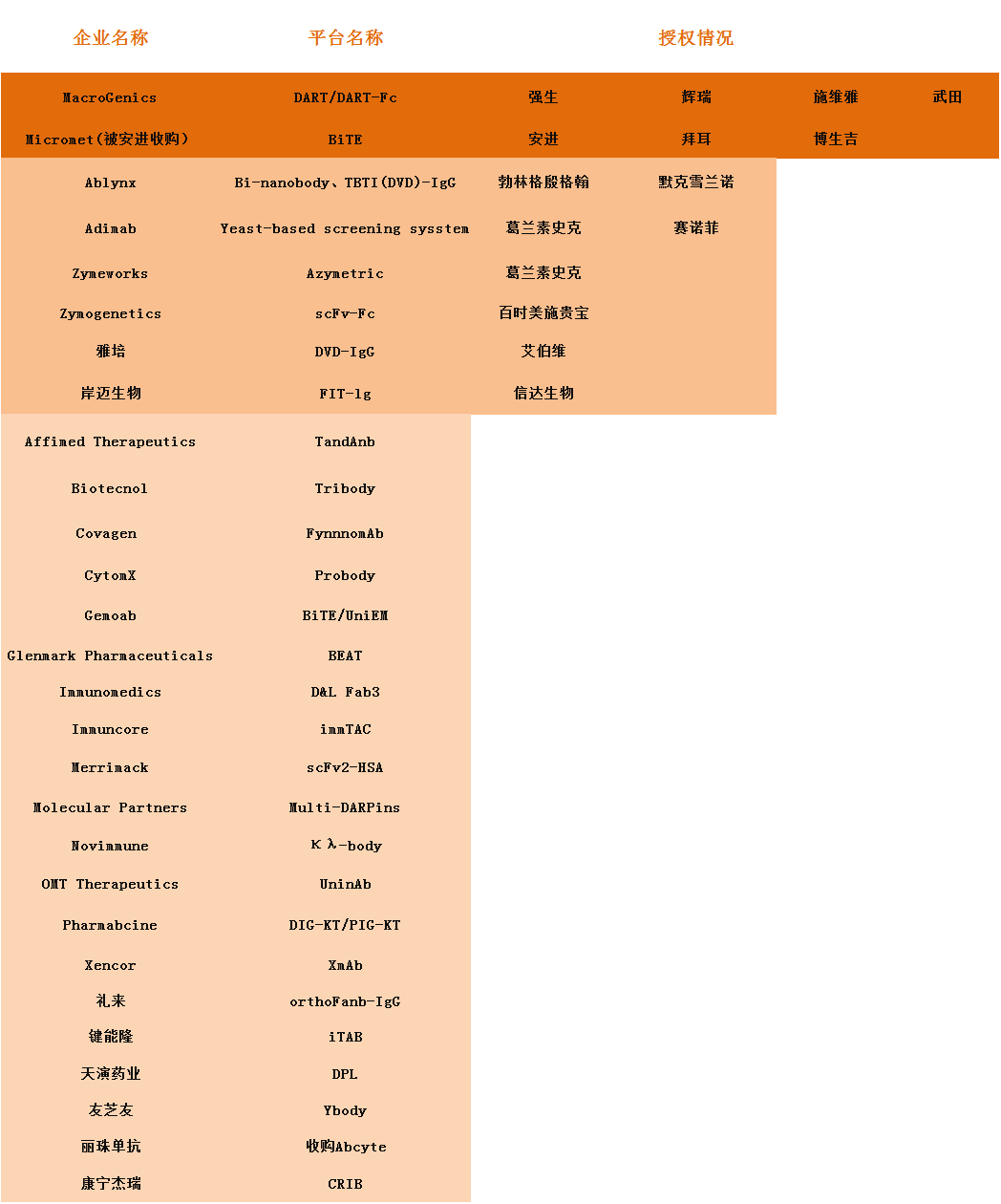
Technical Platform and Licensing Status
Clinical Highlights
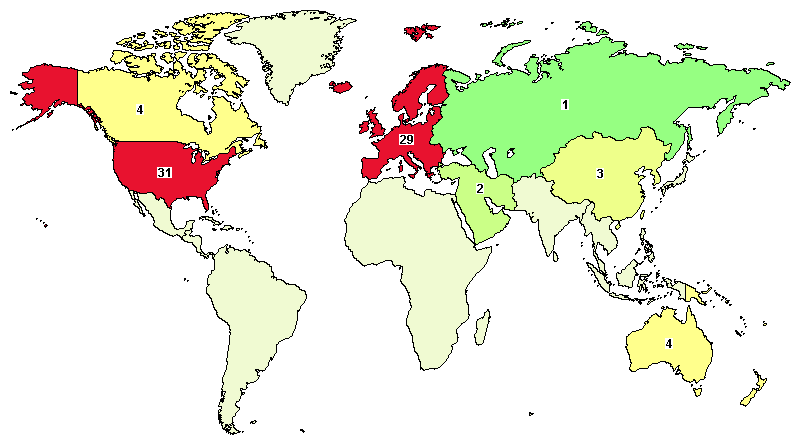
As of September 2017, there were 68 ongoing clinical trials of bispecific antibodies worldwide, with 31 of them conducted in the United States.
Among these projects, nearly all studies are in Phase I and Phase II clinical trials, with the majority either currently recruiting or already completed. To date, a total of 25 projects have been completed, but results have been published for only 10 of them.
Among them, Amgen and the Barbara Ann Karmanos Cancer Institute have the most investigational projects, with seven each; additionally, Roche and MacroGenics each have three; Johnson & Johnson and Merck each have two investigational projects; Pfizer and Eli Lilly each have one project in clinical trials.
Undoubtedly, Amgen is the largest player in the bispecific antibody market. Although Roche does not have the most extensive pipeline of investigational projects, its ACE-910 was once widely regarded by external observers as the most promising drug candidate.
Amgen’s clinical trial of blinatumomab is currently in Phase III, aiming to evaluate its efficacy in leukemia and acute lymphoblastic diseases. The study will verify the safety and effectiveness of blinatumomab by comparing it with conventional chemotherapy agents. The trial is currently recruiting participants and is expected to be completed in 2022.
One of Neovii’s research projects combined Phase II and Phase III clinical trials. The project aimed to evaluate the therapeutic efficacy of catumaxomab (Removab) in EpCAM-positive tumors, such as gastric cancer, colorectal cancer, and breast cancer. The project was initiated in 2004 and completed in 2009; however, the experimental results have not yet been published.
Beyond these global giants, MacroGenics is also a major player in the bispecific antibody field.
In December 2014, Johnson & Johnson entered into a $700 million licensing agreement with MacroGenics to secure global rights to MacroGenics’ bispecific antibody drug (comprising a $125 million upfront payment and $575 million in milestone payments).
Just weeks before Johnson & Johnson reached an agreement, Takeda also signed a $500 million deal with the biotech company to acquire MacroGenics’ preclinical investigational antibody, MGD011. The transaction included a $50 million upfront licensing fee and an additional $75 million to purchase shares of MacroGenics at $39 per share. According to reports at the time, MacroGenics’ stock price surged 16% on the news.
By licensing its technology platform and early-stage molecules, the company has secured licensing partnerships with nearly all pharmaceutical giants engaged in bispecific antibody development. Johnson & Johnson, Takeda, Pfizer, and Servier all utilize MacroGenics’ technology platform, while Merck & Co. entered into an agreement with MacroGenics in 2015 to evaluate combination therapy with Keytruda (Merck’s PD-1 inhibitor).
Domestic Enterprises
There is currently only one clinical trial underway in China: a randomized, controlled clinical study on the treatment of advanced liver cancer using targeted activated CIK cell therapy and bispecific antibody therapy, conducted by Benkang Biopharmaceuticals in collaboration with the 302 Hospital of the Chinese People's Liberation Army. The study is currently in the recruitment phase for its Phase II clinical trial.
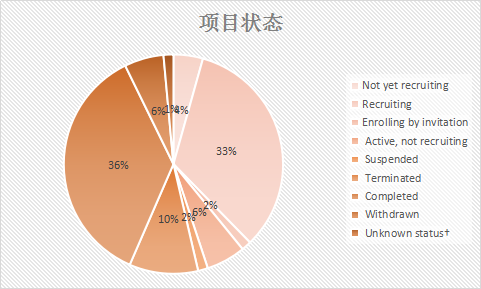
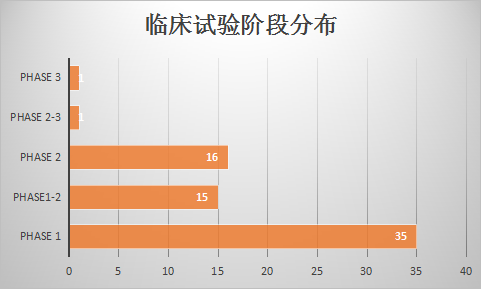
The above data were obtained from ClinicalTrials.gov, which lists clinical trials registered in the United States. VCBeat also searched for information on bispecific antibodies on the Chinese Drug Clinical Trial Registration and Information Publicity Platform, but no domestically registered clinical trial projects have been found to date.
Domestic Enterprises
According to incomplete statistics from VCBeat, there are currently 15 companies in China engaged in the research and development of bispecific antibodies, including two publicly listed companies. In addition to listed companies such as Livzon and Hengrui, as well as companies deeply rooted in the antibody field such as Alphamab Oncology, Innovent Biologics, and Junshi Biosciences, some young startups are also worthy of attention.
Among these companies, YZY Biopharma has the most extensive drug portfolio, with a total of eight candidates. Notably, its HER2/CD3 bispecific antibody for breast cancer has completed druggability studies and pilot-scale process development.
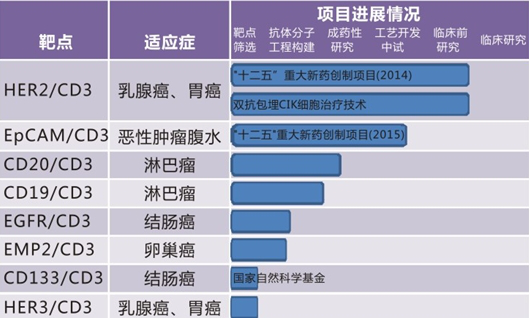
Image from YZY Biopharma's official website
Yzy Biopharma is a high-tech enterprise specializing in the independent innovative research and development of biopharmaceuticals. Its parent company, Yzy Medical, jointly established the Yzy Center for Personalized Medicine with Huazhong University of Science and Technology. The center is directed by Professor Zhou Honghao, an academician of the Chinese Academy of Engineering, who is a leading figure in China’s fields of pharmacogenetics and pharmacogenomics and a prominent advocate of personalized medicine.
Zhou Pengfei, the Company’s Vice Chairman, holds a Ph.D. in Molecular Immunology from McMaster University in Canada and conducted postdoctoral research at the Stanford University School of Medicine Cancer Center. As a leading figure in the development of bispecific antibody drugs in China, Mr. Zhou brings 15 years of experience in immunotherapy, antibody drug R&D, and team management. He previously served as Senior Director of Immunology at Crown Bioscience Inc., Executive Director of the Pfizer-Crown Asia Oncology R&D Center, and Attending Physician in the Department of Surgery at Shenzhen Second People’s Hospital.
Additionally, Vice President Yi Jizu and Director of Antibody R&D Zhang Jiandong each possess over 10 years of experience in the biopharmaceutical industry, having conducted antibody research and development at leading academic institutions and pharmaceutical companies both domestically and internationally.
In terms of team composition, YZY Biopharma boasts an internationally experienced team led by an academician and joined by R&D executives from pharmaceutical giants. In both product pipeline size and development progress, YZY Biopharma is at the forefront of domestic bispecific antibody research and development.
In May 2016, the company completed its Series A financing round led by Panlin Capital (Panlin Capital Equity Investment Fund) and reached a comprehensive cooperation intention with the co-investor, Shenaoji Pharmaceutical.
According to the latest news, YZY Biopharma’s independently developed “Recombinant Humanized Bispecific Antibody against HER2 and CD3 for Injection” (Project Code: M802) received clinical trial approval from the China Food and Drug Administration (CFDA) on September 29, 2017 (Approval Number: 2017L04744). This marks the first independently innovated bispecific antibody in China to enter the clinical development stage, representing a milestone for the country’s entire pharmaceutical innovation industry.
Benkang Biopharma, established in 2015, is primarily engaged in the development of innovative tools and technological solutions for biopharmaceuticals and cell therapy.
The company’s technical team includes R&D talent from industry giants such as Amgen and Bayer. Leveraging the company’s extensive research experience in protein engineering, it has amassed a robust portfolio of tools with the potential to enhance and advance cell therapy technologies. These tools span multiple areas, including bispecific antibody drug development, cell culture protocols, magnetic bead-based cell separation techniques, and cell assays.
There are currently five bispecific antibody drugs, three of which are undergoing clinical trials. With the exception of one trial filed in the United States, the filing locations for the other two trials have not yet been disclosed.
Adagene Inc. was founded in 2012 and is dedicated to the development of next-generation antibody technologies. The company’s co-founder, Dr. Peizhi Luo, is a serial entrepreneur with extensive expertise in antibody development and antibody engineering. He previously co-founded Abmaxis, which was acquired by Merck & Co. (Merck) in 2006. Following the acquisition, Dr. Luo served as Director of Biologics and Head of Antibody Engineering at Merck. Prior to that, he held the position of Chief Scientist at Xencor.
In addition, Li Ge, Chairman of WuXi AppTec, also serves as a director of the company.
Adagene completed two rounds of financing in December 2014 and January 2016, respectively, raising $8 million in Series A and RMB 200 million in Series B. Investors included Fidelity Asia and WuXi AppTec.
In the biopharmaceutical sector, Henlius can be regarded as a “rising star.” Established in December 2009 as a joint venture between Fosun Pharma and a team of U.S. scientists, the company is primarily dedicated to the research, development, and industrialization of monoclonal antibody biosimilars, bio-betters, and innovative monoclonal antibodies using cutting-edge technologies. Leveraging resources from both China and the United States, Henlius has rapidly ascended to the forefront of domestic antibody R&D enterprises within just a few years.
Henlius has successively entered into licensing collaborations with U.S.-based Kolltan Pharmaceuticals and Kite Pharma. Currently, Henlius has 14 monoclonal antibody drugs in its pipeline, including two bispecific antibody drugs (HLX31 and HLX32).
In 2016, the company completed a $19 million financing round led by Huagai Capital, with its valuation exceeding $3 billion.
Among the companies we surveyed, Mabwell is the youngest, yet its explosive growth potential is no less than that of established industry veterans.
Founded in 2016, the company focuses primarily on the research and development of bispecific antibodies in the field of oncology. Its founder, Wu Chenbing, graduated from the University of Georgia in the United States and spent ten years working on antibody R&D at Abbott, where he was the inventor of Abbott’s DVD-Ig bispecific antibody technology platform.
Yumabio’s core technology is its FIT-Ig bispecific antibody development platform, an innovative and highly efficient proprietary platform for developing bispecific antibody products. Based on this platform, the company has entered into a licensing collaboration with Innovent Biologics, under which Innovent will be granted rights to use FIT-Ig in the Chinese market, while Yumabio will receive $120 million in upfront and milestone payments, as well as sales royalties following product commercialization.
Furthermore, leveraging its technological advantages, Biocytogen has successively entered into collaborative development agreements with Kymab and WuXi AppTec.
In April 2017, Aimab Therapeutics secured $25 million in Series A financing, led by Yuanhe Yuandian, with participation from Decheng Capital, Bencao Capital, and Qushi Capital. The company is currently making every effort to advance its existing products toward clinical development, with the first product expected to enter clinical trials in 2018.
Summary:
No one in the innovative drug industry is unconcerned about antibody drugs.Amidst the rapid advancements in pharmaceutical innovation today, antibodies remain an enduring focal point.As a key component of innovative antibodies, bispecific antibodies may also set off a trend in the field of future pharmaceutical innovation.
Finally, to quote a line from the Zhongtai Securities report: “What CAR-T therapy is today, bispecific antibodies will be tomorrow.”