

IHG China and PwC China Forge Strategic Partnership to Co-Build a Value-Based Healthcare Platform
According to VCBeat, on October 17, at the summit forum titled “How to Enter the Healthcare Market?” co-hosted by International Hospitals Group China (IHG China) and PwC China, International Hospitals Group and PwC reached a strategic partnership to jointly build a value-based healthcare platform, providing timely, comprehensive, and in-depth insights into the latest trends and changes in the healthcare industry.
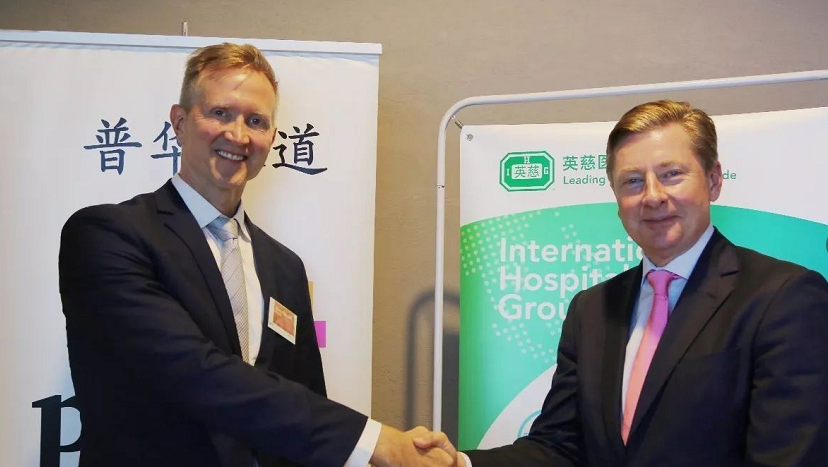
Hertford King, Global CEO of International Healthcare Group (right), and Mark Gilbraith, Partner and Leader of the Healthcare and Pharmaceuticals Industry for PwC China Mainland and Hong Kong
The International Healthcare Group has completed over 480 healthcare projects across 52 countries worldwide, possessing a robust theoretical framework and extensive practical experience in top-level design, process planning, and management operations for healthcare institutions.According to Ralph Dando, Global Development Director of International Medical Group,Not only is China undergoing decentralization reforms in public hospitals, but the entire world is experiencing the deconstruction of traditional hospitals and the integration of healthcare into communities and commercial districts.In this context, Ralph Dando shared architectural design concepts and practical experience in developing new healthcare facilities that integrate residential and commercial real estate.
Wang Yifan, Commercial Director at Yingci Medical, delivered a speech on “How to Build a Hospital Operations Management System.” He proposed that the hospital operational model is transitioning from the previous approach of “managing patients and administering doctors” to the current paradigm of “empowering doctors and managing patients,” reflecting a shift in China’s healthcare sector from focusing on external factors to prioritizing the essence of medical care.Drawing on his extensive experience in hospital operations, he has identified three key modules of hospital management: external operations, which focus on patient acquisition and revenue generation; medical process management, which involves designing streamlined workflows to ensure orderly hospital functioning, facilitate doctor-patient interactions, and create a closed-loop system; and internal operations, which aim to maximize the conversion of revenue into profit while striving to achieve satisfaction among the hospital, physicians, and patients alike.
Xing Liping, Partner in Healthcare Management Consulting at PwC China, provided a detailed interpretation of how to conduct “hospital management and operational process mapping” from a practical implementation perspective.She believes that hospital operations management should center on human resources, finance, and logistics, focusing on four key areas—revenue, costs, assets, and logistics—to optimize resource allocation, facilitate communication and interaction, standardize processes, ensure closed-loop traceability, and support decision-making analysis. For new entrants, she recommends leveraging external expertise to develop a comprehensive strategic plan aligned with their own capabilities, followed by phased implementation.
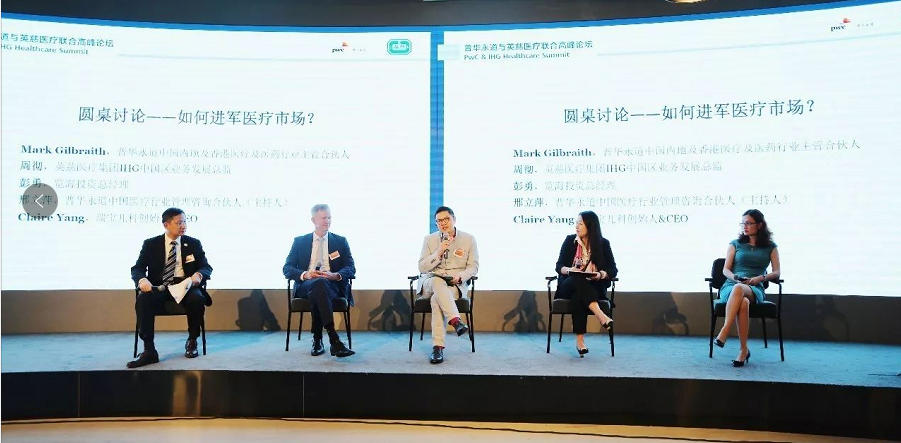
Roundtable Discussion Site
Centered on the topic of “How New Entrants Can Enter the Healthcare Market,” the forum held a roundtable discussion. Mark Gilbraith, Healthcare and Pharmaceuticals Leader for Mainland China and Hong Kong at PwC China; Zhou Che, Director of Business Development at Ince Medical; Yang Weilu, Founder of Ruibao Pediatrics; Peng Yong, General Manager of Lanhai Medical Center; and Xing Liping, Partner in Healthcare Management Consulting at PwC China, each shared their professional experiences and offered recommendations.
Yang Weilu, founder of Ruibao Pediatrics, believes that when engaging in healthcare services, one must first consider policy-related issues. It is essential to thoroughly interpret policies at the national, provincial, municipal, and district levels, ensuring comprehensive consideration from macro to micro perspectives. Regarding marketing strategies for new entrants, her experience suggests delivering an exceptional experience to the first batch of core customers, as building a steady patient flow relies on long-term accumulation of positive word-of-mouth among patients.
Peng Yong, General Manager of Lanhai Medical Center, put forward several novel perspectives. First, he argued that professionals from non-medical industries entering the healthcare sector must first secure competent financial advisors, as the choice of operational model should be dictated by the financial model, which can also “predict how long you can sustain operations.” Second, he urged attention to China’s basic social medical insurance system. From employee and employer contributions to pooled social security funds and final reimbursement, payment models vary across different population groups. Private healthcare providers should not blindly embrace commercial insurance or out-of-pocket payments; rather, many nuances within the social insurance framework present opportunity windows for private practice. Third, Peng asserted that successful healthcare investment requires studying physicians rather than patients, since physicians constitute the core resource in healthcare delivery.
When it comes to doctors, Mark Gilbraith, Partner and Leader of the Healthcare and Pharmaceuticals Industry at PwC China Mainland and Hong Kong, mentioned that he once conducted a survey among 2,000 doctors from large public hospitals in China.One of the conclusions is that the four key factors influencing physicians’ professional well-being are patient volume, patient quality, research resources, and administrative burden in hospitals.
Regarding cross-industry players currently entering the healthcare sector, Zhou Che, Business Development Director at Yingci Medical, summarizes that they can be broadly categorized into two types. The first type positions healthcare as a core future product, hiring hundreds or even thousands of employees in the medical field and entering the sector through mergers and acquisitions or greenfield investments. The second type does not intend to make healthcare its core business in the future; these companies generally adopt a model of co-development through partnerships with professional medical institutions or healthcare consulting firms.The layout strategies of cross-industry entrants are divided into horizontal and vertical approaches. Horizontal integration involves treating healthcare as a new business line that creates synergies with existing operations. Vertical integration entails deploying resources across the upstream and downstream segments of a unified value chain to create an industrial closed loop. Finally, Zhou Che cautions that new entrants must recognize the unique characteristics of the healthcare industry and pay close attention to risks associated with policy, medical practice, and the market.