

Zhang Minming, National Committee Member of Chinese Society of Radiology: Establishing Standardized Databases Is Fundamental and Forward-Looking for AI Development
At the recently concluded 24th National Academic Conference on Radiology of the Chinese Medical Association, doctors and experts in China’s medical imaging field joined forces with Yitu Healthcare, a leading enterprise in China’s medical artificial intelligence sector, to jointly establish standards for AI-based medical imaging.
These medical experts include Professor Liu Shiyuan, Director of the Department of Radiology and Nuclear Medicine at Changzheng Hospital, Second Military Medical University; Professor Chen Min, Director of the Department of Radiology and Director of the Medical Imaging Center at Beijing Hospital; Professor Zhang Minming, Director of the Department of Radiology at the Second Affiliated Hospital of Zhejiang University School of Medicine; Professor Han Ping, Director of the Department of Diagnostic Radiology at Union Hospital, Tongji Medical College, Huazhong University of Science and Technology; Professor Wu Jianlin, Vice President of Zhongshan Hospital Affiliated to Dalian University; and Professor Gong Xiangyang, Director of the Department of Radiology at Zhejiang Provincial People’s Hospital.

Group Photo
How critical are medical imaging standards, and why have they managed to bring together such a distinguished group of experts and physicians from the medical imaging field? What does the establishment of these standards signify for the overall development of artificial intelligence in healthcare across China? Furthermore, how can clinical physicians actively participate in the standard-setting process?
With these questions in mind, we interviewed one of the medical experts, Professor Zhang Minming. The following content is derived from an interview between VCBeat and Professor Zhang Minming, presented in the first person.
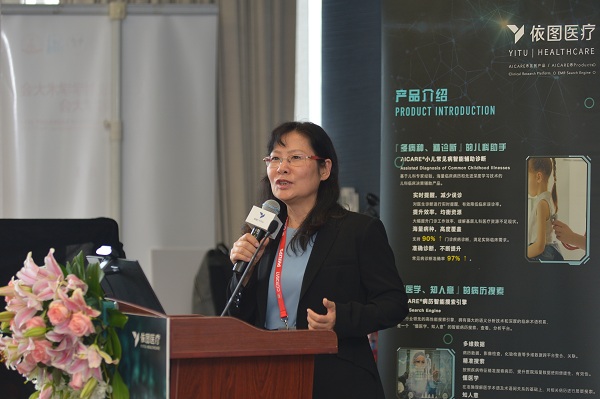
Prof. Zhang Minming
AI Needs a Forward-Looking Standard Database
When companies first embarked on medical artificial intelligence research, most began by downloading or purchasing data from the internet, focusing primarily on modeling and computational methods. So-called medical AI competitions were largely perceived as technical contests, with minimal participation from physicians. Most of us clinicians remained mere spectators, observing from the sidelines.
Furthermore, at that time, the sources of evidence for these companies’ products and the quality of machine learning data were also cause for concern. After all, a poor teacher and a substandard textbook can never produce outstanding students.If a company develops medical AI products without the involvement of clinicians, and fails to formulate questions from a clinical perspective or process data according to clinical needs, its products will lack substance and be impractical for real-world implementation.。The involvement of clinicians and radiologists in the broader wave of artificial intelligence, enabling them to play their proper roles, serves as the central axis and soul that empowers this entire movement.
This role involves formulating clinical questions, establishing criteria for data inclusion, ensuring the quality and standardization of included data, and refining database construction.
Humans are highly complex beings, not limited to binary states of one or zero as in computer programming languages. A critical challenge facing the standardization of medical data in China is thatChina’s healthcare system is highly complex, with each hospital having its own medical specialties, diagnostic and treatment objectives, and image scanning standards.。
Taking lung CT scans as an example, primary care hospitals focus solely on determining whether patients have any pathology, whereas tertiary (Grade 3A) hospitals further identify the specific disease, assess its severity, and formulate subsequent treatment plans. These differing standards result in fundamentally different imaging protocols.
I am highly optimistic about artificial intelligence. I believe that its future development will certainly go beyond simply determining whether a disease is present, but will extend to assessing the benign or malignant nature of diseases, evaluating their severity, and recommending subsequent treatment strategies. However, all of this relies on the foundation of standardized data.
On the other hand,When discussing data standardization, we must first establish a premise by considering the product’s future applications and the specific problems it aims to address.. Rather than blindly pursuing speed and accuracy.
Specifically, companies must first define their objectives and establish standards. These standards are then refined; taking the lungs as an example, this includes specifying CT scan slice thickness, resolution, acquisition protocols, three-dimensional reconstruction, and radiomics. On this basis, large-scale data collection is conducted.
Many artificial intelligence companies are currently focused solely on pulmonary nodules and tumors; however, AI holds tremendous potential in other fields as well, even enabling the discovery of insights beyond our current understanding. For instance, in neurodegenerative diseases, AI models can be built using standardized data to identify preclinical symptoms, helping us detect subtle early-stage changes that are imperceptible to the human eye.
Artificial intelligence’s ability to detect subtle, imperceptible changes and predict disease onset represents an aspirational vision. Should AI advance to that stage, establishing current standards becomes critically important. A comprehensive, macro-level design framework is essential to avoid the need for redundant data collection at each developmental phase.
Since data collection is an arduous process, we must adopt a prospective data collection design to build databases and establish forward-looking industry data standards.
Prospective data standards should encompass multiple types of data.
Taking pulmonary nodules as an example,In addition to standard imaging data, epidemiological data, laboratory test results, and even genetic data are required, along with clinical management data collected during the course of treatment.. If a company possesses such comprehensive data during the R&D process of these products, this AI company holds significant promise; after completing the first step, it can rapidly advance to the second, whereas otherwise, it would need to restart data collection and accumulation from the second step onward.
The establishment of a standard database cannot be achieved by a company alone; it requires the participation of radiologists. This involvement goes beyond merely competing with machines in terms of accuracy and extends to active engagement in the product’s research and development process.
Establishing a standardized database is feasible, not just empty talk.
It is absolutely necessary to establish a standardized database. Experts in this field have the responsibility and obligation to organize and build a large-scale standardized database,The database should encompass data generated by most major hospitals and various hardware companies, while establishing standards to the greatest extent possible for use by artificial intelligence companies in model training.。
Some have dismissed this database as mere talk, but we are already implementing it. We are establishing a standardized database for neurodegenerative brain diseases across multiple centers in Zhejiang Province. Driven by the National Key R&D Program of China’s 13th Five-Year Plan, we have launched research initiatives in more than a dozen hospitals, with participation from neurologists and radiologists. The data are derived from diverse imaging equipment.
We have standardized multimodal imaging scans for neurodegenerative diseases and, across different devices, strive to bridge discrepancies in accordance with this standard.
This database encompasses patients’ disease progression, cognitive assessment procedures, scale scoring processes, brain imaging data, medication histories, and genetic profiles. To date, several thousand cognitively normal elderly individuals from community-based surveys have been enrolled. These participants are currently free of diagnosed diseases. By documenting their lifestyle habits and administering standardized rating scales, we identify their susceptibility to developing conditions. Subsequently, these individuals undergo standard brain scans, followed by prospective longitudinal monitoring to observe disease trajectory. Based on this comprehensive dataset, an artificial intelligence model is constructed to predict the incidence probability in other populations.。
Moreover, given our comprehensive genomic, imaging, and clinical data, we can also investigate the etiology of neurodegenerative diseases, which further amplifies the significance of this work.. The database we have established will serve as a paradigm for database development across various fields of artificial intelligence.
Another point that needs to be emphasized is that our standards must be based on international guidelines, literature, and the opinions of experts with profound clinical knowledge background, so that such standards can be credible.
Data Security and Legal Compliance Cannot Be Overlooked
For all medical big data to be included in research or used for purposes beyond direct patient care, patients must sign an informed consent form; this is their right.
I predict that in the future, if this standard is properly implemented, all patients undergoing hospital examinations will sign informed consent forms authorizing the use of their data for scientific research rather than commercial purposes. Although we have not yet achieved this, international counterparts are already paying attention to this issue.。
Currently, the situation in China’s industry is that although clear regulations have not yet been issued, we perform de-identification during scientific research by removing personal information and replacing it with codes, while retaining clinical data for research purposes. The current point of contention is whether name constitutes sensitive information; furthermore, it remains undefined whether age, lifestyle habits, gender, and geographic location are considered sensitive information. However, removing such data would significantly impact scientific research.
In general, medicine is a highly complex discipline involving legal, ethical, and technical aspects. Therefore, to effectively manage this endeavor, an authoritative body should establish standards for big data development after thorough deliberation and consultation.
The establishment of the database may require the joint participation of the government, hospitals, and enterprises.
As with all major top-tier tertiary hospitals across China, it is highly challenging for our hospital to vet and approve enterprises for entry. Companies are required to sign a series of agreements, including non-disclosure agreements and data usage protocols; the higher the quality of the data accessed, the stricter the entry thresholds. Corporate use of data requires approval from multiple departments, such as the Medical Affairs Department and the IT Department, and must be discussed and approved by the Hospital Administration Committee. Furthermore, data is strictly prohibited from leaving the hospital premises. Yitu Technology gained access to our hospital only after passing through rigorous layers of review, and its system has now entered the promotion phase. Additionally, while building a comprehensive database requires data input from multiple hospitals to ultimately achieve data sharing, other institutions may be reluctant to participate. In such cases, top-level design and coordination are essential.
I aim to establish a coalition-like organization that, under government authorization or endorsement, sets up an institution akin to a data bank. Under this framework, hospitals would be required to share their data, with ownership vested in the coalition, while enterprises could access high-quality big data from the data bank.
Our collaboration with Yitu Technology was also a decision made after careful consideration. Yitu has its own technical background and moves quickly; at times, we even struggle to keep up with their pace. Furthermore, as a corporate entity, Yitu possesses stronger capabilities in translating scientific research into practical applications than we do. However, it is not driven by an urgent need for profit but rather by a commitment to product excellence, which is precisely why our partnership has been viable.
This database may have initially received government support, but its maintenance requires corporate backing. It is important to emphasize that the establishment of this database should be driven by public welfare and scientific research objectives. In the future, the database may become publicly accessible, similar to international open-access databases. Alternatively, companies involved in creating the database might receive free trial access, while other enterprises pay for usage; however, any fees charged would solely aim to sustain the database’s operations.
"The larger the sample size, the more accurate the results."
From a statistical perspective, the larger the sample size, the smaller the error. If an enterprise has access to precise data, a smaller sample size may suffice; however, if the data are not precise, the enterprise must expand its sample size. Therefore, it cannot be categorically stated that system implementation is entirely infeasible for enterprises in the absence of a standardized database. Nevertheless, pursuing this approach requires continuous expansion of the sample size and demands substantial effort.
Additionally, I am a researcher.There is a discrepancy between scientific research and real-world practice. It is undeniable that large sample sizes and diverse data sources can more accurately simulate real-world conditions. While researchers aim to eliminate numerous confounding factors during studies, such factors cannot be removed in real-world settings.. Determining which factors should be excluded and which should be retained requires decisions by experts and frontline clinicians, or even the conduct of controlled experiments. Overall, the establishment of standardized databases plays a foundational and forward-looking role in the development of artificial intelligence.