

Shanggong Yixin Expands AI-Driven Multi-Disease Diagnostic Ecosystem Following $10M+ Pre-A Round
“Fundus photography is used solely for diagnosing diabetic retinopathy—this perception is far too narrow. The retina (fundus) is the only tissue in the entire body where various types of blood vessels can be directly observed with the naked eye.” Ji Xin, CEO of ShangGong YiXin, raised his voice slightly when discussing the role of fundus imaging.
In addition to diabetic retinopathy, fundus images can be used in the study of various other diseases.
Hypertension: Retinopathy is a key indicator in the study of hypertension;
Coronary Heart Disease: Changes in retinal vessel diameter are an independent risk factor for coronary heart disease;
Stroke: Changes in retinal microvasculature can predict the occurrence of stroke;
Kidney Disease: Retinal Vasculopathy Reflects the Risk of Kidney Disease;
Cerebral Small Vessel Disease: Combining Retinal Vascular Changes with Other Markers Helps Assess the Severity of Cerebral Small Vessel Disease...
Beyond diabetic retinopathy, Shangong Yixin leverages fundus imaging and AI technology to study conditions such as glaucoma, cataracts, stroke, and hypertension. Its product, “Shangong Huiyan,” has been deployed in over 300 hospitals across more than 20 provinces in China, including more than 100 tertiary hospitals. Currently, it screens over 30,000 individuals per month, featuring a highly distinctive business model.
Recently, Shangong Yixin secured tens of millions of RMB in Pre-A round financing from KIP Partners and Demao Capital. In light of this, VCBeat conducted an exclusive interview with Ji Xin, CEO of Shangong Yixin, to gain insights into the company’s development strategy.
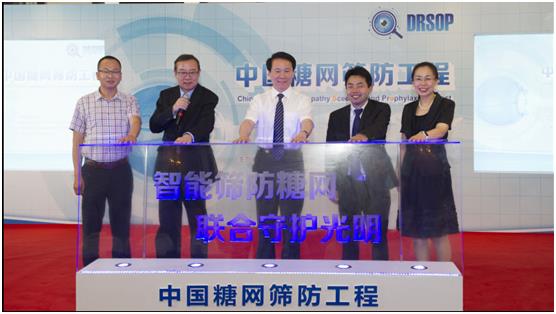
Beijing Tongren Hospital Endorses and Supports Their Project
Before embarking on his entrepreneurial journey, Ji Xin served as the Marketing Manager at Novo Nordisk (China), where he was responsible for market education initiatives in the field of diabetes. His experience at Novo Nordisk enabled him to recognize the substantial market potential and critical industry pain points associated with diabetes and its complications, particularly in the screening of diabetic retinopathy.Over the past decade, many endocrinology departments in hospitals across China have expressed willingness to implement screening for diabetic retinopathy. Furthermore, diabetes-related clinical practice guidelines explicitly mandate such screening. However, progress has been stalled due to difficulties faced by endocrinologists in interpreting fundus images and insufficient patient awareness of screening. Consequently, the screening rate for diabetic retinopathy remains generally below 10%, with some regions reporting rates of less than 5%.。
Ji Xin emphasized, “Screening for diabetic retinopathy has clear clinical guidelines and is feasible in practice; the main challenge lies in physicians’ interpretation of fundus images. Diabetes management falls under the purview of endocrinology, whereas fundus screening is the responsibility of ophthalmology. However, most of China’s more than 30,000 ophthalmologists are occupied with treating established ocular diseases, leaving very few dedicated to screening.”
Therefore, the Department of Endocrinology wishes to assign fundus screening tasks to the Department of Ophthalmology; however, ophthalmologists simply do not have the time to undertake this work.“Endocrinologists, constrained by technical limitations, typically identify and treat patients only when overt pathological changes are present, by which time it is often too late. Therefore, when we launched the project in 2014, our approach was to leverage computer algorithms to simulate ophthalmology specialists, assisting endocrinologists in interpreting retinal images. This strategy aims to address the shortage of ophthalmologists and the limited experience of endocrinologists in fundus image interpretation.”
After conceiving the entrepreneurial idea, Ji Xin and his colleague Wang Zhijun (currently Deputy General Manager of Shanggong Medical Information) began establishing Shanggong Medical Information. Wang Zhijun also recruited his high school classmate, Dr. Kang Hong, an expert in deep learning and database technologies, among others.
Furthermore, leveraging their extensive experience in the healthcare industry, the Shangong Yixin team prioritized the integration of clinical medical technology and applications from the very inception of their venture. They engaged in discussions with Professor Wang Ningli, Director of Beijing Tongren Hospital. The hospital strongly endorsed and supported the application of artificial intelligence for the automated analysis of ophthalmic medical images, leading to a rapid consensus between the two parties. With Professor Wang serving as the lead for clinical technology, the collaboration initially focused on diabetic retinopathy. Beijing Tongren Hospital was responsible for assembling a team of ophthalmology experts and designing the clinical technical pathway for the project, while Shangong Yixin was tasked with developing AI algorithms, building a cloud-based platform for diabetic retinopathy screening, and handling market promotion and platform operations.
The reason why both parties were able to quickly reach a consensus,This is because guidelines were established over a decade ago, aiming to assign ophthalmology departments the responsibility for screening diabetic retinopathy. However, actual implementation has been suboptimal, primarily due to a shortage of ophthalmologists and insufficient image interpretation experience among endocrinologists.. Therefore, the screening rate for diabetic retinopathy has remained consistently low. Experts now hope that computer-aided diagnosis can help address the issue of fundus screening for diabetic retinopathy.
The intended users of the system are endocrinologists.
After several years of research, ShangGong YiXin’s “Huiyan Tangwang” product now achieves a diagnostic concordance rate exceeding 95% and has been deployed on a large commercial scale. The solution is designed for endocrinologists. Endocrinology departments purchase a non-mydriatic fundus camera from ShangGong YiXin. Using this device, physicians and nurses capture images of patients’ fundi. These fundus images are then uploaded to ShangGong YiXin’s servers, where they undergo automated analysis by the AutoEye screening system. A report is generated and transmitted back to the hospital’s computer terminals for physician reference.
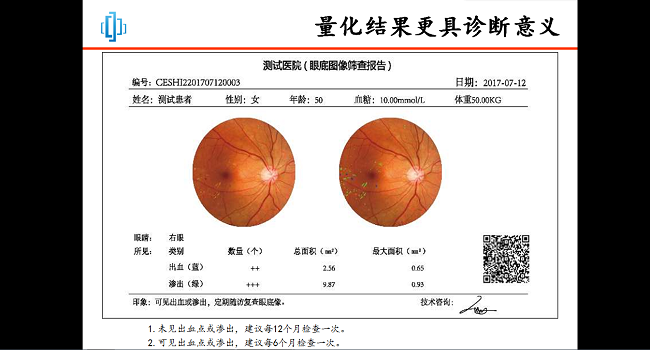
Ji Xin introduced that this report provides both qualitative and quantitative analyses of lesions, marking information such as location, number, and area, and categorizes patients based on these results. Currently, guided by ophthalmology experts and informed by clinical experience and practical needs in endocrinology, Shangong Yixin classifies diabetic retinopathy into three categories: healthy with no lesions, mild lesions not requiring referral to ophthalmology, and moderate-to-severe lesions requiring referral to ophthalmology. Ji Xin stated that the primary purpose of this classification is to assist endocrinologists who are not ophthalmology specialists; they are more concerned with the clinical significance behind the classification and what actions they should take following the categorization.
Therefore, endocrinologists directly follow up with subsequent re-examinations or treatments in accordance with the classification recommendations from Shang Gong Yi Xin.
Ji Xin further added that an intelligent diagnostic system currently under development by Shangong Yixin for primary care ophthalmologists classifies lesions into five categories in accordance with clinical ophthalmology standards, with the product expected to launch in 2018. He believes that clinical medicine is highly complex and that product design should be adjusted based on real-world conditions to better align with users’ habits and capabilities.
In addition, in real-world clinical practice, 10%–15% of healthcare institutions are unable to generate reports because the fundus images they capture are unusable due to limitations in technical capabilities. To address this issue, ShangGong YiXin has engaged ophthalmology experts and physicians from Beijing Tongren Hospital to conduct secondary reviews.
The system originates from clinical practice and is applied in clinical settings.
Regarding the product advantages of Shanggong Yixin, Ji Xin stated that there are no fewer than 20 enterprises and research institutions in China currently conducting research on AI-based fundus screening for diabetic retinopathy. In recent years, the open-sourcing of AI technologies has made it easier to build algorithmic models. However, the real challenge lies in transforming technology into mature products that are not only accepted by clinicians but also preferred in their daily practice. The development of Shanggong Yixin’s system is grounded in actual clinical needs and has been validated by clinicians.
Initially, the data used by ShangGong YiXin to train its models came from public datasets and Beijing Tongren Hospital. While the experimental results appeared impressive, the clinical outcomes were unsatisfactory. Subsequently, the company began incorporating clinical data from various regions to make the system more practical and adaptable. It can be stated that ShangGong YiXin’s intelligent diagnostic system has undergone clinical validation across multiple hospitals of different tiers and in diverse geographic locations. It originates from clinical practice, is developed through clinical insights, and is applied in clinical settings.
Deployed in 300 hospitals and already commercialized on a large scale.
Currently, Shangong Yixin’s “Huiyan Tangwang” product has covered more than 20 provinces across China, with nearly 300 hospitals having implemented it in clinical practice, including over 100 tertiary hospitals. In most provinces, the hospitals where the chairpersons or vice-chairpersons of the diabetes committees are based have become provincial demonstration centers for diabetic retinopathy screening. More than 250,000 fundus images have been uploaded to the Shangong Yixin database, with a monthly increase of overPassGrowing at a rate of 60,000 sheets.
Ji Xin stated that the 1.0 version of Shangong Yixin’s “Huiyan Tangwang” has obtained China’s Class II medical device certification, and the new product is currently in the application process.
Shanggong Yixin’s diabetic retinopathy product line has achieved maturity in both technology and commercialization, with a well-established business model. Starting from diabetic retinopathy screening, the company expands into comprehensive screening for diabetes and its complications, as well as chronic disease management. In certain provinces, Shanggong Yixin has collaborated with government agencies, healthcare institutions, and enterprises to build screening and management platforms for diabetes and its complications, using diabetic retinopathy screening as the entry point. This process has given rise to diverse business models. For the diabetic retinopathy product line, Shanggong Yixin’s strategic focus has shifted from AI-based diagnosis to comprehensive management services for diabetic patients.
Regarding future development, Ji Xin stated that the company’s product portfolio for diabetic retinopathy is now relatively mature. Upcoming products include ophthalmic solutions such as “Huiyan Cataract” and “Huiyan Glaucoma,” as well as cardiovascular and cerebrovascular offerings like “Huiyan Stroke” and “Huiyan Coronary Heart Disease.” Meanwhile, Shangong Yixin has established collaborations with physical examination centers, pharmacies, pharmaceutical companies, fundus camera manufacturers, and Hospital Information System (HIS) vendors. The company is piloting various business models, including comprehensive screening for diabetic complications, supportive services for drug research and development, big data monitoring for diabetes, and tiered diagnosis and treatment for diabetes and ophthalmic diseases.
Ji Xin stated, “At the clinical technology level, ShangGong YiXin has partnered with top-tier domestic ophthalmic hospitals and research institutions, such as Beijing Tongren Hospital and Zhongshan Ophthalmic Center, to promote the clinical application of AI technologies in ophthalmology. At the technical level, it is collaborating with multinational corporations like Intel and Canon to upgrade AI processors and medical hardware products. In terms of the clinical application of pharmaceutical big data, it has engaged in commercial co-marketing collaborations with the multinational pharmaceutical company Merck.”