

Hangzhou G20 Venue to Host Inaugural International Intelligent Medical Conference (IIMC) with Over 1,000 Industry Leaders and 100+ Organizations
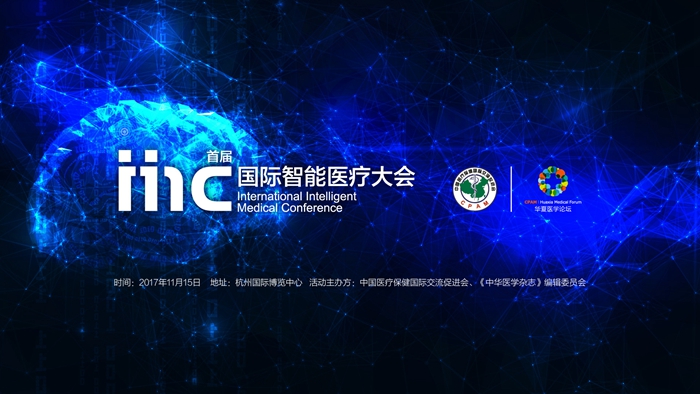
Recently, reporters learned from the Organizing Committee of the International Conference on Intelligent Healthcare that the venue for the inaugural International Conference on Intelligent Healthcare, jointly hosted by the China International Exchange and Promotion Association for Medical and Health Care, the Editorial Board of the Chinese Medical Journal, Zhejiang University, and other institutions, has been selected. The conference will be held on November 15, 2017, at the G20 Summit venue in Hangzhou, China. The official website of the conference (http://theiimc.bagevent.com) and registration for attendance are now officially open.
To date, over 100 dignitaries from government, industry, and investment sectors across multiple countries and regions—including mainland China, the United States, Russia, and Hong Kong, China—have attended the conference and delivered keynote addresses. This is currently the highest-level smart healthcare conference held in China.
Artificial intelligence has become a strategic focal point in international competition. In 2017, “artificial intelligence” was included for the first time in the Government Work Report, and on July 20, the State Council released the Development Plan for New-Generation Artificial Intelligence, outlining China’s “roadmap” for the development of new-generation AI toward 2030. Over the past year, AI products and startups in the healthcare sector—widely recognized as the largest application scenario for AI technology—have experienced explosive growth globally.
To this end, the conference proposed centering on “research, technology, and applications in smart healthcare,” striving to build China’s most influential and credible intellectual platform, governance platform, and industry enhancement and promotion platform in the field of smart healthcare. Guided by the two themes of academic leadership and industry innovation, the inaugural conference attracted more than 1,000 participants—including academicians, experts, investment institutions, and corporate representatives from government, industry associations, medicine, technology, and investment sectors—for exchanges and dialogue, with over 100 industry organizations participating.
According to reports, the inaugural conference showcased four major highlights in its theme and agenda design, reflecting the event’s authority and international character through the selection of speakers and the formulation of conference topics.
The conference has become a “grand mobilization” in the field of international intelligent healthcare. More than ten academicians in medicine and computer science from the Chinese Academy of Sciences, the Chinese Academy of Engineering, and the U.S. National Academy of Engineering were invited to deliver keynote speeches. Presidents (or deans) of Carnegie Mellon University, Saint Petersburg State University, and Zhejiang University—renowned institutions in the fields of medicine and artificial intelligence—will engage in an international dialogue at the event.
The conference has become a “manifesto” for China’s intelligent healthcare industry. As artificial intelligence algorithms continue to achieve breakthroughs, the accumulation of data and advantages rooted in application scenarios will provide China’s intelligent healthcare sector with an opportunity to leapfrog competitors by taking a different path. At the conference, the first industry organization for intelligent healthcare in China, the “Medical Artificial Intelligence Alliance,” will be announced. As a national, social, and industry-oriented non-profit consortium dedicated to conducting research, developing technologies, managing data, and promoting applications in medical AI, the alliance is committed to fostering continuous innovation in medical artificial intelligence.
The conference will serve as a “bellwether” for China’s intelligent healthcare industry. As competition in artificial intelligence intensifies, the concepts of “AI First” and “AI + software + hardware” have become models embraced by tech giants such as Google. These concepts and trends are also poised to be validated within China’s intelligent healthcare sector. It is reported that China’s first intelligent healthcare strategy based on the “AI + software + hardware” model will be unveiled at the conference, with family-centric intelligent healthcare terminals making their debut.
The conference will also serve as an “expo” for China’s intelligent healthcare industry. To showcase the development achievements and advanced experience of the intelligent healthcare sector both domestically and internationally, an Interactive Exhibition on Intelligent Healthcare was held concurrently with the conference. The event invited participation from leading intelligent healthcare enterprises at home and abroad, including Tencent, Cloud Medx, and WeDoctor. In the experience zone, attendees will have the opportunity to engage with cutting-edge AI-driven medical innovations and products, such as surgical robots, 3D printing technologies, telemedicine solutions, and intelligent healthcare terminals.
Notably, the conference also hosted a Smart Healthcare Investment and Financing Summit, jointly participated by investment communities from China and Silicon Valley, USA. Experts in medical artificial intelligence and investors from China and the United States will jointly discuss the achievements of AI technology applications in the healthcare sector and trends in industrial investment. Investment institutions from both countries will sign agreements to establish an industrial investment fund to promote the development of the smart healthcare industry. Meanwhile, the Huaxia Medical Artificial Intelligence Special Fund and the Huaxia Medical Artificial Intelligence Special Award will also be launched at the event.
It is reported that the conference was hosted by the International Exchange and Promotion Association of Medical Health Care and the Editorial Board of the Chinese Medical Journal, co-hosted by Zhejiang University, organized by the Internet Healthcare Branch of the International Exchange and Promotion Association of Medical Health Care and WeDoctor, with the ZJU Ruiyi Artificial Intelligence Research Center, an internationally leading intelligent medical research institution, serving as a supporting organization.