

Medical Robotics in 2017: $2.2B in Annual Funding, Steady Growth in Surgical, Service, and Rehabilitation Robots, with 'Commercialization' as the Key Theme
In 2017, the most appropriate keyword for the medical robotics industry was “Localization and R&D” of domestically produced robots. To ensure comprehensive coverage, VCBeat entered the keyword “medical robots” into Baidu News, OFweek Robotics Network, VCBeat, and several other media outlets focusing on medical robotics to screen all news related to medical robots in 2017.
We have observed that certain surgical and service robots are gradually being deployed in clinical practice. In September and October, there was a significant surge in news reports regarding surgeries performed using Tinavi’s “Tiandi” orthopedic surgical robot across various regions in China. Notably, these deployments were not confined to developed areas such as Beijing, Shanghai, and Guangzhou, but extended to regions including Sichuan, Karamay in Xinjiang, Jiangmen, and Foshan. This indicates that the robot has moved beyond the laboratory settings of major hospitals in Beijing and is now entering the broader market.
With the assistance of artificial intelligence, medical guidance robots, medication dispensing robots, and intelligent consultation robots are also being deployed in tertiary Grade A hospitals and rural hospitals.
In June this year, the Outpatient Department of Anhui Provincial Hospital deployed two iFlytek intelligent medical guide robots named “Xiaoyi.”
In September this year, Jingde County in Xuancheng City, Anhui Province, deployed nine general practitioner assistant robots developed by Jinglun Century, marking the first pilot of robot-assisted healthcare in village-level medical institutions across China.
In May this year, Shanghai TiMi Robot completed a RMB 40 million Series A financing round. The medical service robots developed by TiMi Robot can be used as nursing robots in hospital settings to handle logistics and guidance tasks in medical scenarios...
Progress in the R&D of rehabilitation robots is encouraging. Jianjiao Technology announced a RMB 30 million Pre-A financing round in April this year, and Ruihan Medical revealed an RMB 8 million angel financing round in May...
While reviewing news related to medical robots in 2017, VCBeat also discovered an interesting phenomenon:In the first half of the year, news coverage predominantly focused on two themes: one highlighting the advanced technology of the da Vinci Surgical System as it performed procedures at a certain hospital, and the other emphasizing the promising outlook for the medical robotics industry.
In the second half of the year, particularly in September and October, two major developments occurred in the medical robotics sector: one was the deployment of domestically produced surgical robots (such as Tiangji) and service robots across various regions; the other was the significant advancement of various types of robots facilitated by artificial intelligence technologies.。
What specific changes are occurring in medical robotics? How far behind are Chinese robots in various fields from “catching up with the UK and surpassing the US”? What major events have taken place? VCBeat attempts to provide an analysis for you.
Medical Robot Financing
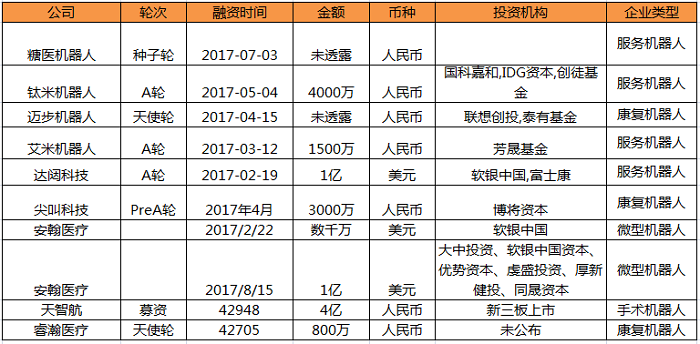
Last year, when VCBeat compiled its 2016 review, a total of four companies secured financing: Baihui Weikang (surgical robots), Timi Robot, CloudMinds, and Libin Medical Technology Company. Most of these deals were seed or Series A rounds. Except for CloudMinds’ $30 million raise, the others were in the tens of millions of RMB range, totaling RMB 200 million. The sectors involved included surgical robots and service robots.
This year, medical robotics companies have experienced rapid growth. The seven companies that secured financing, together with Tinavi Medical Technologies, raised approximately RMB 1.5 billion in total. Excluding the large funding rounds of Tinavi Medical Technologies, Ankon Medical, and CloudMinds, the financing amount for medical robotics companies still exceeded RMB 100 million. These funded companies operate in various fields, including surgical robots, service robots, and rehabilitation robots (exoskeleton robots).)。
Notably, in the field of rehabilitation robotics, three companies announced financing rounds this year: Maibu Robotics’ angel round, Ruihan’s angel round, and Jianjiao Technology’s Pre-A round.。
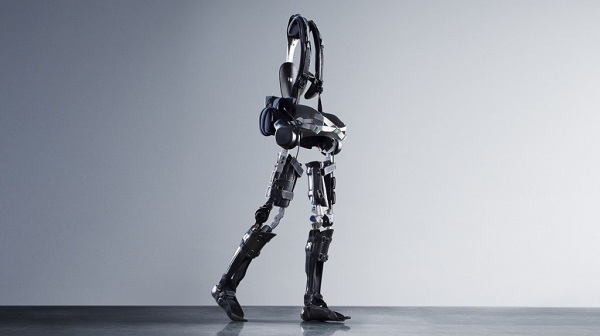
According to VCBeat, the performance of domestically produced exoskeleton robots is rapidly catching up with foreign counterparts, aided by AI. For instance, due to shorter R&D cycles, the price of Chinese products is expected to be only half that of foreign ones. In addition, the R&D cycle for rehabilitation robots is relatively shorter than that for surgical robots, and they only require Class II medical device certification for hospital entry, resulting in a lower barrier to market entry. Therefore, commercial deployment in the coming years is expected to be very promising.
Top 10 Events in China's Medical Robotics Industry
January 2017
The “Priority Review Procedures for Medical Devices” came into effect on January 1, 2017. Priority review is implemented for registration applications of certain Class III domestic medical devices and Class II and III imported medical devices that demonstrate significant clinical advantages, such as those used for diagnosing or treating rare diseases, malignant tumors, diseases specific to or prevalent among the elderly, and pediatric medical devices. This initiative will provide a strong impetus for the rapid adoption of high-quality medical devices across various categories.
February 2017
The international academic journal Small published the latest achievement of the Micro-Nano Research Group at the Shenyang Institute of Automation, Chinese Academy of Sciences, in the interdisciplinary field of microrobotics and biomedicine, titled “A New Method for 3D Biomanufacturing of Microtissues,” as a cover article.
The advent of nanorobots may bring new breakthroughs to new drug development. Relevant researchers need to further intensify the research and development of nanorobots, making their “eyes” sharper, so as to better serve the development of new drugs.
March 2017
China’s First Da Vinci Surgical Robot International Training Center Opens at Changhai Hospital of the Second Military Medical University, with an Annual Training Capacity of 500 Participants.
Surgical robots represent the most advanced surgical technology available today; however, as the installed base of surgical robotic systems and the volume of robot-assisted procedures continue to rise, there is an increasing shortage of surgeons qualified to operate them. These surgeons typically must undergo systematic training and rigorous certification before they are credentialed for clinical practice.
Previously, training had to be conducted overseas, characterized by long durations, high costs, and significant challenges, which severely constrained the application of this cutting-edge technology. The inauguration of the Da Vinci Surgical Robot International Training Center will fill the domestic gap in robotic surgery training, eliminating the previous inconvenience that forced Chinese physicians to seek training abroad. It will also help China accumulate experience in this field. The Changhai Hospital Training Center is expected to train more than 500 individuals annually.
April 2017
Jianjiao Technology secured RMB 30 million in Pre-A financing, marking the largest funding round in China’s rehabilitation robotics (exoskeleton robotics) sector. This year has witnessed rapid development in exoskeleton robotics. In addition to Jianjiao Technology, companies such as MileBot and Chengtian Technology are actively engaged in research within this field, with most firms still at the clinical validation stage.
May 2017
Titanium M Robot Completes $40 Million Series A Funding, Will Continue to Launch Multiple Specialized Medical Service Robots; This Is the Largest Financing Deal in China’s Service Robotics Sector This Year.
August 2017
Anhan Medical Secures $100 Million in Investment
Anhan’s gastroscopy is the only capsule endoscopy system in China to have received Class III medical device certification from the CFDA. Currently, Anhan’s capsule endoscopy robot has been deployed in nearly 1,000 medical institutions across 30 provinces and municipalities throughout China.
Medical robotics company Tinavi plans to raise RMB 400 million, with deployments this year in multiple regions including Xinjiang, Sichuan, and Guangdong.
Surgical robot company Tinavi Medical Technologies announced that it plans to issue no more than 30.1234 million shares at a price of RMB 13.26 per share, raising no more than RMB 400 million.
The announcement revealed that RMB 110 million of the funds raised will be allocated to the research and development, market promotion, and enhancement of clinical service capabilities for surgical robots; RMB 135 million will be used for the construction of production bases; RMB 15.3 million will be designated for establishing subsidiaries; and RMB 135 million will be directed toward equity investment and mergers and acquisitions.
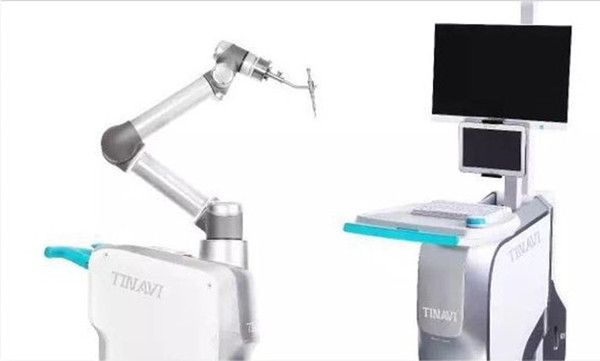
To date, Tinavi’s third-generation general-purpose orthopedic robot, TiRobot, has completed the formulation of product standards, passed medical device product testing, and received approval through the China Food and Drug Administration’s (CFDA) “Special Approval Procedure for Innovative Medical Devices,” becoming the only surgical robot product to enter this special approval pathway. On November 14, 2016, the Tianji Orthopedic Surgical Robot obtained its CFDA registration certificate.
According to news released in September and October, Tinavi’s “Tiandi” orthopedic surgical robot has been deployed in Sichuan, Karamay (Xinjiang), Jiangmen, and Foshan, assisting physicians in performing orthopedic surgeries.
Compared with the first two generations, the third-generation “Tianji” orthopedic robot not only offers higher precision but also accepts images obtained from real-time (360-degree) scanning by a 3D C-arm in the operating room. It updates data in real time based on the initially planned surgical “trajectory,” and even if the patient’s position changes, it can replan the most optimal surgical “trajectory.”
As the first company in China to commercialize medical robot products, Tinavi has undergone a long development journey. Its orthopedic surgical robot received China’s first medical robot registration certificate in 2010. According to international standards, the process from R&D to product commercialization and obtaining registration certification typically takes three to five years; Tinavi spent five years, from initiating R&D in 2005 to securing the certificate in 2010.
Medical robotics only enter the market cultivation phase after regulatory approval, followed by scaling, at which point profitability may be achieved.
Financial data show that in 2016, Tinavi Medical Technologies Co., Ltd. achieved operating revenue of RMB 26 million, a year-on-year increase of 7%; the company incurred a net loss of RMB 25 million for the full year, representing an 80% year-on-year widening; and its gross profit margin stood at 44%, basically flat compared with the previous year.
As the new generation of products is rolled out across China and does not directly compete with the da Vinci Surgical System, revenue in 2017 will see further growth.
On September 1, Tinavi Medical Technologies released its 2017 semi-annual report, which showed that as of June 30, 2017, the company’s operating revenue for the first half of the year reached RMB 21.9582 million, representing a year-on-year increase of 76.53%; net profit attributable to shareholders of the listed company amounted to RMB 1.4264 million, marking a turnaround from loss to profit compared with the same period last year.
September 2017
Midea and Guangzhou Pharmaceutical Holdings Join Forces to Enter Medical Robotics and Automated Pharmacy Sectors
The two companies will engage in multi-dimensional collaboration across specialized sectors, including robotics and medical device development, health data applications, intelligent supply chain construction, healthcare investment, and smart manufacturing. They will explore achieving technological breakthroughs, product innovation, cross-boundary services, and business model optimization through measures such as jointly establishing innovation R&D platforms, incubating startups, conducting joint project research, and setting up industry funds and joint ventures.
September 2017
China’s First Mind-Controlled, Brain-Operated Lower Limb Exoskeleton Rehabilitation Robot Debuts
This robot was developed by Professor Xu Guanghua’s team at Xi’an Jiaotong University. The device assists patients in walking with a biomimetic gait that mimics normal human movement, facilitating rehabilitation training and gait correction while adapting to various terrain conditions. Equipped with a helmet-based system, it detects the patient’s neural signals and transmits them to the exoskeleton rehabilitation robot. The robot then acts on the patient’s intentions, enabling them to stand and walk.
September 2017
The World’s First Autonomous Dental Implant Surgery Robot Debuts
The Department of Implant Dentistry at the Stomatological Hospital of Air Force Medical University (formerly the Fourth Military Medical University) in Xi’an successfully placed two dental implants in a female patient with missing teeth, utilizing China’s domestically produced world-first autonomous dental implant surgical robot.
This robot was jointly developed by the School of Stomatology, Air Force Medical University, and the Institute of Robotics, Beihang University. The team designed an active dental implant robot configuration capable of performing surgical procedures with flexibility within the confined space of the oral cavity. They also pioneered the world’s first integrated software system for dental implant planning, surgical navigation, and robotic control, thereby enabling precise preoperative planning, real-time intraoperative navigation, and automated robotic control.
The surgeon only needs to plan ahead; during the procedure, the surgeon quietly observes the computer monitor while all actions are performed by the robot in front of them.
From November 25 to November 26, the 2017 World Robot Conference will be held in Shenzhen. We hope that more major events and news reports will emerge at that time.
Development of AI-Assisted Medical Robots
In 2017, artificial intelligence seemed to be ubiquitous. With the assistance of AI, triage robots, diagnostic support robots, exoskeleton robots, and surgical robots experienced rapid development.
AtRegarding triage robots, in June this year, the Outpatient Department of Anhui Provincial Hospital also deployed two iFlytek intelligent medical guide robots named "Xiao Yi."
In less than two months, Xiao Yi has enabled physician schedule inquiries across 47 departments, navigation to 618 locations and 607 functional sites, as well as queries regarding operating hours for 227 locations and answers to 260 frequently asked questions, with the accuracy rate of responses improving from an initial 81% to 90.81%.
With the assistance of AI,Auxiliary Diagnostic Robots Begin to Be DeployedFor instance, Jinglun Century’s AI-assisted diagnostic robots have been piloted in Jingde County, Xuancheng City, Anhui Province. The technological core of these assisted-diagnosis robots lies not in the hardware but in the embedded AI-assisted diagnostic system or expert system. The deployment of such products will support the development of primary-care general practitioners.
Li Muran, CTO of Jianjiao Technology, once stated,The future pricing of Jianjiao’s exoskeleton products is expected to be in the range of tens of thousands of RMB, a figure that has stunned industry insiders. This stands in stark contrast to the products from Rewalk and Cyberdyne, which are priced at approximately $70,000 and over $200,000, respectively.
Beyond its hardware advantages, the low price also reflects significant software-related benefits. Jianjiao Technology leverages artificial intelligence technology, eliminating the need to employ a large workforce for programming. This substantially reduces R&D costs in this area, thereby enabling such aggressive pricing.。
AI’s contribution to surgical robots is primarily reflected in the 3D reconstruction of bodily organs, which facilitates precise navigation for the surgical robot. Although surgical robots offer advantages such as minimal invasiveness and rapid recovery, they still require operation by physicians. Therefore, accurate 3D reconstruction technology can enhance preoperative planning and intraoperative navigation, thereby reducing the incidence of surgical complications.
Conclusion:Domestic Surgical and Service Robots Accelerate Commercialization, While Exoskeleton Robotics Sees Rapid Growth
While reviewing news on medical robots from 2017, reporters observed that in the second half of the year, articles discussing the market prospects for medical robots became increasingly scarce, whereas information on domestically produced robots—particularly surgical and rehabilitation robots—grew more abundant. This indicates that, following several years of market education, industry professionals have developed a clear understanding of the sector’s market potential. Their focus has shifted from merely tracking trends to closely examining the specific current state of development.
Encouragingly, in addition to keeping abreast of the latest international developments, industry professionals are witnessing rapid progress in China. News of financing for rehabilitation robots and the clinical deployment of surgical robots for orthopedics, dental implants, and hair transplantation has been coming one after another. Even Karamay, a city with a population of only over 400,000, has begun to adopt domestically produced surgical robots. Furthermore, with the aid of artificial intelligence technologies, service robots are also being deployed and put into practical use.
Behind the industrialization, VCBeat has also learned that many Chinese universities are developing medical robots. How to transform these R&D achievements into commercial products is a challenge, but it is also a huge "gold mine" worthy of attention from industry professionals.
It is worth noting that although surgical robot technology in China is developing rapidly, Liu Yu, Senior Vice President of the Fosun Healthcare Technology Management Committee and Chief Operating Officer, once stated: “The advantage of the da Vinci Surgical System lies not only in its technology but also in the established usage habits of physicians, which are difficult to change. Domestic robotic manufacturers should not merely imitate; instead, they must innovate and capture market share from the da Vinci system by approaching it from a new perspective.”
Professor Wang Tianmiao from Beihang University once said, "Starting a medical robotics company is extremely challenging, typically requiring more than 10 years. Currently, China’s medical robotics industry still faces multiple challenges in technology, safety, and capital. As the industry develops, it must align with actual market demands and effectively prevent concept hype, bubble formation, low-end proliferation, and disorderly competition.", thereby focusing attention on how this cutting-edge technology can help improve the healthcare system and better serve patients."