

AccuBeing LLC Unveils Innovative Precision Oncology Platform Targeting DRASC Tumors
"2015 Chinese Cancer Statistics" shows that in China, 8 people are diagnosed with cancer every minute, and 5 people die from cancer.
With incidence and mortality rates continuing to rise, cancer appears to have “graduated” from a rare disease to a common one. The Medium- and Long-Term Plan for the Prevention and Control of Chronic Diseases in China (2017–2025) has included cancer within the category of chronic diseases, drawing increasing attention from all sectors of society to its prevention and control. Scientists and medical experts worldwide are exploring breakthroughs in the fight against cancer, making tremendous efforts to conquer tumors, yet the road ahead remains long and arduous.
What Is DRASC-Tumor?
Malignant tumors are among the most challenging diseases to conquer and are classified as complex disorders. Due to the high propensity of cancer cells for mutation and metastasis, patients may still develop drug resistance after standard-of-care (DRASC). Consequently, most patients are prone to recurrence following treatment, and standard therapeutic regimens often prove ineffective during second-line treatment.
Each individual possesses a unique genetic makeup, and the tumor genotypes of cancer patients are not identical. With the advent of precision medicine, the classification of tumors based on patient genotypes is gaining traction and acceptance in the medical community, promoting the concepts of “differentiated treatment for the same disease” and “similar treatment for different diseases.”
Undoubtedly, the emergence of precision medicine has brought new hope to overcoming the pain points and challenges in cancer treatment.
AccuBeing: Personalized Medicine for DRASC Tumors
How can precision medicine guide the use of anti-tumor drugs, break the “curse” of drug resistance, and identify the most suitable medication for each patient? How can we directly target cancer cells with optimal drug dosing and minimal side effects?
AccuBeing LLC of the United States has provided a solution.
AccuBeing LLC has proposed a technical and service solution targeting DRASC-tumors. Leveraging its profound scientific research expertise and integrating viable cutting-edge technologies in cancer research, the company provides precise medication guidance tailored to the unique immune characteristics of each patient’s cancer.
In collaboration with the Duke Cancer Institute in the United States and a global intelligent imaging platform, we leverage interdisciplinary cross-sector integration and synergy across mathematics, computer science, oncology, and bioengineering to deliver targeted, individualized treatment plans for patients.
Following diagnosis, while the patient receives standard treatment, the company’s precision medicine model platform, AccuBeing Organoid/PDX/AI, will analyze the test results and identify suitable medications for the patient from its drug library through algorithmic matching.
This personalized cancer therapy targeting DRASC tumors matches patients with approved anticancer drugs that have newly identified indications, offering new insights into precision medicine and even the potential for a cure.
Duke University Health System: Strength-Backed, Expert-Led Personalized Care
The Company has also entered into a partnership with Duke University Medical Center (DUMC). Under this collaboration, patients may have the opportunity to enroll in personalized clinical trials led and overseen by DUMC.
Expert professors at the Duke University Medical Center Cancer Center will personally consult with each patient and design targeted, personalized clinical trials. These trials will begin by diagnosing and analyzing the patient’s condition using molecular diagnostic techniques and bioinformatics analysis, followed by development through the DUMC Personalized Clinical Trial Model.
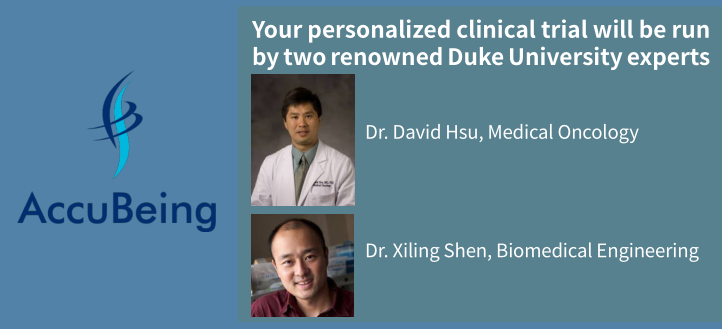
The core experts of the project team include Dr. Xiling Shen, Associate Professor in the Department of Biomedical Engineering at the Duke Cancer Institute, Duke University, and Dr. David Hsu, Assistant Professor of Medicine in the Division of Medical Oncology at Duke University School of Medicine. Dr. Shen serves as a scientific advisor for the CB-839 program under the Cancer Therapy Evaluation Program (CTEP) of the U.S. National Cancer Institute. Dr. Hsu is a specialist in gastrointestinal (GI) medical oncology and a member of both the Gastrointestinal Tumor Clinical Trials Group and the Genitourinary Oncology Group at the Duke Cancer Institute.
Global Imaging Platform: Data Technology Empowers AI to Bridge Sino-Foreign Cooperation
Hangzhou Lianzhong Medical Technology Co., Ltd. (hereinafter referred to as “Lianzhong Medical”) is the sole partner of AccuBeing LLC in China. Its globally hosted imaging-automated machine 3D organoid drug screening platform assists experts in intelligent drug selection by integrating initial patient diagnoses (including tumor staging), medical images, biomarker levels from blood samples, and computational analysis of histological and immunohistochemical images from tumor biopsies. This enables the matching of optimal drug combinations for patients, thereby addressing the limitations of traditional drug screening technologies.
Leveraging its global imaging platform, Lianzhong Medical can provide AccuBeing LLC with auxiliary AI technologies and a data foundation based on existing algorithms, while also building bridges among Chinese medical schools, comprehensive healthcare institutions, expert physicians, and patients.
This robust transnational collaboration, characterized by the convergence of resources, has opened new avenues for cancer treatment and established a convenient channel for clinical and scientific exchange between China and other countries.
Scientists and doctors are immersing themselves in a wave of global collaboration, exploring new technologies amidst this transformation. The seamless integration of healthcare and technology will redefine precision medicine in the field of oncology.