

Tasly Transcends Traditional Chinese Medicine, Emerges as a Rising Innovative Drug Leader
On October 25, Tasly (600535) released its financial report for the first three quarters of 2017. The report showed that Tasly’s overall performance maintained steady growth: the company achieved revenue of RMB 11.1 billion in the first three quarters, a year-on-year increase of 16.18%, and realized a net profit of RMB 1.138 billion, a year-on-year increase of 13.5%.
In addition to its consistently improving performance, Tasly, traditionally perceived as a “traditional Chinese medicine (TCM)” company, has also drawn attention for its strategic layout in the chemical and biological pharmaceutical sectors. The third-quarter report highlighted this trend, stating, “While TCM sales maintained steady growth, the company achieved rapid growth of 226-fold and 34% in biological and chemical pharmaceutical sales, respectively, with their contribution to overall sales growth gradually increasing.”
Tasly’s strategic evolution from a traditional Chinese medicine (TCM) manufacturer to a synergistic model integrating TCM, biologics, and chemical drugs offers notable insights. Its development path holds exemplary significance for the modernization of TCM, the advancement of ethnic medicine, and the broader upgrading of the pharmaceutical industry.
Dongxing Medicine offered the following analysis: “The company has significantly increased its R&D investment in blockbuster drugs in recent years. Its current pipeline encompasses the development and strategic layout of more than 60 products across traditional Chinese medicine, chemical drugs, and biologics, including over 20 innovative drugs. Furthermore, through equity funds under its holding group, the company has established a presence in areas such as insulin and precision medicine. With a robust R&D pipeline and substantial future potential, the company is poised to emerge as a new leader in the innovative drug sector.”
Seizing the opportunity of the third-quarter report announcement, VCBeat (WeChat ID: vcbeat) has comprehensively reviewed Tasly’s recent strategic layout in chemical drugs, biologics, and the broader health sector, providing a detailed analysis of the synergistic development pathways across its various pharmaceutical portfolios.
Tasly Builds Pharmaceutical IndustryBiologyIndustrial Cluster
Tasly went public in 2002 and currently has a market capitalization of nearly RMB 40 billion, ranking among the top 20 out of more than 200 pharmaceutical stocks listed on China’s A-share market, and within the top 10 among traditional Chinese medicine (TCM) concept stocks. In terms of revenue, Tasly ranks among the top five A-share pharmaceutical companies. The company’s revenue approached RMB 14 billion in 2016, with its pharmaceutical manufacturing and pharmaceutical commercial segments contributing in a roughly 40:60 split—manufacturing revenue amounted to RMB 6.178 billion, while commercial revenue reached RMB 7.684 billion.
Modern Chinese Medicine is Tasly’s core business. Led by its flagship product, Compound Danshen Dripping Pills, the company has cultivated a series of branded products, including Yangxue Qingnao Granules, Yangxue Qingnao Pills, and Qishen Yiqi Dripping Pills, thereby solidifying Tasly’s market-leading position in the field of Modern Chinese Medicine.
Tasly, with its portfolio of star proprietary Chinese medicine products such as Compound Danshen Dripping Pills, is easily labeled a “traditional Chinese medicine (TCM) company.” However, since its inception, Tasly has differed from conventional TCM enterprises by prioritizing innovative R&D and strategically investing in innovation across traditional Chinese medicines, chemical drugs, and biologics.
The most intuitive indicator is, of course, R&D investment. While the R&D expenditure of domestic pharmaceutical manufacturers generally remains below 5%, Tasly’s annual R&D investment ratio has reached as high as 7%. According to statistics from VCBeat, its R&D spending in 2012 was RMB 187 million, accounting for 5.49% of its pharmaceutical industrial revenue. This figure has since surged, doubling by 2016 to RMB 440 million, which represented 7.12% of its industrial revenue.
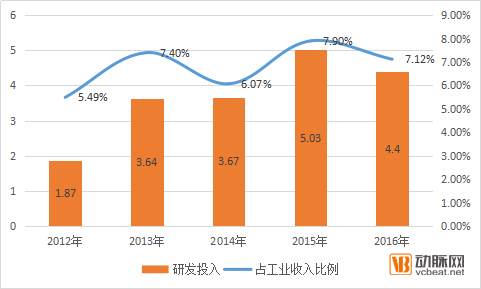
Tasly's R&D Investment and Proportion Changes in Recent Years
Driven by sustained high R&D investment, Tasly’s revenues from chemical drugs and biologics have also been on the rise. In 2016, the combined revenue from these two categories exceeded RMB 1 billion, accounting for nearly one-sixth of its industrial revenue.
Zhu Yonghong, General Manager of Tasly, stated that since its initial public offering, the company has formulated and adhered to a clear strategy and direction. Founded on traditional Chinese medicine (TCM), Tasly is dedicated to refining and specializing in modern TCM to achieve greater scale and strength, while simultaneously striving for innovation and advancement in biologics, and developing specialized and high-quality chemical drugs. To this end, Tasly has established an international industrial strategy centered on modern TCM, with biologics and chemical drugs serving as two complementary pillars.
In the field of chemical drugs, Tasly’s currently marketed products cover series including anti-tumor, cardiovascular, psychotropic, and hepatoprotective agents. In the field of biological drugs, with its wholly-owned subsidiary Shanghai Tasly Pharmaceutical as the development hub, it has successively laid out a portfolio of biopharmaceutical innovation companies and products through cooperation, investment, mergers and acquisitions, laying the foundation for future biological drug business.
Tasly’s core competitiveness in the biopharmaceutical industry cluster stems from multiple sources, including its established business foundation and capital accumulation, as well as its strategic mindset of openness, collaboration, and innovation.
Tasly has repeatedly elaborated on its core competencies in its periodic financial reports. One key competency is its international standard system covering the entire industry chain. The internationalization of Tasly’s modern traditional Chinese medicine (TCM) products has driven the global expansion of its various business operations. Aligning with international market demands and standards, the company has implemented internationalized management across all stages—from the cultivation and processing of TCM raw materials to formulation manufacturing and distribution—thereby achieving a comprehensive upgrade of its existing industry chain. Meanwhile, Tasly emphasizes connectivity and collaboration across the industry chain, fostering strong synergies among its various business segments.
Second is the soft power of R&D innovation: Tasly focuses on unmet clinical needs, centering on innovative drug development and the cultivation of blockbuster marketed products, while building a diversified model for R&D resource allocation. By leveraging R&D resources to accelerate the transformation of innovative achievements, it aims to achieve overtaking on the curve in product portfolio layout.
Other components include the intellectual property protection system, modernized production and intelligent manufacturing systems, as well as end-market networks and marketing capabilities.
Certainly. As a publicly listed company, its most critical capability lies in capital operations. Leveraging the listed entity as the primary investment vehicle, it has successively invested in and acquired multiple enterprises engaged in the formulation of traditional Chinese medicines, chemical drugs, and biological products, as well as R&D firms. These moves have secured a portfolio of mature marketed drugs and a robust pipeline of investigational new drugs, thereby establishing a solid foundation for building a biomedical industry cluster.
In-Depth Analysis of Tasly's Strategic Layout for Biologics and Chemical Drugs
“Industry + Capital” dual-wheel drive, and the “four-in-one” R&D mechanism are Tasly’s primary approaches to its layout in the fields of biologics and chemical drugs.
In recent years, Tasly has successively completed the acquisitions of Shanghai Saiyuan Biotechnology and Tianjing Biopharma, established the Tasly International Gene Network Drug Innovation Center and Chuangshijie Biopharmaceutical Company, thereby enhancing its innovative drug portfolio in oncology, cardiovascular and cerebrovascular diseases, and metabolic disorders.
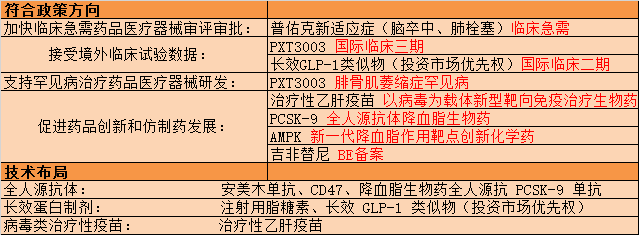
According to Tasly’s third-quarter report, the company has currently developed and established a pipeline of more than 60 drugs across the fields of traditional Chinese medicine (TCM), biologics, and chemical drugs, including over 20 innovative drugs. These include Puyouke, a national Class I biologic thrombolytic novel drug; PXT3003, an innovative drug for Charcot-Marie-Tooth disease from France’s Pharnext; Anmeimu monoclonal antibody; a therapeutic hepatitis B vaccine; and the generic drug gefitinib, among others.
Tasly stated that, benefiting from new regulatory policies—such as accelerated review and approval of clinically urgent drugs and medical devices, acceptance of overseas clinical trial data, support for the research and development of drugs and medical devices for rare diseases, and promotion of drug innovation and generic drug development—the aforementioned new drugs will be accelerated to market in China.
From the perspective of technological layout, Tasly has achieved comprehensive coverage in key therapeutic areas—including fully human antibodies, long-acting fusion proteins, and virus-like therapeutic vaccines—through its portfolio of products such as the fully human anti-ANGPTL3 monoclonal antibody, fully human anti-CD47 monoclonal antibody, fully human anti-PCSK9 monoclonal antibody for lipid lowering, injectable glucagon, long-acting GLP-1 analogs (with priority investment rights), and therapeutic hepatitis B vaccine.
Tasly's Innovative Drug Portfolio
Puyouke, with the generic name recombinant human pro-urokinase for injection, is a national Class I biological thrombolytic drug that was officially launched in 2011. Phase IV clinical data showed that among 2,088 patients with ST-segment elevation myocardial infarction (STEMI) treated with Puyouke, the vessel recanalization rate reached 85.2%, and the risk of intracranial hemorrhage was only 0.28%, making it the preferred thrombolytic agent for STEMI patients. Earlier this year, following adjustments to the National Reimbursement Drug List, Puyouke was included in the list. This success has enabled Tasly to establish a complete pathway from biopharmaceutical R&D to market launch.
PXT3003 is an innovative drug introduced by Tasly through product licensing, originally developed by the French company Pharnext. The drug has completed screening and enrollment of 300 patients with mild-to-moderate Charcot-Marie-Tooth disease type 1A (CMT1A) globally, is actively advancing its international Phase III clinical trials, and is simultaneously seeking early market access qualifications in Europe. Tasly stated that the drug meets the requirements for simultaneous domestic and international development and dual regulatory submissions. The rights for the Greater China region have been fully licensed to Tasly, and the drug is expected to benefit from accelerated review processes under China’s new regulatory policies.
From the perspective of indications, Charcot-Marie-Tooth disease is a rare disorder with no effective therapeutic products currently available on the market; similar R&D projects by other companies worldwide are all in the preclinical stage. In terms of market potential, the incidence of Charcot-Marie-Tooth disease is 1 in 100,000 in Japan and 5 in 100,000 in the United States. Based on the median value, the domestic patient population in China is estimated to be approximately 30,000.
Other generic drugs, such as gefitinib, position Tasly as a likely first-tier company to gain approval. According to market monitoring data, the expenditure on small-molecule targeted therapies for lung cancer in key public hospitals across China reached RMB 816 million in 2015, with gefitinib accounting for RMB 253 million. This indicates substantial future market potential following Tasly’s entry into the segment.
From the perspective of the overall pharmaceutical innovation ecosystem, China currently enjoys numerous favorable conditions, including top-level policy designs that encourage innovation, strong enthusiasm from the capital market, and an increasingly mature talent pool and industrial environment. These factors also support Tasly’s continued increased investment in the innovation of chemical drugs and biologics.
It is foreseeable that, under favorable policy conditions and a robust industrial environment, Tasly’s continuous R&D investment and its “four-in-one” innovative R&D mechanism will provide long-term momentum for its sustained growth and value discovery.