

Quanyuantang: How a Heritage Pharmacy Achieved RMB 500M Revenue in Three Years and Broke into China's Top 10 Pharma E-commerce Platforms
Quanyuantang is likely one of the fastest-growing companies in the pharmaceutical e-commerce sector.
Within less than three years of launch, revenue approached RMB 500 million, representing a 25-fold increase; net profit also grew nearly 25-fold, making it one of the few profitable companies in the pharmaceutical e-commerce sector. Total assets increased 33-fold, with its online business ranking among the top ten nationwide, while actively expanding offline operations and pursuing diversified business strategies.
Recently, VCBeat (WeChat ID: vcbeat) conducted an exclusive interview with Chen Zhouhua, General Manager of Quanyuantang. He provided an in-depth analysis of the “secret” behind Quanyuantang’s rapid growth, as well as the “Internet + Pharmaceutical Innovation Platform” that Quanyuantang aims to build under the new landscape of pharmaceutical e-commerce.

Chen Zhouhua, General Manager of Quanyuantang
Fourth-Generation Pharmaceutical Family Enters Online Pharmaceutical E-commerce
The story of Quanyuantang began in 1902, when renowned Sichuan physician Li Xichen founded the establishment and commenced his medical practice. With his benevolence and expertise, he brought blessings to the local community. Over the past century, the family’s lineage has remained firmly rooted in the field of medicine.
In 2012, after Li Xichen founded Yiguan 110,QuanyuantangLi Can, the fourth-generation successor, established Chengdu Quanyuantang Pharmacy Chain Joint Stock Co., Ltd., entering the pharmaceutical retail sector. Within two years, Quanyuantang opened 17 stores in Chengdu and Pujiang, Sichuan Province, achieving sales revenue exceeding RMB 20 million. In 2014, Quanyuantang began strategizing its entry into the pharmaceutical e-commerce sector.
Chen Zhouhua recounted to VCBeat the reasons why Quanyuantang entered the pharmaceutical e-commerce sector in 2014.First, policies for pharmaceutical e-commerce are becoming increasingly clear., the state began to encourage "Internet + pharmaceutical distribution";Second, traditional pharmaceutical distributors and major internet companies are entering the pharmaceutical e-commerce sector., at that time, companies such as Jointown Pharmaceutical Group and Kangmei Pharmaceutical began launching pharmaceutical e-commerce projects, while Alibaba had just acquired CITIC 21st Century, which owned the “95095” platform, to establish its presence in online pharmaceutical retail;Third, pharmaceutical e-commerce has demonstrated very high growth potential., maintaining a market growth rate of over 200%, with substantial future market scale.
“Guided by industry trends and its existing business DNA, Quanyuantang chose to enter the pharmaceutical e-commerce sector at that time, aiming to grow into a national brand through this rapidly expanding new channel and become a true ‘neighborhood pharmacy’ for people across China,” said Chen Zhouhua.
Quanyuantang established an independent pharmaceutical e-commerce team in Guangzhou. Explaining the choice of location, Chen Zhouhua stated, “Guangzhou can be regarded as a national hub for pharmaceutical e-commerce; at that time, the top three pharmaceutical e-commerce companies in China were all based in Guangzhou. By setting up its pharmaceutical e-commerce team there, Quanyuantang could better integrate into the industry ecosystem and gain valuable operational expertise.”
Starting from scratch, Quanyuantang rapidly launched flagship stores on Tmall and JD.com, while steadily establishing its warehousing and logistics infrastructure. By January 2015, the company had achieved monthly sales exceeding RMB 1 million, becoming the fastest-growing pharmacy store on both platforms within just a few months.
Brand Operations: The “Secret” to Quanyuantang’s Success
Throughout 2015, Quanyuantang experienced its most critical “period of business growth.” During this year, the company completed its listing on the National Equities Exchange and Quotations (NEE), executed its second round of stock issuance, and successfully raised RMB 40.2 million; acquired Pujiang Shentong Express Co., Ltd.; had its newly built 10,000-square-meter warehousing center pass Good Supply Practice (GSP) certification; and laid out its Pharmacy Benefit Management (PBM) business, beginning to explore a diversified business system integrating pharmaceutical e-commerce with insurance.
Most importantly, Quanyuantang’s e-commerce business achieved substantial growth this year, with e-commerce revenue rising from under RMB 1 million to over RMB 70 million, and its share of total revenue increasing from 2% to more than 75%. Quanyuantang has fully transformed into an innovative company integrating pharmaceutical retail with internet-based services.
Chengdu Quanyuantang Pharmacy Chain Joint Stock Co., Ltd. stated in its 2015 annual report:The revenue share of the e-commerce segment increased from 2.28% in 2014 to 75.05% in 2015., primarily driven by rapid sales growth across various e-commerce platforms (such as Tmall Health, JD.com, and Wanda City Cloud), with outstanding performance during promotional events like JD.com’s 618 Shopping Festival and Tmall’s Double 11. Notably, Quanyuantang achieved online sales exceeding RMB 15 million on the day of the 2015 Double 11 Shopping Festival, earning the “Double 11 Sales Progress Award” from Tmall.
Reflecting on Quanyuantang’s rapid growth over the past year, Chen Zhouhua summarized it with a seemingly simple reason:Uphold the brand operation strategy.
He stated that the pharmaceutical e-commerce sector, or more broadly, the entire e-commerce industry, has roughly undergone three stages of development:The first is the stage where traffic is king., from the establishment of the Taobao platform in 2004 to JD.com’s ramp-up in 2009, both adopted a blockbuster product strategy, leveraging hit items to drive traffic; while short-term turnover figures appeared impressive, this approach lacked sustainability;The second phase is primarily supply chain-driven., since 2012, practitioners have come to recognize that the core of e-commerce still lies in products, focusing on product categories and combinations to meet consumer demands and enhance platform value;After 2014, the company entered the brand operation stage., from the perspectives of consumer demand, big data, and the integration of online and offline channels—including the current trend of “New Retail”—are essentially aimed at building the brand identity of e-commerce.
“Looking at examples from the pharmaceutical e-commerce industry, traffic operations were the focus before 2014. At that time, some merchants created many best-selling products and developed various single-product labels. However, they stopped at creating best-sellers and failed to leverage post-best-seller product operations and product combination advantages to sustainably utilize traffic. They also did not truly establish a consumer-demand-centric supply chain and service closed loop, which would have fostered genuine consumer recognition of pharmacy e-commerce brands and encouraged repeat purchases,” recalled Chen Zhouhua.
“WhereasChengdu Quanyuantang Pharmacy Chain Joint Stock Co.,Ltd. initially pursued a brand operation strategy.“We have established dedicated pharmacist and operations teams, adopting an operational strategy that differs from the tactics used for viral hits and traffic generation,” said Chen Zhouhua. Quanyuantang has gradually assembled a pharmacist team of over 100 members, including more than 20 licensed pharmacists. It has also formed specialized operational teams categorized by disease type, providing users with consultation, follow-up, and health management services for all medications.
“For example, if a user purchases a medication to be taken after meals on our platform at 3:00 PM, our follow-up team may call them at 6:00 PM to remind them to take the medication and provide relevant usage precautions.” It is precisely this series of brand operations that enabled Chengdu Quanyuantang Pharmacy Chain Joint Stock Co., Ltd. to build strong user reputation in a short period.
In addition, Chen Zhouhua noted that Quanyuantang emphasizes the integration of online and offline channels. “We offer a wide variety of SKUs online. Meanwhile, we leverage our extensive network of physical stores to provide services; customers can turn to our online platform for medications unavailable in-store, creating strong synergy between our online and offline operations.”
“One of the most important metrics in e-commerce is the repurchase rate, we”The repurchase rate for purely online services is 35%, while the repurchase rate for integrated online-offline models exceeds 50%..” It can be said that, basically, after experiencing Quanyuantang’s services once, users will return to its offline or online pharmacies.
In 2016, Quanyuantang sustained the high-speed growth achieved in the previous year. In May, it was approved by the Chengdu Food and Drug Administration as a pilot entity for “internet-based remote prescription” services. In September, its first DTP (Direct-to-Patient) pharmacy was successfully launched, expanding new out-of-hospital sales channels. That same month, Quanyuantang’s subsidiary, Quanyi Health, released its first internet insurance product, “Tangbaobao,” which was then the only commercial insurance product in China available to patients with diabetes, marking the official launch of Quanyuantang’s PBM (Pharmacy Benefit Management) business. In November, the company completed asset restructuring, establishing a synergistic layout integrating pharmaceutical retail and pharmaceutical wholesale.
“Adhering to brand operations, centering on consumers, optimizing pharmaceutical care services, and actively extending pharmacy-related services to form a synergistic layout constitute the main development trajectory of Chengdu Quanyuantang Pharmacy Chain Joint Stock Co.,Ltd.“Chen Zhouhua thus summarized Quanyuantang’s past operational experience.”
Quanyuantang’s rapid growth is further corroborated by its financial data. According to historical financial reports, since 2014, Quanyuantang’s assets have increased more than 15-fold; its revenue has grown 25-fold, approaching RMB 500 million (as reported in the 2016 annual report); and its net profit has also risen 25-fold, making it one of the few profitable companies in the pharmaceutical e-commerce industry.
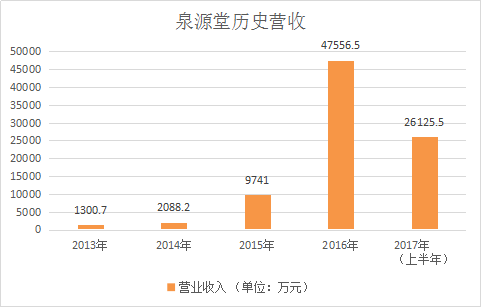
Quanyuantang's Historical Revenue Data
An Online-Offline Integrated Internet Healthcare Innovation Platform
From an industry-wide perspective, pharmaceutical e-commerce has experienced rapid growth since 2014. In terms of the most intuitive market size, relevant data show that the scale of online pharmacies was less than RMB 10 billion in 2014, exceeded RMB 25 billion in 2016, and is projected to surpass RMB 30 billion this year.
How does Quanyuantang view the current state of the pharmaceutical e-commerce industry, what are the trends at the policy and industrial levels, and how will Quanyuantang position itself? Chen Zhouhua provided answers to each of these questions.
He stated that the policy landscape is improving: from the abolition of the three licenses required for pharmaceutical e-commerce, to the encouragement of “Internet Plus” pharmaceutical distribution models such as “online ordering with in-store pickup” and “online ordering with store delivery,” and further to the gradual advancement of public hospital reforms promoting the separation of prescribing from dispensing and the outflow of prescriptions, policy dividends are being progressively released.
In addition, Sichuan and Guangdong have also launched local pilot programs: The electronic prescription pilot implemented by the Chengdu Food and Drug Administration last year has already covered nearly 4,000 pharmacies; Guangdong also piloted a regulation in the first half of this year that allows patients to repurchase medications without a prescription after their past medication history and detailed information have been fully reviewed, signaling a relaxation of restrictions on online sales of prescription drugs by brick-and-mortar pharmacy-based online stores.
Chen Zhouhua stated that, in response to such promotional policies, Quanyuantang has followed up at the business level, including by establishing a “Cloud Pharmaceutical Business Division” to developSmart Pharmacy,Dedicated to enhancing the internet and O2O capabilities of traditional pharmacies.Furthermore, by collaborating with internet healthcare institutions and integrating data interfaces with hospitals, we facilitate medication delivery through internet hospitals, enabling patients to enjoy more convenient and efficient end-to-end services, including diagnosis and treatment, prescription issuance, medication consultation, drug delivery, and insurance claims processing.
From an industry perspective, the cancellation of the three required certificates for internet transaction services in pharmaceutical e-commerce has lowered policy barriers, leading to an increase in market entrants. Continuous user education and guidance have further enhanced consumers’ acceptance of purchasing medications online.
“Over the next 5–10 years, pharmaceutical e-commerce is expected to maintain explosive growth, becoming a major channel for pharmaceutical distribution.”
Nevertheless, Chen Zhouhua also offered some “sobering reflections” on the industry. He noted that new entrants to the pharmaceutical e-commerce sector should recognize that major platforms such as Alibaba and JD.com have successively launched self-operated businesses, granting certain advantages to their own stores in terms of traffic allocation and keyword prioritization. In addition, operating on third-party platforms involves significant uncertainty, while building independent official websites entails substantial costs; these factors warrant comprehensive consideration. Overall, it will become increasingly difficult for new market entrants, who must therefore identify differentiated positioning and cultivate core competitive advantages.
From the perspective of Quanyuantang itself, multi-business synergy, economies of scale, and the integration of online and offline channels will become its core competitive advantages for future development.“Offline pharmacies, pharmaceutical e-commerce, pharmaceutical distribution, insurance services, and health management are the core areas currently prioritized by Quanyuantang, forming an innovative ‘Internet + Healthcare’ platform.”
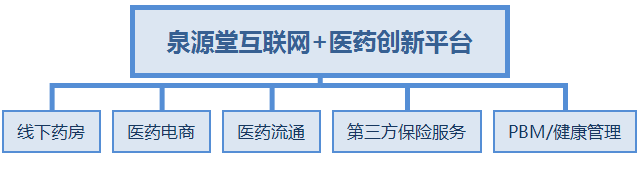
Quanyuantang Business Lines
The industry often says that “medicine and pharmacy are inseparable.” Quanyuantang also emphasizes integration with internet healthcare, pursuing expansion through partnerships. According to Chen Zhouhua,Quanyuantang has entered into partnerships with Tencent’s Teng Ai Doctor, WeDoctor, and Fudun Technology, effectively integrating its high-quality pharmaceutical care services with these companies’ medical service capabilities.“Enable users to enjoy one-stop services”
“Looking at the current mainstream models of pharmaceutical retail, hospital pharmacies are tied to medical services with cumbersome processes; offline retail is sales-oriented rather than driven by user needs; in contrast, online retail incorporates e-commerce DNA, focuses on user needs, and is better equipped to address consumer mindset issues. Quanyuantang aims to combine the strengths of these three models, integrating online and offline channels to facilitate the evolution of pharmaceutical retail.” This was Chen Zhouhua’s response regarding Quanyuantang’s future strategy in pharmaceutical retail.
According to the plan, in addition to consolidating its online presence,Over the next three years, Quanyuantang will establish 1,000 new retail stores across China, completing its “online + offline” layout to provide users with convenient, readily accessible services.
“Quanyuantang Pharmacy aims to differentiate itself from other retail stores in three aspects: sales per square meter, SKU management, and specialized services. It seeks to enhance individual staff performance, integrate online and offline services for efficient management, and share SKUs and warehousing between online and offline channels to truly achieve the goal of ‘no medicine is unavailable at Quanyuantang.’ With a patient-centric operational approach focused on meeting medication needs, it strives to build a ‘neighborhood pharmacy’ that consumers can trust.” This is Chen Zhouhua’s vision for the development of Quanyuantang’s new retail stores.
In this regard, it can be summarized that “Internet + Healthcare” has provided fertile ground for the development of pharmaceutical e-commerce. The gradual liberalization of policies has released substantial dividends, nurturing the growth of pharmaceutical e-commerce companies.Chengdu Quanyuantang Pharmacy Chain Joint Stock Co.,Ltd. entered the market at the right time and in the right way, gaining user recognition and market reputation through efficient operations, refined management, and demand-oriented services. It has rapidly developed and secured a place in the innovative field of "Internet + Healthcare."In the future, Quanyuantang may consolidate its existing advantages, focus on its core pharmaceutical business, optimize services, and expand its market presence.