

Future Medical Launches World’s First Gamified Smart Nebulizer, Achieving What Omron and Yuwell Haven’t
“Our company adheres to two core principles: prioritizing medical efficacy and emphasizing technological innovation. First and foremost, our products must be therapeutically effective; then, we leverage technology to enhance their therapeutic performance.” During the 45-minute interview, he repeated this statement three times.
Qingdao Future Mobile Healthcare Technology Co., Ltd. (hereinafter referred to as"Future Healthcare") CEO Wang Weilai was born into a large medical family, with all his relatives working in healthcare-related fields. Consequently, his entrepreneurial ventures have also been focused on the healthcare industry.

Wang Weilai, CEO of Future Healthcare
In 2014, Wang Weilai left Lucent Technologies to start his own business. His ten years of experience in software and hardware development at Lucent Technologies laid a solid foundation for his entrepreneurial venture. On one occasion, Wang took his sick child to the hospital for nebulization therapy. He was surprised to find that all the children in the nebulization room were crying and showing strong resistance to the treatment, while the nebulizers beside them continued to spray medication nonstop.“This is simply a waste of medication! Why can’t our nebulizer therapy be more patient-centered and efficient?”"Wang Weilai lamented."
This experience allowed Wang Weilai to identify entrepreneurial opportunities. He subsequently founded Future Medical, focusing the company’s business on the field of respiratory medicine and committing to providing advanced product solutions for patients with respiratory diseases such as asthma and chronic obstructive pulmonary disease (COPD). To address pain points such as the discomfort and low efficiency associated with pediatric nebulization, Future Medical launchedThe World's First Smart Nebulizer—Yirdoc。
Yirdoc (Your Intelligent Respiratory Doctor), i.e.,Your Intelligent Respiratory Physician, is an innovative product that upgrades and transforms traditional medical products through digitalization, the Internet of Things (IoT), and intelligent technologies for future healthcare. The product was ranked among the Top 5 in the healthcare category at the 2016 North America (Silicon Valley) High-Level Talent Entrepreneurship Competition, and won second place in the Qingdao division of the team category within the Internet group at the National Ministry of Science and Technology Innovation and Entrepreneurship Competition.
Subverting Tradition, World's First
How Does the Yirdoc Smart Nebulizer Differ from Conventional Models? According to our reporter, there are currently three main types of nebulizers on the market: ultrasonic nebulizers, jet (compressor) nebulizers, and mesh nebulizers.
Ultrasonic nebulizers atomize liquid medication using ultrasonic waves; however, due to various technical drawbacks, they have been largely phased out. In contrast, jet (compression) nebulizers primarily atomize medication using compressed air. They offer relatively better particle size distribution and are cost-effective, making them the mainstream choice currently. As of 2015, their global market share reached 63.8%. Nevertheless, they have long been criticized by consumers for issues such as bulky size and high noise levels.
The most advanced nebulizers currently available are mesh nebulizers.It utilizes periodically varying voltage to vibrate the mesh, atomizing the liquid medication as it passes through, thereby perfectly addressing the noise issues associated with compressor nebulizers while achieving medically graded aerosol particle sizes. Although mesh nebulizers are currently slightly more expensive than compressor nebulizers, the price advantage of traditional compressor nebulizers will gradually diminish as mesh nebulizer technology matures.The market share of mesh nebulizers will steadily increase in the coming years, ultimately gradually replacing compression nebulizers.
Future Healthcare's Yirdoc Smart Nebulizer is precisely this type of mesh nebulizer.It is reported that only a handful of manufacturers, such as Omron, Yuwell, and Boya, currently produce mesh nebulizers in the Chinese market. However, their products remain conventional nebulizers with no significant innovation and virtually no intelligent features.
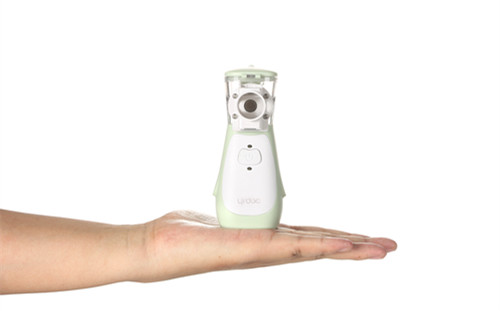
Penguin-shaped design, appealing to children's aesthetics
Compared to traditional nebulizers, Yirdoc is smaller in size and lighter in weight (100g), with an operating noise level of only 40 decibels, making it virtually silent. Furthermore, Yirdoc eliminates the need for a power cord by using a lithium battery, which supports up to 4 hours of continuous nebulization therapy, offering users greater portability. More importantly,Yirdoc leverages children’s natural inclination toward play and, through IoT technology, creatively integrates gaming to guide them through nebulization treatments—a world-first innovation!
5 Key Highlights of the Intelligent Respiratory Physician
What Makes the Yirdoc Smart Nebulizer Claim to Be a World First? What Are Its Highlights?
"Game-Guided Nebulization Makes It More Fun"
Treatment modalities include “pharmacological therapy” and “non-pharmacological therapy,” with the latter encompassing psychotherapy. Play is intrinsic to a child’s nature; leveraging games to guide nebulization constitutes a non-pharmacological intervention and falls under the category of digital therapeutics. The Yirdoc nebulizer is equipped with low-energy Bluetooth technology, enabling connectivity to a companion free mobile app featuring games. This allows children to control the game through oral maneuvers, engaging in nebulization while playing and earning corresponding score-based rewards. This gamified approach not only enhances adherence to and participation in nebulization therapy, helping children overcome fear and enjoy the treatment process, but also guides patients to take deep breaths, prolong inspiratory time, and increase tidal volume. These effects improve pulmonary drug deposition, thereby enhancing the efficacy of nebulization therapy.
Intelligent Respiratory Monitoring to Enhance Drug Utilization Efficiency
Traditional nebulizers continuously aerosolize medication regardless of whether the patient is inhaling, resulting in the waste of at least half of the drug. The Yirdoc smart nebulizer utilizes patentedI.A.D. Technology(Intelligent Aerosol Delivery), the intelligent respiratory monitoring sensor located at the nozzle willReal-time monitoring of patients' respiratory behavior, precisely adjusting the nebulization process to ensure that nebulization occurs only during inhalation and not during exhalation.This approach enhances drug utilization efficiency, indirectly reduces medication costs for patients, and eliminates the sensation of choking or coughing during nebulization.
Adjustable nebulization rate for more comfortable drug delivery
Unlike oral administration or subcutaneous injection, which simply involve delivering medication into the body, nebulization therapy requires precise control of the aerosolization rate. An excessively high or rapid mist output may cause acute airway obstruction, while an insufficiently low or slow output can compromise therapeutic efficacy. The Yirdoc Smart Nebulizer offers personalized treatment protocols tailored to the specific characteristics of different age groups, populations, and diseases. Users can adjust the nebulization rate according to their individual conditions, effectively addressing the discomfort associated with the fixed-rate nebulization of competing products.
Real-time Data Recording for Precise Medication
Yirdoc can also record data generated throughout the patient’s entire nebulization process in real time, including medication administration time and dosage.“With traditional nebulizers, there is no way to know the exact amount of medication administered, leaving physicians without an evidence-based basis for assessment. In contrast, the Yirdoc smart nebulizer precisely records the volume of medication delivered, the duration of nebulization, and the patient’s respiratory status throughout the entire process (including the inspiratory-to-expiratory ratio).”“These data also serve as a basis for future evidence-based medical practice and provide data support to assist physicians in diagnosis,” Wang Weilai told reporters.
Ultra-fine Nebulization: Enjoy Hospital-Grade Equipment at Home
Nebulization therapy involves dispersing medications into mist or fine particles suspended in gas via an inhalation device, which are then inhaled and deposited in the respiratory tract and/or lungs to achieve localized therapeutic effects. Therefore, the particle size of the nebulized aerosol directly influences drug efficacy. Generally, if the particle size is less than 1 μm, the medication will be exhaled; if it exceeds 5 μm, the medication will remain confined to the upper respiratory tract. Thus, maintaining the nebulized particle size within the range of 1–5 μm is essential to ensure proper drug absorption.
The Yirdoc smart nebulizer utilizes mature vibrating mesh technology, achieving a mass median aerodynamic diameter (MMAD) as low as 2.19 μm. This allows the aerosol particles to penetrate deeply into the lower respiratory tract and alveoli, delivering medication directly to the affected areas. Furthermore, over 80% of the aerosol particles are smaller than 5 μm, which helps reduce dosage requirements while enhancing therapeutic efficacy.
“Combining a high-quality nebulizer with medication achieves a drug-enhancement effect. Drug enhancement aims to improve therapeutic efficacy.”“According to Wang Weilai, the Yirdoc Smart Nebulizer has already obtained CE and CFDA certifications, with FDA certification expected to be completed in the near future, as the Yirdoc Smart Nebulizer expands into overseas markets.”
Equal Emphasis on Domestic and International Markets: Prioritize B2B Before B2C
Therefore, the future of healthcare is by no means confined to the narrow domestic market; instead, it adopts a global perspective. According to relevant data,In 2017, the global nebulizer market was valued at RMB 5.5 billion (USD 849.1 million), and is projected to exceed RMB 8 billion (USD 1.2345 billion) by 2025.. To claim a share of this RMB 8 billion market, what strategies will the future healthcare sector adopt?
For overseas markets, Future Healthcare has initially adopted a B2B-focused business model. According to Feng Yuheng, Head of Overseas Markets at Future Healthcare, the company has already begun collaborating with well-known local health brands and pharmaceutical manufacturers abroad, leveraging their brand recognition and distribution channel advantages to rapidly penetrate the market. Meanwhile, Future Healthcare will partner with overseas e-commerce platforms to launch its proprietary Yirdoc product series, adopting a user-centric approach to obtain customer feedback on products in real time.
The first destination for the overseas expansion of future healthcare is the German market. As the country with the strongest economic power in Europe, Germany has over 6 million asthma patients, a number that continues to rise, indicating substantial market demand. Furthermore, with the entry of other overseas nebulizer manufacturers in recent years, the market has been “educated,” making patients more receptive to the concept of nebulization therapy. VCBeat has learned thatYirdoc Smart Nebulizer has been launched in Germany and is available on multiple leading pharmaceutical e-commerce platforms in the country.
In the domestic market, although there has been development in recent years and user awareness of nebulization therapy has gradually increased, it still lags far behind that of developed countries in Europe and the United States. Therefore, patient education remains a necessary step for the Chinese market. As such, when targeting the domestic market, Future Medical will first engage physicians by collaborating with multiple Chinese pediatric associations, respiratory societies, and obstetrics and gynecology groups, leveraging healthcare professionals to educate patients.
“Given our company’s strong focus on healthcare, we will prioritize physician-oriented promotion, encouraging doctors to inform patients that this product significantly aids in disease management and enhances the utilization rate of prescribed medications.”We will begin with offline academic promotion, transition to online channels after two to three years, and ultimately achieve a seamless integration of online and offline efforts.“Wang Weilai said.”
In addition to collaborating with physicians, Future Medical has partnered with leading respiratory departments and pharmaceutical companies to integrate drugs with medical devices, thereby enhancing drug absorption. Commenting on this approach, Wang Weilai stated, “Previously, respiratory medications and delivery devices were separate; by integrating the drug and device, we can significantly improve drug utilization and therapeutic efficacy.”
Certainly, the goals of future healthcare extend far beyond this. Future Healthcare is currently collaborating with multiple hospitals in China to buildIntelligent Nebulization Room, allowing children to receive nebulization therapy while playing games. Meanwhile, all data generated during nebulization is automatically uploaded to the physician’s clinical system, forming a preliminary version of a minimal electronic medical record. Currently, the smart nebulization room for future healthcare has been in operation at a pilot hospital for three months. It is expected that by November, the company will roll out this smart nebulization room across 30 Grade-A tertiary hospitals in Shandong Province.
Starting with nebulizers, develop more IoT devices and platforms for respiratory medicine.
When discussing future plans, Wang Weilai stated that they would first participate in the China International Medical Equipment Fair (CMEF), held in Kunming from October 29 to November 1, to officially announce the launch of the Yirdoc smart nebulizer in the Chinese market. Subsequently, in November, they will attend MEDICA, the international medical trade fair, in Düsseldorf, Germany.
In addition to smart nebulizers, future healthcare will see the development of more respiratory products, includingPulmonary Function Tester. Pulmonary function testers are used to assess patients' lung function, enabling physicians to administer medications more precisely based on diagnostic data. Furthermore, the Yirdoc pulmonary function tester can also be integrated into the Internet of Things (IoT).A nebulizer is a therapeutic device, while a spirometer is a diagnostic device. Together, a diagnostic tool and a therapeutic tool form the minimal closed loop for the management of chronic respiratory diseases.“Wang Weilai explained.”
In fact, nebulizers and spirometers represent only the initial minimal viable loop in future healthcare. Their long-term goal is to launch a broader range of IoT-enabled devices and platforms for respiratory medicine, ultimately benefiting all patients with respiratory diseases. Wang Weilai stated: “Our company’s core focus on healthcare and technology remains centered on driving innovation around patients’ diseases. Innovating with a focus on patients’ diseases is, in essence, a social responsibility.“We hope to significantly improve the management of chronic diseases in children across China through the integration of IoT and AI, thereby contributing to the fight against pediatric respiratory diseases and helping to alleviate the national healthcare burden, which amounts to tens of billions of yuan annually.”
Finally, Future Healthcare is undergoing its latest round of financing. VCBeat believes that with capital support, Future Healthcare will bring more surprises to everyone, and we look forward to seeing what happens.