

Global Think Tanks Converge in Haikou to Spotlight New Drivers for Healthcare Industry Transformation
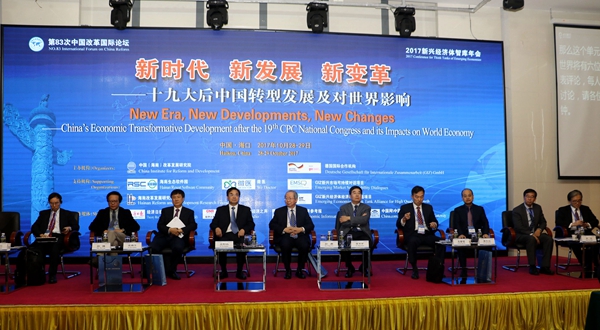
The digital economy is injecting new momentum into the transformation and upgrading of the healthcare industry. The rapid development of information technologies, represented by big data and artificial intelligence, is driving the deep integration of the digital economy with the healthcare sector. This convergence has given rise to new models and business formats, exemplified by internet-based healthcare, thereby propelling industrial transformation and upgrading.
On October 28, the “2017 Annual Conference of Emerging Economies Think Tanks and the 83rd China International Forum on Reform” was held in Haikou. As a typical representative of the new momentum in the digital economy, WeDoctor, a leading domestic intelligent healthcare platform, was invited to attend the conference. At the main forum, Liao Jieyuan, Chairman and CEO of WeDoctor, presented to 500 attendees from top think tanks, as well as experts and scholars, on the exploration and practice of leveraging technological innovation to drive transformation and upgrading in the healthcare industry.
For a long time, the uneven distribution of medical resources and information asymmetry have constrained the development of the healthcare industry, constituting the primary bottleneck behind the difficulty of accessing medical care. Today, the progressive application of “Internet + AI” technologies, underpinned by big data and artificial intelligence, is driving transformative change. Leveraging Zhejiang University’s research prowess and WeDoctor’s extensive medical resources—which connect more than 2,400 hospitals, over 290,000 physicians, and more than 7,300 expert teams—WeDoctor and Zhejiang University have jointly established the Ruiyi Cloud Platform. The platform currently provides cloud-based solutions to tens of thousands of partners, with services encompassing computing, storage, networking, security, visualization, and intelligence. It is emerging as an efficient “enabler” propelling innovation and upgrading within the healthcare industry.
Leveraging the advantages of high-performance algorithms and a wide range of application scenarios, Ruiyi Cloud provides cloud-based services to numerous Grade IIIA hospitals, primary healthcare institutions, medical consortia, government agencies, financial enterprises, pharmacies, and other entities. By integrating medical big data, cloud computing, and artificial intelligence, it helps hospitals enhance their informatization management, assists physicians in making efficient and precise clinical decisions, improves operational efficiency, and delivers personalized and precise medical experiences for patients, thereby comprehensively facilitating industry upgrading.
Heilongjiang Province is leveraging Ruiyi Cloud technology to build a population health information platform, which will establish three core databases covering the entire population, electronic medical records, and health records. Upon completion, the platform will benefit 38 million local residents.
The Tiantan Neurological Diseases Specialist Alliance of Beijing Tiantan Hospital comprises 79 member institutions across 31 provinces, autonomous regions, and municipalities. Leveraging Weiyi Ruiyi Cloud’s advantages and strategic layout in medical artificial intelligence and big data, the alliance addresses key pain points of traditional medical consortia, including communication challenges due to vast geographical spans, fragmented resources, and strong demand at the grassroots level.
Ruiyi Cloud has also extended its empowering reach into traditional Chinese medicine (TCM), collaborating with strategic partners to develop an intelligent application platform for TCM. The platform has been adopted by over 300 TCM clinics, achieving comprehensive coverage across all 11 prefecture-level cities in Zhejiang Province, with a cumulative total of more than 1.5 million prescriptions issued. It has become the most widely used “Cloud-Based TCM Brain” in China.
Not long ago, the intelligent core of Ruiyi Cloud—the Zhejiang University Ruiyi AI Research Center—released its first AI research achievement for diabetic retinopathy. The AI tool can assist physicians in clinical diagnosis and treatment, serving as a “super brain” for doctors and helping to enhance primary healthcare services, ultimately benefiting 30 million patients with diabetic retinopathy. It is reported that more AI achievements will be unveiled at the International Intelligent Healthcare Conference, to be held on November 15 at the G20 venue in Hangzhou.
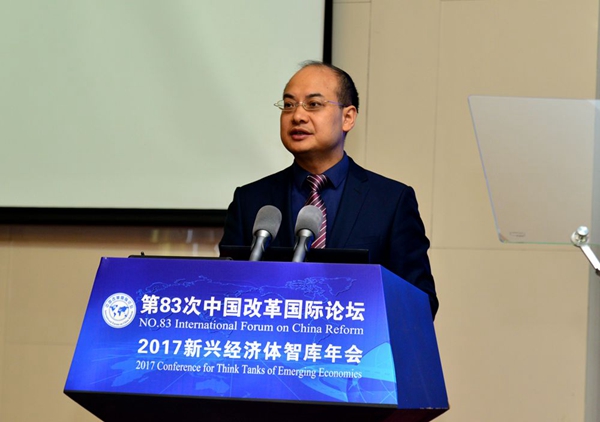
Liao Jieyuan, Chairman and CEO of WeDoctor
Liao Jieyuan believes that the essence of the digital technology economy lies in connectivity, sharing, and collaboration. Industry pain points, favorable national policies, and information technology are the three driving forces propelling the upgrade of China’s healthcare industry. Driven by digital technologies, the shift from passive medical care to proactive health management has become possible. In the future, Weiyi will, on one hand, gradually build a family-oriented medical service system comprising bases, outlets, and terminals; on the other hand, it will collaborate with research institutions such as the Ruiyi Artificial Intelligence Research Center of Zhejiang University. Leveraging its role as a “connection screen” for offline medical institutions and a “matcher” for medical resources, Weiyi will deeply integrate artificial intelligence technologies, medical services, and disciplinary and expert capabilities. These integrated solutions will be extensively applied across various scenarios, including large-scale and primary healthcare institutions, households, and pharmacies, thereby using technology to facilitate policy implementation and drive industrial innovation and upgrading.
More than 500 think tank experts and scholars from various sectors attended the conference, representing central ministries and commissions such as the Development Research Center of the State Council and the National Development and Reform Commission, research institutions, universities, and provinces, municipalities, and autonomous regions across China, as well as countries including Germany, Brazil, India, Russia, Japan, Turkey, Singapore, and Thailand.