

From Sci-Fi to Reality: This Is What the Hospital Room of the Future Truly Looks Like — A Medical IoT Special Report
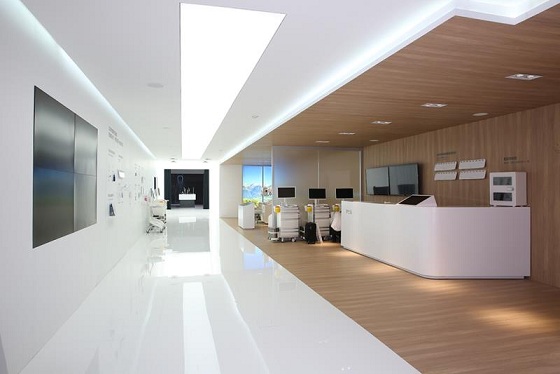
In many science fiction films, there is always a scene where a nurse uses a tablet-like device to scan a patient with light, instantly displaying the patient’s health status on the screen with ease. In reality, while not as flashy as in the movies, smart hospital wards have quietly made their way into healthcare facilities as Internet of Things (IoT) technology continues to mature.
Lianxin Smart Ward Integrated Solution
In the exhibition hall of Shenzhen Lianxin Mobile Medical Technology Co., Ltd. (hereinafter referred to as “Lianxin”), reporters saw a real-world prototype of the future ward.
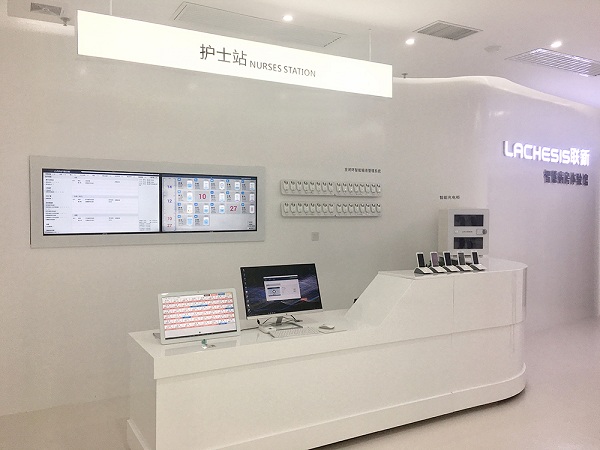
Lianxin Smart Ward is an integrated software and hardware solution based on the hospital’s Internet of Things (IoT), providing auxiliary diagnosis and treatment, nursing care, and management services for hospitals. Leveraging technologies such as IoT, big data, and cloud computing, this smart ward integrates intelligent hardware and application software with existing hospital facilities and systems to build an intelligent and efficient comprehensive management platform for medical staff, nurses, and patients. It supports clinical decision-making and nursing management decisions, enabling healthcare professionals to work more efficiently and safely.
In such smart hospital rooms, you will no longer see patients entangled in various wires; you will not hear the incessant, urgent beeping of alarms; nor will you witness nurses rushing through the wards.
At the nurses’ station, the “angels in white” are receiving intelligent alerts on their NDAs (clinical mobile terminals). They proceed calmly to the tidy, quiet wards, where they access patient information at the bedside and patiently explain the condition and treatment plan to patients and their families. The patient lies quietly in bed, resting, while his vital signs are being uploaded to the system in real time…
How Can Smart Wards Be Implemented?
Peking University Shenzhen Hospital is a modern tertiary general hospital in Shenzhen. Since 2016, Lianxin has officially established a project partnership with Peking University Shenzhen Hospital to jointly build “Smart Wards.”
According to Wang Pan, Head of Intelligent Hardware Products at Lianxin, “Lianxin builds smart hospital wards with the aim of helping medical staff work more safely and efficiently, thereby allowing them to devote more time to patients. Physicians can conveniently conduct mobile rounds and teaching sessions at the bedside using mobile physician workstations. Meanwhile, the application of intelligent systems—such as the closed-loop intelligent infusion management system, clinical mobile terminals (NDA), and vital signs acquisition information systems—provides nurses with more convenient workflows. The ultimate goal is to free up more time for healthcare professionals to engage in patient treatment.”
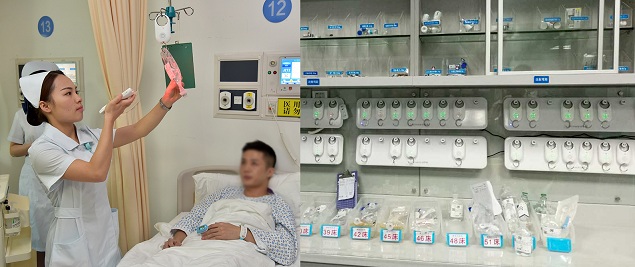
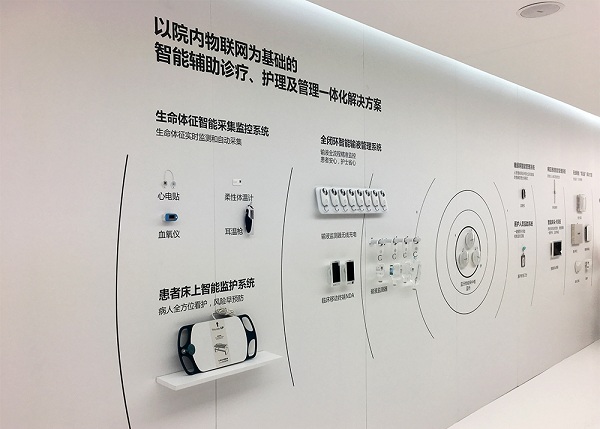
The image above depicts an infusion scene in a patient ward and a corner of the treatment room at Peking University Shenzhen Hospital. The small devices mounted on the white backboards are infusion monitors, the core components of Linknew’s fully closed-loop intelligent infusion management system.
This system is China’s first fully closed-loop infusion solution based on Bluetooth IoT. Its sleek, minimalist design—lightweight and agile—combined with a high-precision technological core, makes it particularly eye-catching. It operates by integrating imported German ultra-micro gravity sensors and acceleration sensors with Lianxin’s patented algorithms to accurately monitor the remaining volume of infusion fluid, and transmits the data to the nursing backend via the BlueBridge (Bluetooth IoT hub).
Nurses can remotely monitor patients’ infusion drip rates and remaining fluid volume at the nursing station via large screens, computers, or handheld NDAs. The system provides intelligent alerts for upcoming tasks such as bottle changes and needle removals, as well as any infusion abnormalities. This supports nurses in achieving closed-loop infusion management across the entire workflow—from physician order entry and solution preparation to administration—thereby effectively ensuring infusion safety and improving work efficiency.
“With this system in place, nurses can respond to alerts at the nursing station by going directly to the patient’s room for dressing changes, eliminating the need for frequent back-and-forth trips and freeing us from repetitive tasks,” said Sun Yongmei, Head Nurse of the Spinal Surgery Department at Peking University Shenzhen Hospital.
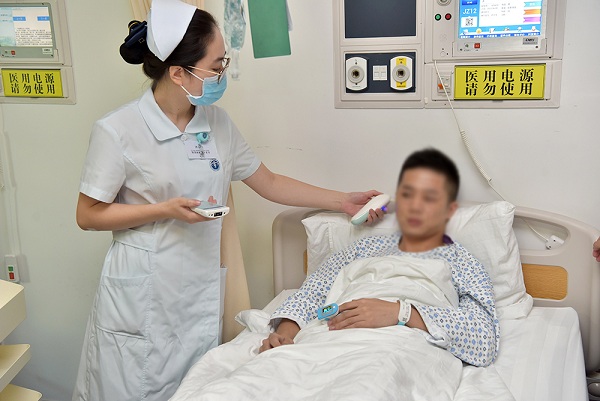
In the wards of Peking University Shenzhen Hospital, the collection of vital signs has shifted from traditional manual measurement and recording to the use of devices such as pulse oximeters, wireless infrared ear thermometers, and wireless blood pressure monitors.
Through these devices, nurses can easily collect patients’ vital signs, including body temperature, heart rate, blood oxygen saturation, blood pressure, and pulse. Patients no longer need to be firmly restrained or entangled with wires, significantly enhancing nursing comfort.
For patients who are bedridden for extended periods, require continuous monitoring, or are unwilling to accept contact-based monitors, non-contact smart monitoring systems can be used.
According to VCBeat, this product, jointly developed by Lianxin and EarlySense, a renowned Israeli medical device company, enables contactless monitoring of patients, accurately measuring and transmitting vital signs data such as heart rate, respiratory rate, bed exit status, and turning movements.
In addition to the fully closed-loop intelligent infusion management system and the intelligent vital signs acquisition system, Lianxin has also developed a series of hardware and software products around clinical needs to help medical staff improve efficiency.
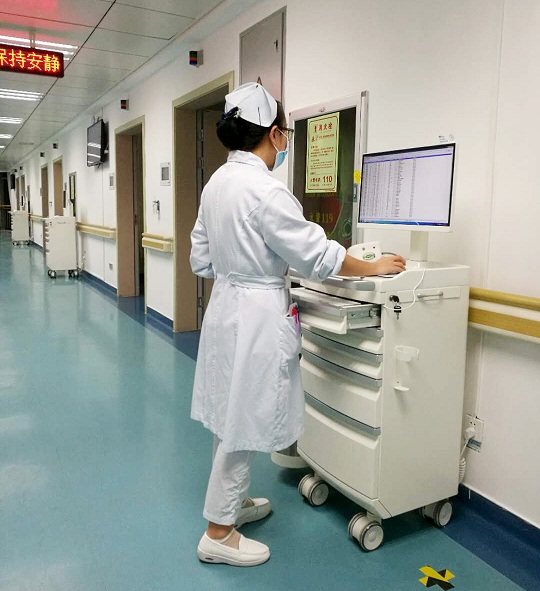
In the past, nurses often had to make multiple trips to complete nursing tasks. Now, with mobile nursing workstations, they can bring commonly used nursing tools and medications to the bedside in one go, while also accessing patient information, medical orders, and other data at any time. This effectively reduces the frequency of nurses' back-and-forth movements, improves work efficiency, and truly realizes the goal of "giving time back to nurses and returning nurses to patients."
Furthermore, Lianxin has also equipped physicians with a dedicated “Intelligent Assistant”—the Mobile Physician Workstation. By leveraging the Mobile Physician Workstation and the Clinical Medical-Education-Research System, physicians can rapidly retrieve and review patient conditions at the bedside. The system employs proprietary cognitive algorithms to deeply mine medical data, thereby assisting physicians in diagnosis and treatment, as well as in teaching and scientific research.
Mobility is the core user experience of the cart. Traditional mobile carts often fall short in terms of caster smoothness, brake responsiveness, and system startup speed during use.
Compared with traditional equipment, Lianxin’s mobile workstations feature numerous product innovations. Wang Pan enumerates them with ease: first, in terms of appearance, the entire unit adopts a concealed cabling design, with no visible cables anywhere on the device; for mobility, it is equipped with ultra-quiet, anti-slip, tangle-free casters that make pushing effortless, and incorporates a proprietary one-touch braking technology, allowing users to engage the brake with a simple press; furthermore, the cart features an integrated design that enables one-touch power-on and power-off, thereby delivering exceptional speed and efficiency in system user experience.
In terms of appearance, the two products closely resemble robots from a distance. Regarding this, Wang Pan stated, “We have reserved significant room for development, with the aim of evolving them into robot-like mobile workstations in the future.”
Lanqiao: The Origin of Union Medical IoT
It is not difficult to see that the various devices used in the “Smart Ward” at Peking University Shenzhen Hospital are seamlessly integrated with the hospital information system. The key technology enabling this integration is the Bluetooth IoT Hub (BlueBridge).
Why Choose Bluetooth Technology to Enter the Medical IoT?
According to Wang Pan, the company conducted extensive research during the early stages of product development and found that Bluetooth technology holds greater advantages in terms of applicability and application prospects compared to other wireless transmission technologies for the Internet of Things (IoT).
Across the entire market, the vast majority of smart devices designed for monitoring vital signs or worn on the body have adopted Bluetooth Low Energy (BLE) as their wireless transmission method. The Bluetooth Special Interest Group (SIG) has specifically defined standard protocols for health devices within its Bluetooth technical specifications. The Continua Health Alliance (CHA) has also selected BLE as the transmission standard for personal area networks. This demonstrates that Bluetooth is not only an integral part of the Internet of Things (IoT) ecosystem but also highlights the development trend in the medical field for the coming years.
“In addition to the advantages of Bluetooth technology, a significant portion of the rationale is based on the actual needs of hospitals,” explained Wang Pan. Traditional Bluetooth connections can only establish point-to-point links within a limited range and cannot communicate directly with hospital data servers. With the widespread adoption of wearable smart devices in hospitals, how should data transmission be handled for such a large number of devices?
Union’s solution is to establish a data channel that can simultaneously connect various Bluetooth smart devices, convert the Bluetooth signals, and transmit them via Wi-Fi to the hospital. This product has an appealing name, “Blue Bridge,” which serves as the core of Union’s in-hospital Internet of Things (IoT) infrastructure.
Lianxin’s in-hospital IoT platform, built on the Lanqiao framework, serves as a supplement to hospitals’ existing backbone information networks, enabling the connectivity of a large number of small-scale smart devices.
“Most previous wearable monitoring devices came with their own dedicated apps, a model that is virtually unfeasible in hospital settings. ‘We are building both a platform and products, while encouraging more manufacturers to join us in co-creating the entire medical Internet of Things ecosystem,’ said Wang Pan.”
According to him, the fully closed-loop intelligent infusion management system achieves smart infusion monitoring through devices such as infusion monitors and Lanqiao. Meanwhile, the Bluetooth IoT platform is open; other manufacturers’ Bluetooth ear thermometers, Bluetooth temperature patches, and similar devices can be connected in real time after passing security certification, enabling true plug-and-play functionality.
It is foreseeable that, driven by companies like Lianxin, a wide variety of Bluetooth devices will be integrated into the medical networks of “Smart Hospitals.” An increasing number of hospitals will also be interconnected through the Internet of Things (IoT), ultimately forming an “Internet of Everything” in the healthcare sector.