

Intuitive Surgical's Real Edge Isn't Just Technology—It's Over 4 Million Global Da Vinci Surgeries and a Vast Network of Trained Surgeons
In October 2017, the FDA evaluated the “hyper-sensitive” Senhance minimally invasive surgical robotic system as being equally precise and superior in performance compared to the da Vinci Surgical System. It seemed that someone had finally stepped forward to challenge the da Vinci robot’s dominant position. However, the situation was not as simple as imagined.
Recently, at the “China Smart Connected Health Innovation Summit” co-hosted by Fosun Pharma and VCBeat, Liu Yu, Senior Vice President of the Fosun Healthcare Technology Management Committee and Chief Operating Officer, stated that although other surgical robots have recently entered or are about to enter the market,However, the da Vinci Surgical System has been a dominant force for over a decade. Its advantages lie not only in its technology but also in the extensive experience accumulated by surgeons through years of performing da Vinci procedures, as well as the large scale of physicians trained to operate the system.
This article is based on Liu Yu’s presentation, “Demystifying the da Vinci Surgical System,” delivered at the summit, and was compiled by VCBeat from an interview.
In addition, with the release of next-generation devices, systems, and instruments, the market size in 2021 is projected to reach $20 billion.
The development of surgical robot technology has led to numerous specialized subdivisions. For instance, recent reports have highlighted the world’s first autonomous dental implant surgical robot, jointly developed by the School of Stomatology at Air Force Medical University and Beihang University, as well as endoscopic surgical robots, orthopedic robots (for spine, trauma, and joint procedures), and neurosurgical and otorhinolaryngological (ENT) surgical robots.
These robots are classified as semi-automatic systems, combining partial automated control with manual surgeon operation to perform surgeries. Compared to the first generation of simple robotic arms, they offer features such as tremor filtration and remote control. The original intention behind the development of the da Vinci Surgical System was to serve astronauts in space by enabling remote operation of robotic arms.
However, enabling robots to perform automated cutting and suturing without the need for physicians, akin to autonomous vehicles, is not currently feasible. Beyond technical limitations, the more significant barriers include safety concerns, ethical issues, and regulatory policies imposed by governments worldwide.
The FDA has clear regulations stipulating that surgical procedures must be performed by physicians. Therefore, it is important to clarify a common misconception: what we commonly refer to as “medical robots” are more accurately described as “medical assistant robots.” These systems do not perform surgeries autonomously; rather, surgeons conduct the procedures by manipulating robotic arms to control surgical instruments under computer assistance. Consequently, the surgeon’s skill level determines the quality of outcomes in robot-assisted surgery.
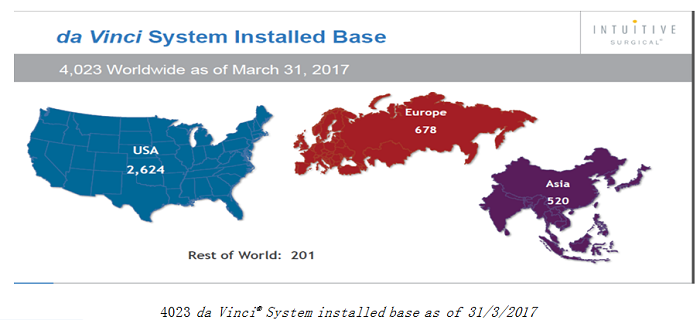
As of March 31, 2017, the global installed base of da Vinci surgical robots stood at 4,000 units; by late October of this year, it is estimated to have exceeded 4,200 units. Of these, approximately 3,000 are in the United States and around 550 are in Asia, with Japan accounting for nearly 260 of the Asian installations.South Korea has approximately 60 units, while mainland China and the Hong Kong Special Administrative Region combined have 78 units. This is primarily because surgical robots are classified as Class A large-scale medical equipment, requiring government approval for hospital procurement and use. Specifically, such large-scale equipment can only be purchased through centralized procurement after obtaining configuration permits following technical reviews conducted in accordance with established allocation plans.
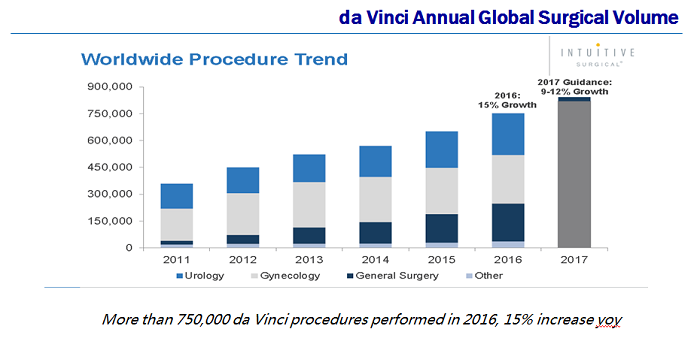
Currently, the number of surgeries performed using the da Vinci Surgical System is growing at an annual rate of 15%. This growth does not stem from an increase in the total global volume of surgeries, but rather from a shift of certain conventional procedures to robotic-assisted surgery, which clearly demonstrates the appeal of the da Vinci robotic system.
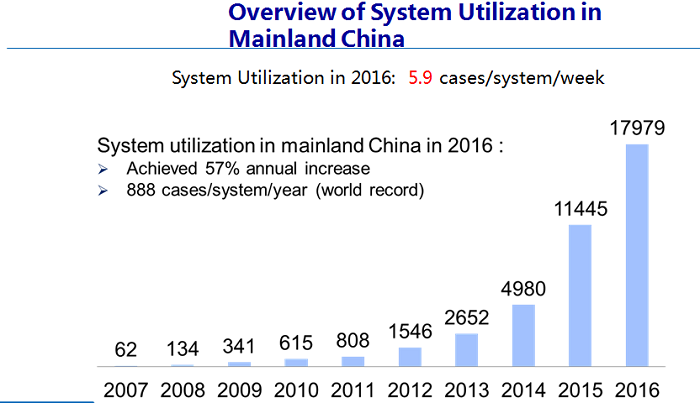
This chart illustrates the surgical volume of da Vinci Surgical Systems in China. The total number of procedures performed in 2010 was 615, which rose to 18,000 by 2016. The volume is projected to exceed 27,000 in 2017, with 12,000 procedures already completed in the first half of the year. Currently, more than 600 surgeries are performed each week, a figure that has already reached the total annual volume recorded in 2010.
Furthermore, China’s per-unit surgical utilization rate for robotic systems ranks first globally, standing at twice the world average. Currently, the average annual number of surgeries performed per robotic system in China is 384, compared to just over 140 in the United States. To date, the da Vinci Surgical System has completed more than 60,000 procedures in China.
As the Chinese distributor for the da Vinci Surgical System, Liu Yu has worked with the platform for a decade. He believes that while the da Vinci’s technology is undoubtedly industry-leading, it is not insurmountable. Currently, countries such as China, South Korea, and Japan are actively researching surgical robots, and industry giants like Medtronic and Google are also engaged in R&D. These nations and companies possess robust technological capabilities, substantial funding, top-tier experts, and large patient populations. So why has no product comparable to the da Vinci system emerged yet? There are many factors at play.
1. Da Vinci's first-mover advantage,Da Vinci entered the market early and holds numerous patents. Moreover, its technologies align with physicians’ clinical workflows, compelling other companies to circumvent these design features during their R&D efforts to avoid patent infringement.。
For instance, to achieve magnification, users hold objects close to their eyes with both hands, similar to reading a newspaper. To circumvent this technology, other companies opt for moving the body forward; while this achieves the same effect, it does not align with natural human behavioral patterns.
No. 2,The da Vinci Surgical System has been on the market for many years. Many surgeons who operate the da Vinci system have performed a large number of robotic surgeries and are largely accustomed to using this platform, making it somewhat challenging to transition to alternative systems.。
A company once sought to invite experts to endorse its product after they had experienced it. While the experts acknowledged the merits of its robotic system, they were accustomed to operating the da Vinci Surgical System and were reluctant to switch. This year, the robot manufacturer, together with Fosun Pharma and Changhai Hospital, established a da Vinci International Training Center. The center is capable of training 100 lead surgeons annually, thereby securing the future growth in the volume of da Vinci robotic surgeries.
The da Vinci system is not invincible; in the era of artificial intelligence, for various robotics research companies to surpass da Vinci,The first step is not to imitate, but to forge a new path—for instance, by developing surgical robots dedicated to single-disease procedures.Now that Tianzhihang’s “Tiandi” orthopedic surgical robot has entered the market, its technology has reached a world-leading level. Medtronic and Johnson & Johnson are also actively developing surgical robots. It is believed that more surgical robots will emerge in the market.