QingCloud Unveils Four Healthcare Cloud Solutions in IPO Filing, Targeting Hospital Digital Transformation
Those familiar with the cloud computing market are certainly no strangers to QingCloud, an enterprise-grade cloud service provider.
In June 2017, Qingyun announced the completion of its Series D financing round amounting to RMB 1.08 billion. Investors included China Merchants Securities International, China Merchants Zhiyuan Capital, Sunshine Ronghui Capital, CICC Jiatai, and Oceanwide Investment, among other institutions. Early-stage investors such as BlueRun Ventures and Lightspeed China Partners also participated in the follow-on investment.
According to Chen Weiguang, Managing Partner of BlueRun Ventures, QingCloud possesses technical advantages far exceeding the industry average. QingCloud is one of the few companies in China with an excellent team that boasts international-level technical expertise and commercialization experience. Within just a few years, it has established benchmark clients across multiple vertical industries. By collaborating with partners through its AppCenter, QingCloud provides comprehensive cloud services spanning from IaaS to PaaS and SaaS layers, thereby building a diverse, open, and inclusive cloud computing ecosystem.
As of September 2017, QingCloud had amassed over 100 partners, including Application Center partners and vertical industry project partners. Its public cloud user base had surpassed 80,000 enterprises. Currently, QingCloud has formally embarked on its expansion into the healthcare sector.
For hospitals, cloud computing is an essential requirement
“With the continuous advancement of healthcare, hospitals’ internal IT resources are expanding rapidly. The legacy infrastructure struggles to support this growth, leading to escalating costs. As hospitals are unable to expand their on-premises server rooms, they face a shortage of data center space,” said Sha Xiaomeng, Healthcare Industry Architect at QingCloud, in an interview with the reporter.
In his view, as large hospitals continue to expand in scale and adopt various models of medical consortia, greater investment in human, material, and financial resources is required for the construction and integration of hospital IT systems. Hospitals are increasingly in need of deploying a user-friendly infrastructure to address the growing complexities of healthcare IT.
With the widespread adoption of PACS, hospitals accumulate vast volumes of medical imaging files. Consequently, they must balance rational investment in medical IT with ensuring the secure storage of large-scale data.
Modern hospitals not only serve the role of diagnosing and treating patients but also engage in research on certain diseases, necessitating the deployment of additional medical information systems to support such scientific endeavors. This type of research requires IT systems that are optimized for intensive computational tasks and capable of storing large volumes of both structured and unstructured data, thereby posing new challenges to hospital IT infrastructure.
Hospital information systems must ensure the stable operation of diverse medical systems and support large-scale storage of historical legacy data, while taking investment ratios into account. Meanwhile, in today’s internet era, hospitals are deploying additional billing and patient-convenience auxiliary systems to facilitate payment and clinical visits for patients. Due to the proliferation of internal hospital systems, prolonged implementation timelines, significant operational pressures, and the critical requirement to avoid business interruptions during daily operations, IT maintenance faces substantial challenges.
However, the current traditional medical IT infrastructure architecture is no longer sufficient to address these challenges. This is because hospital legacy information systems generally suffer from the following issues:
1. There are constraints on the server room environment, with limited space in some hospitals;
2. Shortage of operations and maintenance personnel, low operational efficiency, and complex equipment operation;
3. The systems are complex and numerous, resulting in low utilization of device resources and complicated management;
4. Business continuity cannot be guaranteed, and business deployment is slow.
As hospitals continue to expand, their internal IT resources are growing accordingly. In addition to the limitations of the existing infrastructure in supporting this growth, associated costs are also rising. Hospitals are unable to expand their on-premises server rooms and are facing insufficient data center space.
As large-scale hospitals continue to expand and adopt various models of medical consortiums, greater investments in manpower, resources, and funding are required for the construction and integration of hospital IT systems. Consequently, there is an increasing need for hospitals to build a user-friendly infrastructure that can address the ever-expanding demands of healthcare IT.
As hospitals expand in scale, they have accumulated a vast volume of medical imaging files. While making rational investments in healthcare IT, hospitals must also ensure the secure storage of this large amount of data. Due to the proliferation of internal systems, many of which were implemented years ago and are now under significant operational strain, coupled with the critical requirement to maintain uninterrupted daily operations, IT maintenance and operations face substantial challenges.
By leveraging cloud services, hospitals can reduce the costs associated with purchasing traditional hardware servers and lower the proportion of fixed assets within their total asset base, thereby achieving a leaner asset structure.
Hospitals generate vast amounts of medical imaging data. Cloud storage enables long-term, reliable preservation, ensuring multi-copy redundancy for hospital data to guarantee security and reliability.
Qingyun's Four Solutions
Medical consortium hospitals typically face challenges such as a wide variety of business systems, inability to integrate operational data, and localized data storage at individual branches that prevents shared access. Furthermore, due to varying outpatient volumes across different hospitals, data growth cannot be managed uniformly, leading to disorganized procurement of infrastructure facilities.
In response to these challenges, QingCloud Public Cloud can consolidate hospital operational data distributed across different regions into a unified public cloud environment. The horizontal scalability of cloud storage enables hospitals to manage their data more efficiently and plan IT investments with greater clarity.
In response to the national policy of decentralizing medical resources, some large Grade-A tertiary hospitals have established branch hospitals in different regions. This has led to prolonged IT infrastructure construction cycles and low efficiency at these branches, with business data stored across multiple locations, preventing centralized utilization.
In response to this situation, Qingyun Hybrid Cloud offers cloud-based services through integration with partners and implements various strategies, such as transmitting data generated by branch hospitals back to headquarters in real time via dedicated lines or enabling shared usage on public clouds. These measures accelerate the deployment of hospital business systems and enhance convenience for end users.
QingCloud’s public cloud solution enables hospitals to migrate their entire IT business systems to the cloud. Both cloud-native applications and data generated by multiple business systems can be centrally managed and utilized within the QingCloud public cloud environment. Hospitals no longer need to concern themselves with infrastructure maintenance and management, thereby significantly reducing IT operational costs.
QingCloud Object Storage Service
Scenario: Hospitals must retain vast volumes of imaging data in compliance with regulatory standards over the long term, requiring tiered storage and archival services. Strict access controls and data encryption mechanisms are implemented to ensure the privacy protection of patient and provider data.
QingCloud Object Storage Features: MD5-based storage verification during the storage process ensures data integrity during transmission and supports online retrieval. Therefore, compared with block storage, object storage can better meet the storage and access needs of massive medical imaging data in hospitals while significantly reducing storage costs.
The Four Major Advantages of Qingyun
1. For healthcare users engaged in medical research, QingCloud provides mainstream big data analytics platform components. Users can leverage QingCloud’s ETL tools to ingest various types of data into the big data platform’s storage services, and select computational frameworks such as Hadoop, Spark, or Storm for data analysis based on specific analytical scenarios. Additionally, QingCloud offers ELK services to meet users’ data retrieval needs across diverse scenarios.
2. For medical consortium hospitals, QingCloud interconnects sub-zones within the same region via a high-speed transmission network. Hospitals can deploy their services across different sub-zones, establishing an infrastructure system for active-active data centers within the same city to achieve high service availability. Furthermore, hospital users can not only store off-site replicas of their hosts in other sub-zones but also migrate them to other sub-zones. Meanwhile, QingCloud provides millisecond-level failover of public Elastic IP (EIP) addresses between sub-zones, ensuring business continuity for healthcare enterprises.
3. For healthcare users with hybrid cloud requirements: The private cloud management platform provides secure and reliable infrastructure services for production and disaster recovery operations. QingCloud offers flexible hybrid cloud deployment models to ensure business continuity and availability. Ultimately, core hospital business systems are integrated with non-critical business systems deployed on the public cloud into a unified interface for use.
4. QingCloud Dedicated Cloud is a physically isolated, exclusive virtualized resource pool where users have sole access to computing, storage, and network resources, all managed centrally through the management console. It offers the flexibility of utilizing dedicated cloud resources akin to a self-built private cloud. Healthcare users can opt to store core data in this dedicated private cloud to ensure complete physical isolation of their data.
Qingyun's Implementation Cases
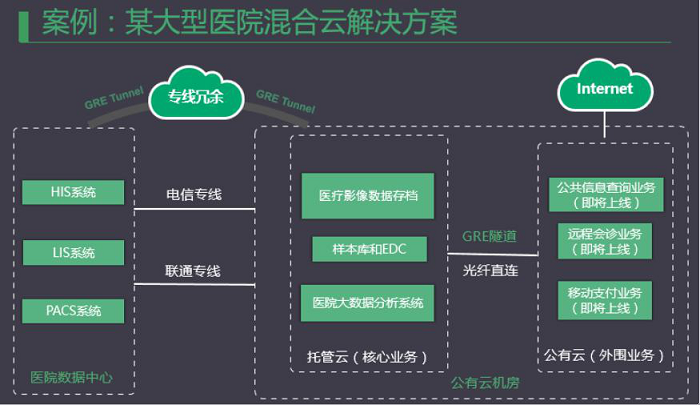
At a Grade A tertiary hospital, QingCloud adopted a hybrid cloud model to drive the transformation and upgrading of the hospital’s IT architecture. By deploying certain medical applications and data on the cloud, the solution addressed space constraints in the hospital’s on-premises data center, while reducing infrastructure investment costs and enhancing operational flexibility.
By leveraging a hybrid cloud storage solution that integrates private and public clouds, medical imaging data and medical sample databases are processed and stored via cloud computing. The system connects to the hospital’s intranet through a private cloud to enable object storage and archiving of image-level medical data, while providing public internet access interfaces via the public cloud to deliver medical services such as information inquiry and mobile payment to the general public.
The hospital has deployed a Hadoop big data cluster on a cloud platform for business analytics, leveraging its big data resources to analyze patient medical records and support scientific research.
Two Physical Dedicated Lines: Two physical dedicated line links are logically bundled into a single logical link. Interconnection addresses are configured on the logical link to increase bandwidth and redundancy, providing load balancing capabilities.
Qingyun's Future Plans
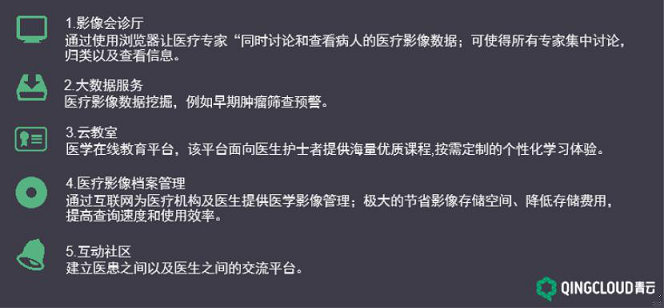
Through integration with its partners, QingCloud will add more available features to its QingCloud Imaging Cloud in the future: