JD Health Recruits Doctors Nationwide Amid Annoroad's $1B Funding and Third HKEX Filing

1
# This Week's Hot Topics
#2017 Medical VR/AR Review#
After the VR/AR boom in 2016, its spotlight has long since been eclipsed by artificial intelligence and robotics this year.This year, the VR industry has become much more subdued, moving away from hype-driven narratives and delving deeper into practical industry applications.
In October 2017, ABI Research released a report stating that the development of medical VR is jointly driven by various stakeholders, including healthcare professionals, hospitals, schools, and medical technology companies. ABI Research predicted that the market value of the medical VR industry would reach $8.9 million this year, and by 2022, this figure would grow to $285 million.
Perspective
1、In China, VR technology is primarily applied in preoperative planning and surgical navigation.
Preoperative Planning
Many physicians diagnose conditions using two-dimensional CT images, which provide only a planar view and preclude comprehensive examination of all bodily structures, thereby increasing the difficulty of making accurate clinical assessments.
VR technology enables three-dimensional visualization of various body parts, allowing for the observation of minute details and internal structures.
Some products allow the use of a stylus to perform comprehensive six-dimensional analysis of body parts, enabling functions such as zooming, panning, rotation, slicing, and coloring.
Surgical Navigation
The navigation system enables physicians to clearly ascertain the current procedural status and subsequent targeting, thereby significantly reducing operational and localization errors. As illustrated in the figure below, the images displayed by VR navigation are superimposed on the original imagery.
In this field, Shenzhen Zhangwang Technology is highly representative. In October 2017, Zhangwang Technology and the Third Affiliated Hospital of Southern University of Science and Technology jointly established a VR Medical Joint Laboratory to co-develop industry-leading VR medical products.
From the current development perspective, preoperative planning and surgical navigation are the most mature applications of VR/AR technology in healthcare, as well as the most promising for monetization.
2、Medical Education Is a Key Area Where VR Excels
Virtual reality systems can provide students with superior medical training that cannot be offered in a classroom setting.
By leveraging technologies such as 3D modeling, localization and ranging, and five-dimensional coordinates (three-dimensional space plus parallel universes), VR offers significant advantages in simulating organ anatomy and virtual surgical procedures that are difficult to match with traditional teaching methods.
Specifically, VR applications in medical education take three forms: panoramic live streaming of surgeries, surgical training, and acupuncture instruction.
3. The first step toward the commercialization of medical + VR is to build a solid product foundation
Healthcare is a traditional and highly rigorous industry with a much lower tolerance for error compared to other sectors. Therefore, the first step for entrepreneurs seeking commercialization is to build a robust product, exercising particular caution with applications involving surgical procedures. During research and development, insights can also be drawn from other industries; for instance, examining how surgical robots address the challenge of force feedback.
During clinical application, companies should engage professionals to conduct summary evaluations in order to secure expert endorsement. If a startup encounters difficulties in fundraising, it may consider applying for research grants to obtain financial support; however, this serves only as a stopgap measure. The most critical priority remains conducting thorough risk assessments.
Last but not least, it is crucial to identify the payers. Only with a continuous influx of capital can a company achieve long-term sustainability. In addition to hospitals, enterprises can also collaborate with other businesses. For instance, partnerships with the robotics industry are viable; although surgical robots enable minimally invasive procedures, their navigation systems require integration with VR or AR technologies, which entrepreneurs should consider exploring.
Meanwhile, the state must also introduce corresponding policy support. Wen Junlei, a senior researcher at the Institute of Virtual Reality and Artificial Intelligence Industry, School of Economics and Management, Tsinghua University, pointed out that the government needs to roll out incentive policies to encourage joint product development between enterprises and hospitals, thereby accelerating the cultivation of an ecosystem for “VR + Healthcare.” This approach would not only address issues related to hospital payment and tender-based procurement, fostering collaborative R&D and innovation between enterprises and hospitals, but also enable hospital research institutions to advance the development of “Healthcare + VR.”
Report
2
This Week's Headlines

3
This Week's Financing Events in the Healthcare Sector
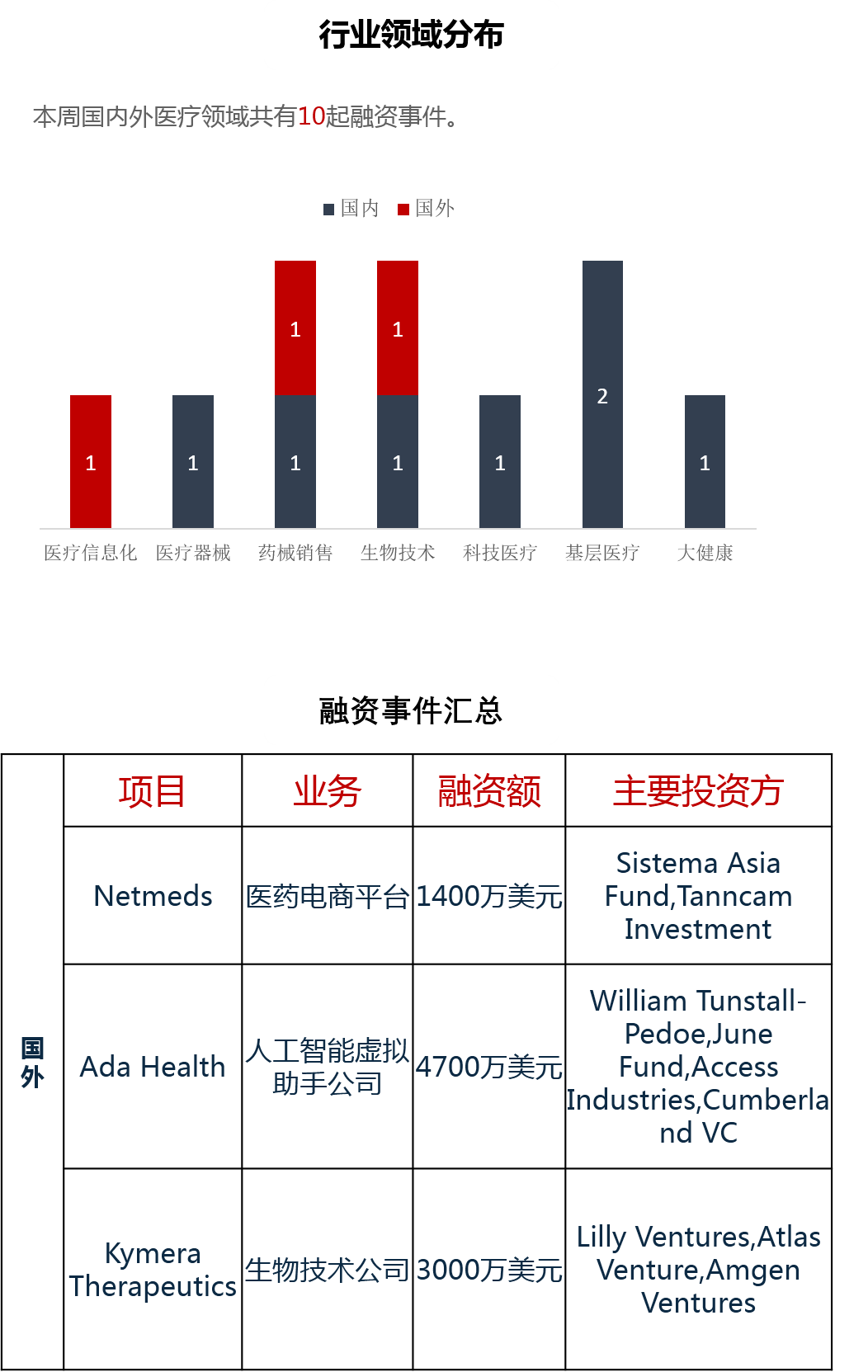

4
Upcoming Events in the Healthcare Sector

5
This Week's Industry Updates

6
This Week's In-Depth Report

7
Member Needs Disclosure


For more content, please visit the VCBeat Knowledge Base!