

Artefact, Founded by Former Apple Engineer, Files IPO for Autonomous AI-Powered Mobile Clinic and Pharmacy Aim
Over the past few years, we have witnessed a boom in the field of artificial intelligence, with a wide variety of emerging tools springing up like mushrooms after rain and becoming integrated into our daily lives. Autonomous vehicles and 24/7 on-demand convenience stores have captured significant public attention, leading to a marked improvement in people’s quality of life.
However, in the healthcare sector, emerging technologies that were already at the forefront have not fully realized their potential. In response, Artefact, a technology design firm based in Seattle, introduced the “Aim” concept and designed a lightweight, autonomous AI clinic to provide door-to-door medical services for patients. VCBeat (WeChat: vcbeat) provided a detailed introduction.
In today’s healthcare experience, regardless of whether patients suffer from chronic diseases or have yet to receive a diagnosis, they are all funneled into a undifferentiated healthcare service system.
Patients’ health data are also stored in disparate systems, making it difficult for clinicians to effectively access relevant patient information. Although we operate within the same societal framework, we fail to consider the consequences when allocating healthcare resources.
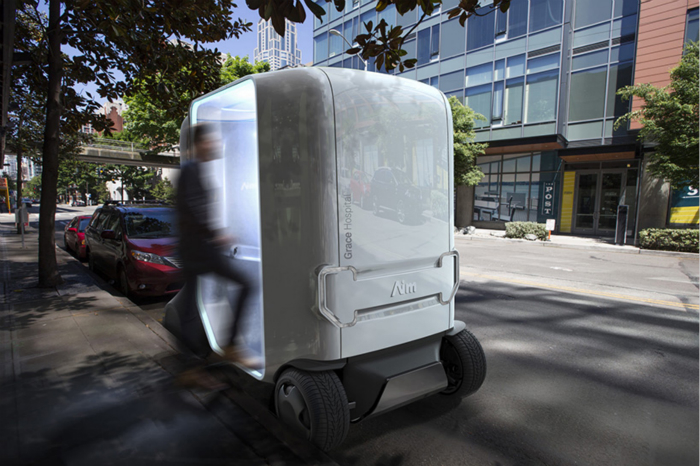
In terms of design, it is a mobile car.
Aim is an emerging service platform proposed by Artefact, designed to lay the foundation for positive health outcomes by delivering enhanced care experiences and novel, flexible models for discovery, understanding, and intervention.
Aim not only stands for Artificial Intelligence and Medicine, as well as Augmented Interactions and Mobility, but also represents the company’s goal of designing and building more integrated and efficient care systems.
Aim: To leverage autonomous vehicle technology and AI to diagnose patients' health conditions, thereby providing more precise medical assessments and addressing their specific healthcare needs.

Rob Girling is a former employee of Apple Inc.
Design consultancy Artefact was founded by Gavin Kelly and Rob Girling in 2006, focusing primarily on consumer electronics, communications, and computer software services, with its headquarters located in Seattle. Founder Gavin Kelly was formerly an employee of Ogilvy, while Rob Girling is a former Apple employee who has also worked at Microsoft, IDEO, and Sony; both were involved in the design of Microsoft Office.
The mission of Aim is to bridge the gaps in data, patient experience, and transportation burden between residential care and outpatient services. The demand-based allocation model in healthcare service delivery, along with a holistic conceptual transformation of the entire industry, not only empowers patients with greater autonomy but also enables care institutions to triage patients more effectively, manage the burden on the healthcare system, and allocate resources efficiently.
In the past, we prioritized the scale and cost of care over its value, resulting in the rigid healthcare system we see today—one riddled with gaps, urgent issues, and disputes. Previous attempts to innovate and rescue this complex system often amounted to robbing Peter to pay Paul, ultimately leaving behind even more problems.The electronic health record (EHR) system is one example.
To address the interoperability challenges in healthcare, we need a system-level approach. A distinctive feature of AIM is its reduced emphasis on the individual. Technologies such as data platforms, autonomous vehicles, and AI-assisted diagnostics already exist; the key lies in how they interconnect and collaborate within a unified system to maximize value for patients, healthcare providers, and society at large.
Aim provides patients with the medical care they need through autonomous driving clinics, minimizing the transportation burden on patients and making it more likely for them to engage in treatment before medical costs rise. At the same time, Aim helps doctors focus on patients with more complex conditions, where their expertise is most needed.
Aim'sThe autonomous clinic, after optimization, is capable of performing diagnostic analyses including temperature, imaging, and respiration for patients.. As soon as you step inside, the floor records your weight. Pressure sensors can measure body mass index and posture. The seat is equipped with built-in acoustic sensors that listen to your breathing like a stethoscope.
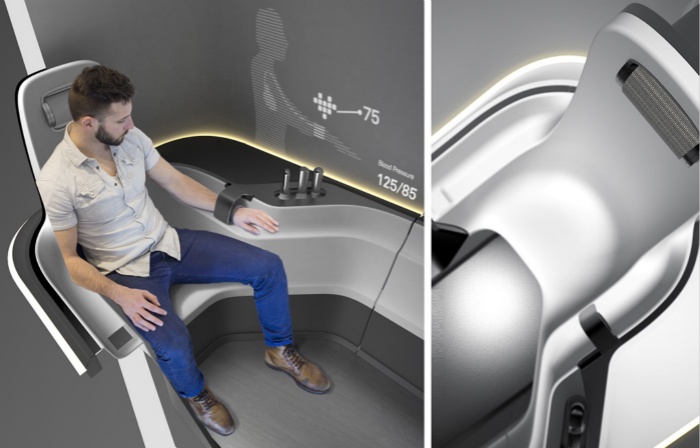
Immersive Experience
Although the care process for each patient varies significantly, existing healthcare systems still structure medical workflows for all patients in a uniform manner. Aim leverages artificial intelligence and autonomous vehicle technology to provide patients with more precise assessments and deliver tailored medical care services.
Aim engages patients in simple interactions, encouraging them to share detailed descriptions of their sensations while integrating with diagnostic tools. The surround screen provides augmented reality (AR) interactivity, and motion sensors work in conjunction with body projectors to guide patients throughout the medical experience, enabling them to precisely indicate the location of pain and helping them focus on their symptoms.
If the self-assessment indicates that the patient needs to consult a physician,The Aim platform will connect the patient with an on-call partner physician. The Aim clinic can also be rapidly converted into an ambulance to transport the patient directly to the emergency room., ensuring the critical time for patients to enter the diagnosis and treatment environment.
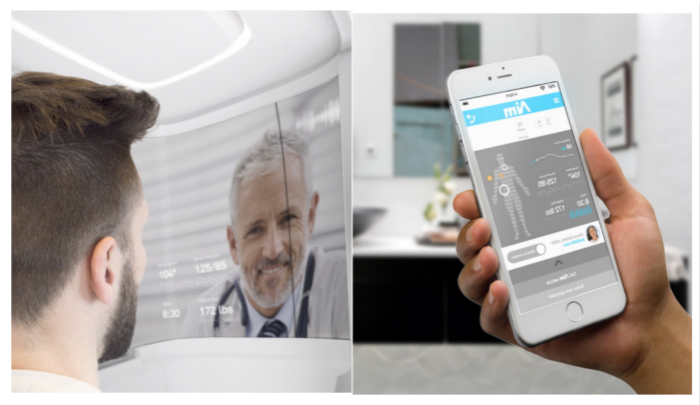
Telemedicine-Assisted Diagnosis and Visualized Data
Additionally, Aim provides patients with highly visualized summaries, making it easier for them to understand their diagnostic results and take action. Patients can access this diagnostic data in real time via a mobile app to facilitate ongoing continuity of care.
For simple prescription refills or basic diagnostic issues, Aim also features a pharmacy that, powered by AI technology, can automatically dispense common medications to patients, such as prescription painkillers, antibiotics, and contraceptive pills.
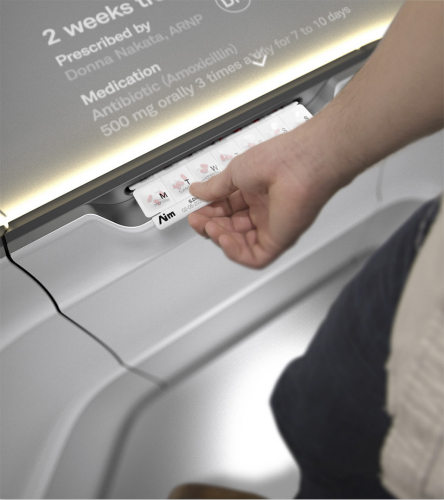
Built-in Pharmacy Function
Aim can also clearly tell you the cost required for a certain treatment,Mine patient data with shared symptoms to enable more comprehensive data analysis, rather than relying solely on individual physicians’ past experience as was previously the case. Aim provides small-scale storage for these frequently used medications, sparing patients the transportation burden of visiting a pharmacy.
Aim envisions the future as follows:Healthcare should be a continuum of care, eliminating the need for patients to visit hospitals.。
Aim: Autonomous Driving Clinic Workflow | |||
Composition | Behavior | AI | |
Data Collection | Machine Learning | ||
Home Health Centers and Equipment
| Integrating Active Testing, Passive Surveillance, and Household Self-Reporting
| Multidimensional, Longitudinal Patient Data Collected at Home and Outdoors | Under constrained conditions, aggregate preliminary sample data from patients and healthcare providers to train AI (supervised learning)
|
Patients and Mobile Apps
| Collect relevant data and provide patients with continuous care across consultation experiences.
| ||
Autonomous Vehicles
| Provides autonomous diagnosis, remote consultation, essential medication stockpiling, and emergency transportation
| Integration of Diagnosis with Specific Data from Immersive Environments | As More Cause-and-Effect Data Enter the System, AI Is Enhanced
|
Patient Population
| Provide extensive data on relevant patient types and medical factors
| Compare integrated data with patient cohort datasets to provide provisional diagnoses for patients and care teams
| The physician reviews the provisional diagnosis provided by the AI, considers other relevant factors, and subsequently further trains the system (unsupervised learning).
|
Nursing Team and Experts
| Evaluate based on automated detection data, provide relevant options, and discuss with the patient. | Physicians' and Healthcare Institutions' Reference to the Likelihood and Recommendations for a Specific Diagnosis
| Matching patterns between relevant data and outcomes can be appropriately adjusted, including factors such as machine utilization and physician bias.
|
Healthcare Institutions and Communities
| Evaluate based on a deep understanding of conditions, testing, and interactive value, and take action. | ||
It all begins in your bathroom, where smart mirrors, toothbrushes, and toilet lights can monitor your vital signs. Should any issues arise, an autonomous clinic will promptly arrive at your doorstep or workplace, automatically guiding you through a series of examinations.
You will be advised to seek medical attention only if your health condition truly requires immediate consultation with a doctor.Physicians will also be equipped with AI assistants that help them review patients’ multi-year diagnostic records and health trends in advance, compare these data with those of individuals having similar health profiles, and subsequently provide preliminary diagnoses and treatment recommendations.
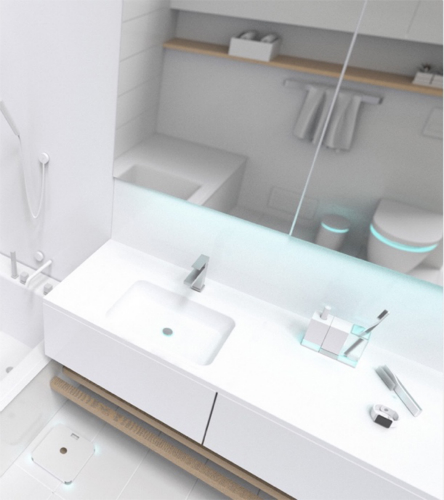
Home Environment: Continuous Collection of Health Data
For anyone following the development of the healthcare industry, these scenes are hardly unfamiliar. It has long been recognized that wearable devices can collect our health data and assist physicians in monitoring our vital signs.
The latest focus of Aim is on the use of autonomous vehicles. Although this car may appear to be merely a showpiece, it is in fact a meticulously designed space.
Matthew Jordan, Executive Creative Director at Artefact, said, “There is more to this car than meets the eye.”It is like a CVS MinuteClinic on wheels, where patients can receive self-guided care through program-directed protocols., thereby reducing healthcare costs.
Regardless of what others may say, the complexity of healthcare is well known. Some of this complexity is inevitable, while a significant portion has, over time, become a burden on the healthcare system, undermining efficiency, patient experience, and cost-effectiveness.
Emerging technologies, new business models, and the growing public focus on personal health have created unique opportunities for us to aim higher, design more efficient healthcare systems, and meet the diverse needs of patients, healthcare providers, and society.
Ben Collette, a designer at Artefact, said, “The challenging part is that we need to create entirely new user experiences based on current technology within one or two years. We haven’t invented anything new; everything you see has either already received clinical validation or is about to do so.”
Doctors will not be completely excluded,Aim still leaves room for telemedicine, as well as remote and in-person consultations.. Artefact pointed out that 52% of Kaiser Permanente's business was conducted online in 2015, and Aim Autonomous Clinics can drive the continued growth of this segment.
The future envisioned by Aim may seem too good to be true. Although the core technologies underpinning Aim are functional, it remains difficult to imagine autonomous driving and automated medical consultations in an era where even Uber still requires human operators.
Insurance companies may need to foot the bill, and patients themselves must adopt a more open attitude toward their personal health data. The U.S. Food and Drug Administration considers these changes necessary, but the healthcare industry’s inherent structure is slow and cumbersome. Ultimately, achieving this will require major companies to collaborate and agree on enabling interoperability of patient data.
Artefact currently has no corresponding clients for this project, and designers have not planned to bring it to market. Jordan said, “What we hope is to let everyone see what the future could look like. So, Aim will serve as a North Star, guiding our expectations. We desperately need better care experiences.”
References:
https://www.designboom.com/technology/artefact-aim-self-driving-clinic-06-23-2017/
https://www.artefactgroup.com/work/aim-healthcare-service-delivery-platform/
https://www.fastcodesign.com/90130217/who-needs-a-hospital-when-this-self-driving-doctor-comes-to-you