

Traditional Chinese Medicine in 2017: Regulatory Easing, Resource Decentralization, Industry Consolidation Accelerates, and 'Internet + TCM' Cools Down – Year-End Review
If 2016 was the “Year of Policy” for Traditional Chinese Medicine (TCM), then 2017 can be described as the “Year of Policy Continuation” for TCM.
On July 1, 2017, the Traditional Chinese Medicine (TCM) Law officially came into effect, legally affirming the significant status of TCM and adhering to the principle of equal emphasis on support and regulation to strengthen oversight of TCM. It also introduced reforms and innovations to existing management systems in areas such as TCM clinic licensing, TCM physician accreditation, and Chinese herbal medicine administration.
In the past two years, important documents such as the Outline of the Development Plan for Traditional Chinese Medicine (2016–2030), the Belt and Road Initiative Development Plan for Traditional Chinese Medicine, the 13th Five-Year Plan for the Development of Traditional Chinese Medicine, and the White Paper on Traditional Chinese Medicine in China have been successively released. As a result, traditional Chinese medicine has gradually become a strategic industry with unique advantages and broad market prospects in national economic and social development.
According to incomplete statistics, by mid-October of this year, national and local competent authorities had successively issued more than 200 policies and administrative orders related to the traditional Chinese medicine (TCM) industry. Among these, national-level authorities issued over 50 policies, while provincial-level authorities issued more than 100. In terms of issuing bodies, the main publishers included the State Council, the National Health and Family Planning Commission, the State Administration of Traditional Chinese Medicine, and the China Food and Drug Administration. Departments such as the National Development and Reform Commission, the Ministry of Science and Technology, and the Ministry of Industry and Information Technology also participated in the formulation of some policies.
VCBeat reviews the development of traditional Chinese medicine (TCM) in 2017 from both policy and industry perspectives, and outlines the trends and pathways for the growth of the TCM industry.
Streamlining Approval Processes Benefits Private Healthcare Providers
In recent years, the field of traditional Chinese medicine (TCM) services has experienced a contraction. The scale and level of development are still insufficient to meet the public’s health needs. In light of the goal established in the Outline of the Strategic Plan for the Development of Traditional Chinese Medicine, issued by the State Council last year, which aims to “ensure that everyone has basic access to TCM services by 2020,” there is an urgent need to comprehensively improve both the scale and quality of TCM service development.
The solution proposed in 2017 was to relax regulatory reviews at three levels—personnel, clinics, and prescriptions—to open up the traditional Chinese medicine (TCM) market, encourage non-governmental entities to establish TCM practices, streamline administrative procedures, lower entry barriers, and ease market access requirements.
The overarching strategy is to improve the TCM service network covering both urban and rural areas, ensuring that TCM medical institutions operated by social entities and those run by the government enjoy equal rights in practice and other aspects.
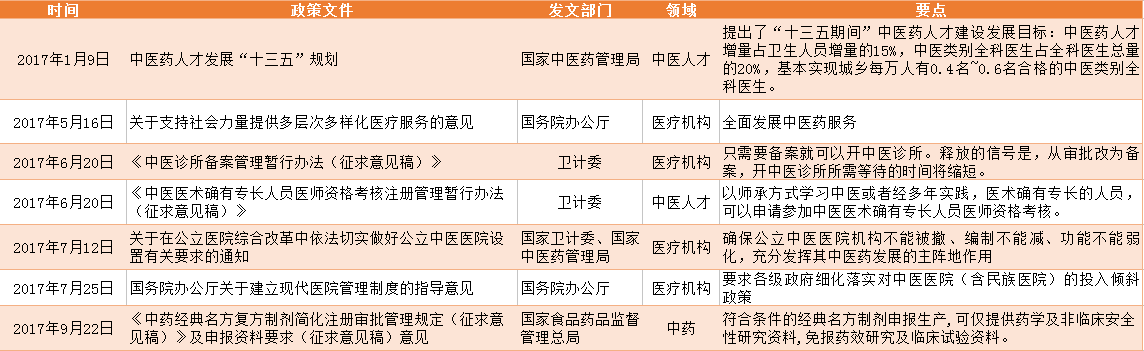
TCM: Policies on Simplified Review, Relaxed Qualifications (Compiled by VCBeat)
Regarding practitioners of traditional Chinese medicine (TCM), the Interim Measures for the Administration of Examination and Registration for Physician Qualifications of Individuals with Demonstrated Expertise in TCM Clinical Techniques stipulate that individuals who have studied TCM through apprenticeship or have developed verified clinical expertise through years of practice may obtain TCM physician qualification upon passing assessments of their practical skills and therapeutic outcomes. Notably, the shift from “examinations” to “assessments,” along with the removal of academic degree requirements, has directly broadened the pathways for becoming a licensed TCM physician.
Regarding traditional Chinese medicine (TCM) clinics, the Interim Measures for the Record-filing Administration of TCM Clinics shifted the regulatory framework from a licensing system to a record-filing system. From an administrative perspective, it is clearly stipulated that if all required documents are complete, the TCM Clinic Record-filing Certificate can be issued on the spot, allowing the clinic to commence operations immediately. This change significantly shortens the waiting time for approval previously required to open a clinic.
Currently, there is a significant mismatch between market supply and demand for Traditional Chinese Medicine (TCM) clinics. According to statistics from the National Health and Family Planning Commission, in 2016, there were 45,241 TCM outpatient departments and clinics nationwide, an increase of 2,713 compared with 2015, while the total number of patient visits to these TCM outpatient departments and clinics reached 140 million.
As the requirements for establishing TCM clinics are relaxed, and the asset-light "in-clinic consultation" model of TCM is more conducive to multi-site practice, the scale of TCM services will further expand. Consequently, the number of individual and chain TCM clinics is poised for explosive growth, making TCM clinics the predominant category among private medical practices.
As an increasing number of TCM practitioners with proven expertise, along with licensed TCM physicians from hospitals, enter the private clinic sector, multi-level, diverse, and multi-demographic market demands will drive the refinement and optimization of TCM services offered by private TCM clinics.
In addition, with the introduction of a series of new policies, the traditional Chinese medicine (TCM) industry has entered a period of dual-driven development fueled by policy incentives and healthcare reform dividends, while the review and approval process for classical formulas has been streamlined. Under the combined constraints of zero markups on TCM services and reduced pharmaceutical revenue share, TCM decoction pieces have become the only pharmaceutical products exempt from these restrictions. Consequently, the industrial output value of TCM, represented by decoction pieces, is poised to reach an inflection point in its growth rate.
According to statistics from VCBeat, 80 out of the 92 listed traditional Chinese medicine (TCM) companies that disclosed their financial results for the third quarter of 2017 reported a year-on-year increase in net profit. Leading listed TCM decoction piece enterprises have intensified their strategic layout in this sector primarily through three approaches: expanding production capacity, deepening downstream sales channels by establishing hospitals and clinics, and acquiring upstream herbal raw material production bases.
However, “opening up” does not equate to “relaxing oversight.” As access to traditional Chinese medicine (TCM) services is fully liberalized, regulation of TCM clinics and quality control of Chinese herbal medicines will be strengthened.
These documents cover the entire ecosystem of traditional Chinese medicine (TCM), encompassing relaxed market access for TCM medical service institutions, the cultivation and protection of TCM practitioners, as well as the planning and development of the herbal medicine supply chain. Together, these measures reflect the government’s proactive “open” stance toward the TCM industry this year.
Emerging TCM Sector Gains Investor Favor as Services Become More Specialized
According to public information, there were a total of seven financing events this year. As of November 1, 2017, the total amount of financing explicitly disclosed by emerging TCM (Traditional Chinese Medicine) startups was approximately RMB 1.136 billion. In terms of financing rounds, there was one case each for Seed round, Angel round, Series A, Series B, and Series D, and two cases for Pre-Series A.
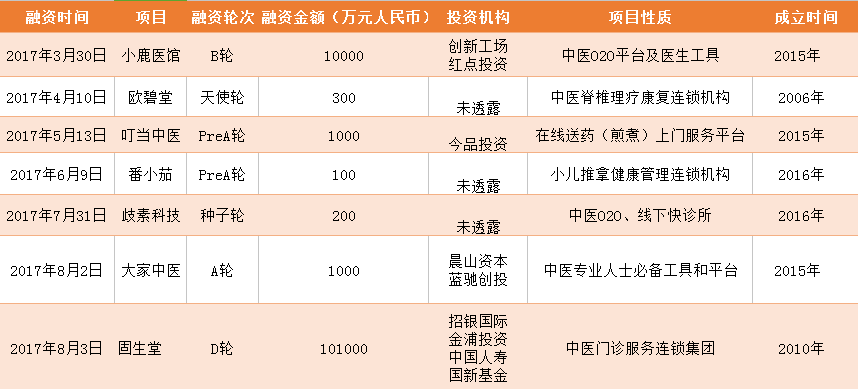
In terms of service delivery, online TCM platforms such as Xiaolu Yiguan, Dingdang TCM, and Qisu Technology are leveraging their accumulated online traffic to establish offline clinics or medical halls, introducing the “in-house physician + self-operated pharmacy” model. This reflects a clear trend of shifting from online to offline TCM consultations, with significant channel penetration into lower-tier markets.
Riding the wave of the sharing economy, shared traditional Chinese medicine (TCM) clinics have begun to emerge. The core concept of shared TCM clinics is to leverage offline pharmacy resources and utilize medical facilities, clinical services, diagnostic and treatment equipment, and TCM pharmacies within these shared spaces, against the backdrop of physicians practicing at multiple locations.
In terms of service offerings, offline TCM services are becoming increasingly specialized, with pediatric tuina, spinal rehabilitation, and health management—services in high demand among urban populations—gaining popularity.
Compared with traditional TCM clinics, emerging startups tend to focus their services on urban young demographics with higher levels of education, such as office white-collar workers and young mothers.
This year, investment in emerging TCM enterprises has primarily come from three sources of capital: private, foreign, and state-owned. Among these, private capital is the main force investing in emerging TCM projects, while international capital is gradually entering the TCM investment market.
Compared with the previous year, there were 21 explicitly disclosed financing events for emerging TCM (Traditional Chinese Medicine) startups in 2016, with a total financing amount of nearly RMB 800 million. Consequently, while the number of financing deals in 2017 dropped by two-thirds, the total financing volume increased. Among these, Gushengtang and Xiaolu Yiguan secured substantial funding for two consecutive years, accounting for the majority of the total financing raised by emerging TCM projects.
It is worth noting that since 2015, “Internet + Traditional Chinese Medicine (TCM)” has become the primary category for TCM-related startups. The prevailing trend has been to create online O2O platforms for lightweight consultations and appointment scheduling through new media channels such as mobile apps, websites, and WeChat official accounts. There were 19 and 20 financing deals in the TCM sector in 2015 and 2016, respectively, but this number dropped to only seven in 2017, indicating a cooling of investor enthusiasm.
Through an analysis of this year’s financing projects, VCBeat has found that Traditional Chinese Medicine (TCM) O2O ventures have entered a period of industry cooling, with competition for online traffic reaching saturation. “Leveraging” existing online traffic and brand recognition to pursue transformation has become one of the key directions for many TCM entrepreneurs.
Following the implementation of the filing-based registration system for TCM clinics, entry requirements have been relaxed. Projects with a large pool of TCM practitioners are leveraging this policy tailwind to expand their offline clinic networks. By partnering with renowned pharmaceutical companies or pharmacies and facilitating multi-site practice for TCM physicians, they are using asset-light TCM clinics to access the terminal market for TCM diagnosis and treatment, thereby launching new business models.
In the race to capture offline clinical endpoints, chain TCM clinics will see explosive growth. Furthermore, as industry consolidation and reshuffling intensify, financial strength will become a decisive factor in determining the offline expansion strategies of TCM startups, leading to an increase in mergers and acquisitions.
In this context, TCM clinics catering to different fields, populations, regions, and levels will emerge, with service models undergoing innovative upgrades, services becoming more refined, and service offerings growing more diverse. This will also inject new vitality into the grassroots TCM industry.
Pharmaceutical Companies Enter the Diagnosis and Treatment Sector, Accelerating Industry Consolidation
“Data from the Outline of Strategic Plan for the Development of Traditional Chinese Medicine (2016-2030)” shows that in 2014, China had 3,813 traditional Chinese medicine manufacturing enterprises, with a total industrial output value of RMB 730.2 billion, and traditional Chinese medicine has spread to 183 countries and regions.
"The 13th Five-Year Plan for the Development of Traditional Chinese Medicine" elevated the TCM industry to the status of a "key pillar industry in the national economy" for the first time. During the 12th Five-Year Plan period, the main business revenue of Chinese herbal medicine enterprises above designated size grew from RMB 317.2 billion to RMB 786.7 billion, representing an average annual growth rate of 19.92%.
It is projected that during the “13th Five-Year Plan” period, the main business revenue of traditional Chinese medicine (TCM) enterprises above designated size will continue to maintain rapid growth, with the total revenue expected to reach RMB 1.5823 trillion in 2020, surpassing the one-trillion-yuan mark. The average annual growth rate is anticipated to reach 15%, which will serve as a significant boost of confidence for investors entering the TCM industry.
According to Choice data, based on the Shenwan Hongyuan industry classification, there are a total of 74 listed traditional Chinese medicine (TCM) companies in the A-share market, an increase of nine compared to last year. In the first three quarters of this year, these 74 listed companies achieved a total operating revenue of RMB 187.576 billion and a net profit attributable to shareholders of the listed company of nearly RMB 24.73 billion.
Driven by policy support, industrial consolidation has accelerated significantly compared to previous years.
According to incomplete statistics, since 2017, there have been more than 60 M&A and investment cases in the traditional Chinese medicine (TCM) industry, surpassing the total number of M&A transactions in the TCM sector for the entire year of 2016. From TCM decoction pieces and proprietary Chinese medicines to TCM hospitals and clinics, industrial capital has focused its attention on the entire value chain of TCM health services.
Furthermore, traditional Chinese medicine (TCM) hospitals and TCM clinics are also emerging as new “hunting grounds” for industrial capital.

Notably, it has become a trend for traditional Chinese medicine (TCM) pharmaceutical companies to expand into the downstream sector of TCM diagnosis and treatment. By the end of October 2017, there had been four cases of TCM medical institutions being acquired by pharmaceutical companies.
With the promulgation and implementation of laws and regulations related to Traditional Chinese Medicine (TCM), as well as the improvement of clinical service capabilities and systems for Chinese herbal medicine, the incremental market generated by TCM services will become more attractive.
On one hand, healthcare reforms have encouraged private capital to enter the clinical service sector and relaxed market access restrictions for traditional Chinese medicine (TCM) clinics; on the other hand, amid policy shifts such as the elimination of “drug-revenue-dependent healthcare” and the implementation of “zero markup” policies, TCM herbal decoction pieces have become the only category of pharmaceuticals exempt from these restrictions, resulting in substantial market growth.
Therefore, listed pharmaceutical companies represented by Kangmei Pharmaceutical have leveraged their strong financial capabilities to actively participate in public hospital reforms, establish smart pharmacies and clinics, and acquire TCM hospitals and clinics, thereby laying out the entire traditional Chinese medicine (TCM) industry chain and building a chain of TCM clinic groups.
Technological Innovation Drives the Intelligent, Modernized, and Standardized Development of Traditional Chinese Medicine
How to Promote the Modernization and Standardization of Traditional Chinese Medicine Has Always Been a Challenge in the TCM Industry.
To address the long-standing issue of insufficient innovation in Traditional Chinese Medicine (TCM), the policy direction proposed this year is to integrate TCM with modern technologies and build a comprehensive technological system. This approach aims to empower traditional TCM through big data research and development, intelligent application platforms, and smart diagnostic and therapeutic equipment, thereby unlocking the production capacity of TCM.
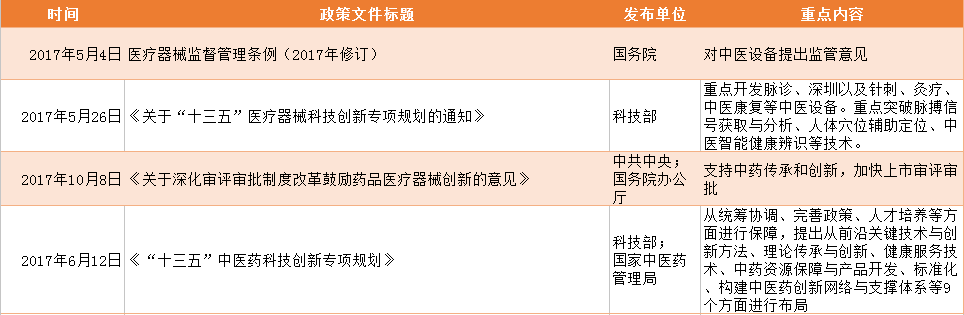
To this end, on June 12, the Ministry of Science and Technology issued the Special Plan for Scientific and Technological Innovation in Traditional Chinese Medicine during the 13th Five-Year Plan Period, emphasizing the need to carry out research on technologies related to TCM preventive treatment of disease, rehabilitation, medical instruments, big data development in TCM, and “Internet+” TCM services, so as to establish a TCM technological system.
Smart Traditional Chinese Medicine (TCM) integrates next-generation information technology products to optimize the allocation and utilization efficiency of grassroots TCM resources, thereby meeting the multi-level and diversified TCM service needs of different populations across various regions. Current explorations into Smart TCM are fully leveraging the rapid advancements in medical informatics and artificial intelligence, with the aim of facilitating the decentralization of TCM resources.
The integration of Traditional Chinese Medicine (TCM) with modern technology must progress through stages of digital inheritance, large-scale application, and finally, big data-driven intelligence. TCM incorporates computer-based information products, leveraging the advantages of the internet in areas such as big data mining, information storage, and information maintenance.
Challenges such as the sourcing of clinical data in Traditional Chinese Medicine (TCM), along with the difficulties in standardization and scaling, remain significant obstacles to the commercial implementation of TCM big data and AI-driven solutions. Nevertheless, driven by efforts from national authorities, research institutions, and enterprises alike, the development of the TCM industry and its intelligent transformation is gaining momentum, making its future prospects highly promising.
Outlook
VCBeat believes that the policies related to traditional Chinese medicine (TCM) in 2017 will continue the “encouraging” and “liberalizing” stance of the previous two years. The industry is showing a clear trend of marketing efforts shifting downward toward clinical endpoints, strategic expansion into the broader health sector, and accelerated integration. The following trends are expected:
1. As regulations governing traditional Chinese medicine (TCM) clinics are relaxed, the number and scale of individual and chain TCM clinics are poised for explosive growth, with services becoming more specialized and diversified;
2. It will become a trend for traditional Chinese medicine (TCM) enterprises to expand into downstream diagnosis and treatment terminals, and cooperation between TCM hospitals and social capital will deepen;
3. Relaxed review and approval for classic famous formulas; the exemption of clinical trials for proven prescriptions in R&D is promising and will become a new profit growth point for pharmaceutical companies;
4. The “Internet + TCM” project is seeking transformation, combining online traffic with offline diagnostic and treatment terminals to form a development model for the “new retail era” of Traditional Chinese Medicine;
5. Capital is concentrating on leading enterprises, industrial consolidation will accelerate, and the number of M&A transactions will increase;
6. Big data and intelligent technologies in traditional Chinese medicine will achieve commercial implementation, unlocking new productive capacity;
7. The elderly care, maternal and infant, pediatric, and tourism sectors within the broader health industry have emerged as new strategic directions for Traditional Chinese Medicine (TCM). By integrating TCM culture, medicinal materials, and therapeutic efficacy, these sectors are evolving into a new industrial economy.