

Yue Health Files for IPO: Capturing 30% of Pregnant Women in Guangzhou with Content-Driven and Tech-Enabled Maternal-Child Health Platform
With the opening of the two-child policy, the maternal and infant service industry has welcomed significant opportunities. According to Analysys forecasts, China’s maternal and infant service market reached $244 billion in 2015, representing a 15% growth, and is projected to reach $500 billion by 2020.
Faced with a maternal and infant health service market characterized by rigid demand and rapid entry into an explosive growth phase, various traditional institutions are vying for market share. Consumers find it increasingly difficult to choose among the dazzling array of service offerings and institutions that all claim to be “professional.” Consequently, the emergence of a pure maternal and infant health service platform, built around core user-specific needs, is becoming increasingly urgent.
The era when the nascent internet could generate massive traffic dividends in the maternal and infant sector through a simple “portal + community + e-commerce” model has passed.
Various platforms built around the numerous needs of maternal and infant populations are fragmenting user traffic, while there is an urgent need for a new platform to meet demands for high-quality scientific education and matching with local maternal and infant services.
Guangzhou Haihui Mingkang Information Technology Co., Ltd. was established in 2015. “Yue Health” is a platform it developed, focusing on maternal and infant health services, with the mission of empowering expectant and new mothers to better care for their own and their babies’ health.
Yue Health not only provides users with professional, high-quality popular science content to maintain user retention and high engagement, but also leverages big data mining models to build an intelligent platform for curating healthy lifestyle options. This platform establishes convenient channels for users to access and experience health services, thereby meeting the needs of both users and reputable merchants for communication and service delivery.
In Guangzhou’s urban areas, approximately one in three pregnant women uses Yue Jiankang. By leveraging professional health education content and proprietary technological advantages, Yue Jiankang integrates high-quality merchants to create a maternal and infant platform favored by young people in the mobile internet era.
What is the company’s strategy, and how did it achieve such remarkable results in such a short period? To find out, VCBeat (WeChat: vcbeat) conducted an exclusive interview with Hu Min, founder of Yue Health.
For mothers and infants, users are extremely cautious when making decisions on health-related issues, unlike ordering food delivery or group-buying deals, where simply checking reviews suffices.
“This belongs to the opaque information service industry. For instance, when a young mother looks for a postpartum care center, she will certainly clarify factors such as location, distance from home, service offerings, and the level of medical and nursing care. Generally, she will only choose facilities within a 5-kilometer radius and place orders between 16 and 28 weeks of gestation. This is not as simple as ordering food or takeout, where one can make a decision merely by checking user reviews on Meituan,” said Hu Min.
Now, the traditional format of posting in general mother-and-baby communities is struggling to capture user attention. Users are increasingly seeking professional, high-quality science-based health education content.
Yue Jiankang drives traffic through content, which is divided into two parts: health education knowledge primarily based on professional doctors’ science popularization, and high-quality health services that complement it.
Among these, the IP-based “Health Consultant” persona, which is popular among younger users, holds a pivotal position on the platform. Behind these health consultants lies an operations team primarily composed of professionals with medical and healthcare backgrounds. The team also invites physicians, specialists, and professors from hospitals to repeatedly deliberate and educate on the same maternal and child health issue, distinguish pseudoscience from evidence-based practice, identify effective solutions, and present them to users in an internet-friendly format.
 Yue Jiankang’s IP as a health consultant for youthfulness is backed by professional content and medical talent.
“For postpartum exercises, we invite medical experts to provide interpretations based on rehabilitation principles. The content is presented from a purely professional perspective and is not intended for profit. Through long-term, credible health education courses, we have built trust with the community of mothers.”
This popular science content features daily interactive Q&A sessions and weekly thematic courses, primarily focusing on pure educational material that garners high interest among mothers. Topics include newborn health and care, authoritative guidance on prenatal exercise, and scientific parenting.
“These high-frequency public health education campaigns are offered free of charge to users, yet they require substantial operational efforts behind the scenes. The aim is to help mothers fill knowledge gaps and pave the way for them to select appropriate health services in the future.”
The reporter accessed the “Yue’er” and “Yueyun Wanda” mini-programs on the Yue Health platform, where daily health Q&A sessions are archived in note format. These archives compile questions raised by tens of thousands of real users on the Yue Health platform and present them to interested users primarily through audio, supplemented by text and images.
“The archived Q&A content is designed for mothers to search when their specific questions cannot be addressed directly. In reality, many maternal health inquiries are quite similar, and it is impractical for physicians to respond to every individual question; we encounter such scenarios on a daily basis. Additionally, we host weekly open lectures, featuring leading experts in the field who provide insights on trending topics, which attract significant attention.”
Certainly, Hu Min also highlighted a broader context: the middle class in first-tier cities generally has a strong health consciousness and a high willingness to pay for services. They require advanced technology, robust diagnostic and treatment systems, and high-quality service to meet their needs. Their goal in childbirth is to obtain superior, more professional care rather than to save money.
Yue Health’s popular science content is co-produced in collaboration with hospitals and professional maternal and infant care institutions, a model that has been widely embraced by healthcare providers. “Hospitals lack the time to systematically deliver services in out-of-hospital settings, particularly obstetricians and gynecologists, who are heavily burdened with prenatal check-ups, deliveries, and other clinical responsibilities. Health education efforts are constrained by insufficient staffing and resource allocation, despite strong demand. As a result, our ‘Evening Q&A’ and ‘Open Course’ channels have gained significant popularity among mothers, hospitals, and industry partners.”
It has been reported that the service matrix of the Yue Health platform consists of a Doctor Services APP, a WeChat Service Account, mini-programs for “Wan Da” (Evening Answers) and open courses, a microservices official website, and branded health consultants.
Why Adopt an IP-Driven Health Advisor Model? Hu Min told reporters, “Our current user base is predominantly composed of individuals born after 1985, with a significant proportion from the post-1990 generation. They prefer learning online and are less inclined to attend traditional, non-interactive lectures at hospitals. In addition to popular science articles, the platform offers micro-courses and micro Q&A sessions, leveraging high-quality physician resources and a social, interactive operational model to meet the needs of younger users. Socially interactive content has always been our core focus.”
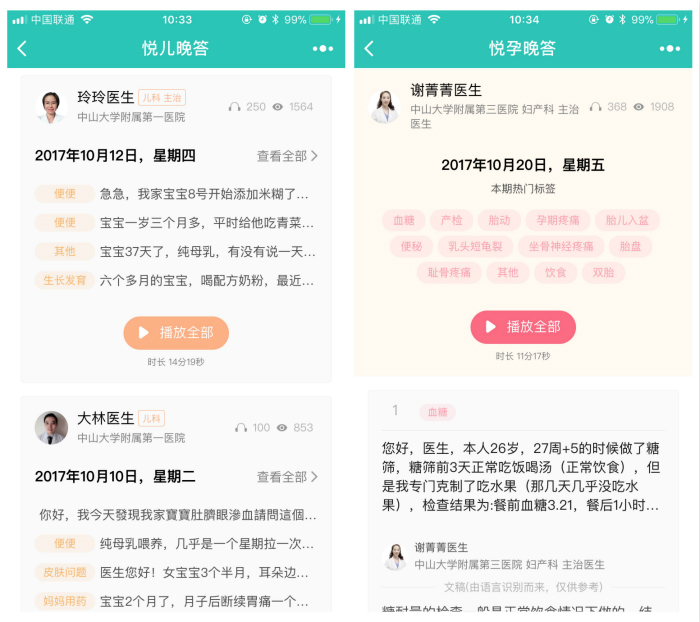
Yue'er and Yue Yun: Professional, Highly Interactive Late-Stage Pregnancy Q&A
Health advisors establish one-on-one social interactions with users, while tailoring channel content based on the user’s menstrual cycle and location settings. This effectively assigns precise tags to each user, enabling the continuous delivery of targeted popular science information according to the actual needs of young mothers. The published content also evolves with advancing gestational weeks and the baby’s growth, adapting to each new developmental stage.
“Our IP characters emphasize the role of consultants in operations. They help users connect with experts, organize courses and offline events, and foster closer engagement through social interaction. In the medical and health sectors, physicians’ specialties are highly fragmented; for instance, a physician specializing in prenatal diagnosis cannot deliver content on ultrasound imaging. However, mothers require a broad spectrum of dispersed health knowledge, which necessitates integration by consultants.”
Hot topics are typically selected from two dimensions. One is seasonal; for instance, hand, foot, and mouth disease peaks during the autumn and winter seasons, prompting the immediate production of content on pediatric cough. The other dimension involves emerging issues, such as vaccine-related concerns or cesarean section debates, which are addressed by frontline experts.
“The second dimension is based on users’ personal experiences, addressing a wide range of frequently raised questions. Each day’s evening Q&A session begins by collecting questions, from which representative ones are selected for one-on-one responses, while the remaining questions are archived into the audio Q&A library. Through continuous operational efforts, the platform has accumulated a vast repository of high-quality audio Q&A content and themed public courses,” explained Hu Min, outlining Yue Health’s principles for content operations and course development.
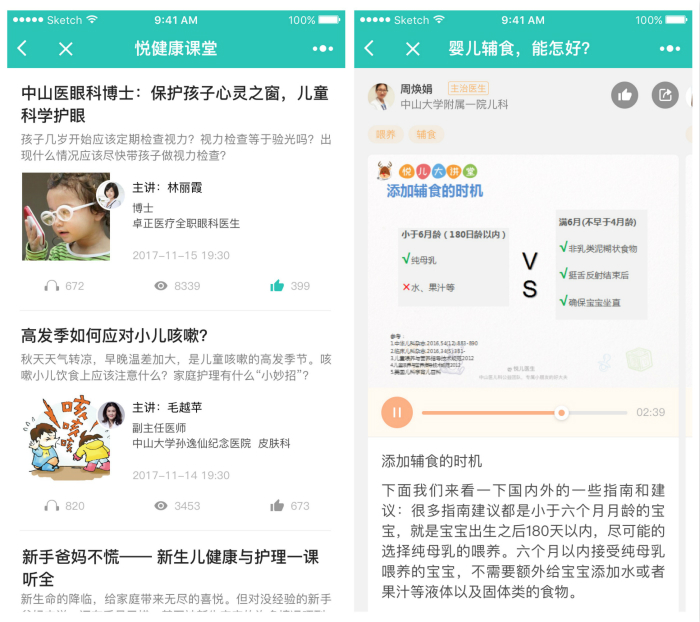
"Yue Health Classroom" features hot topics of concern to mothers.
Courses, outlines, and Q&A sessions on Yue Health all adopt a live rapid-response mechanism. This ensures that high-ranking, high-quality questions are answered by physicians who possess both strong clinical expertise and a keen service orientation, rather than relying on pre-recorded courses as seen on some other platforms, which often appear tedious to mothers. This process requires coordinated efforts among multiple team members, and our team has undergone extensive collaboration to achieve this level of synergy.
Hu Min stated that only by effectively managing content can one be qualified to discuss subsequent service screening: “For users, consumption of maternal and infant health services follows a certain cycle; although it is a rigid demand, overall frequency remains low. Therefore, earning user trust in the platform is no easy feat.”
In a nutshell, Yuejiankang’s business model uses enhancing maternal and infant populations’ awareness of health services as a customer acquisition channel, offering interactive health education that differs from the research-oriented prenatal classes provided by hospitals. This approach maintains trust and user engagement while matching high-quality health services to users with purchasing power, thereby minimizing industry cycle time.
For merchants, advertising slots on large maternal and infant communities and platforms are becoming increasingly expensive. Moreover, as these platforms deliver nationwide traffic, offline businesses with a limited service radius—such as postpartum care centers and postnatal exercise rehabilitation providers—experience very low conversion rates.
“Mere advertising models are no longer sustainable; they have become unviable. We approach this from the perspective of user needs, curating reputable merchants to allow users to experience services with low barriers before deciding whether to make a purchase. We then charge merchants only upon successful transactions. This performance-based revenue-sharing model has high entry barriers, testing a team’s comprehensive capabilities in data processing, content production, merchant selection, and health services,” the founder of Yue Health told VCBeat.
The current state of the industry is that quality merchants struggle to find suitable maternal and infant platforms to build their brands, while large platforms are increasingly burdened by prohibitive costs.
Yue Health leverages high-quality science popularization and socially interactive content to rapidly build brand recognition among targeted audiences, guiding users to share their positive experiences on social media after product use, thereby scaling up word-of-mouth reputation.
In terms of customer acquisition pathways and operational costs, the platform leverages refined operations to effectively shorten the cycle for maternal and infant health service users to recognize, experience, and commercially convert emerging offerings.
The Yue Health Platform launched its postpartum care center services in 2017 and gradually expanded into early childhood education, premium healthcare, and other sectors. In June 2017, the platform introduced services such as photography, postpartum rehabilitation, and prenatal exercise. Its regional local traffic grew rapidly, and to date, it has captured approximately 30% of the market share in Guangzhou.
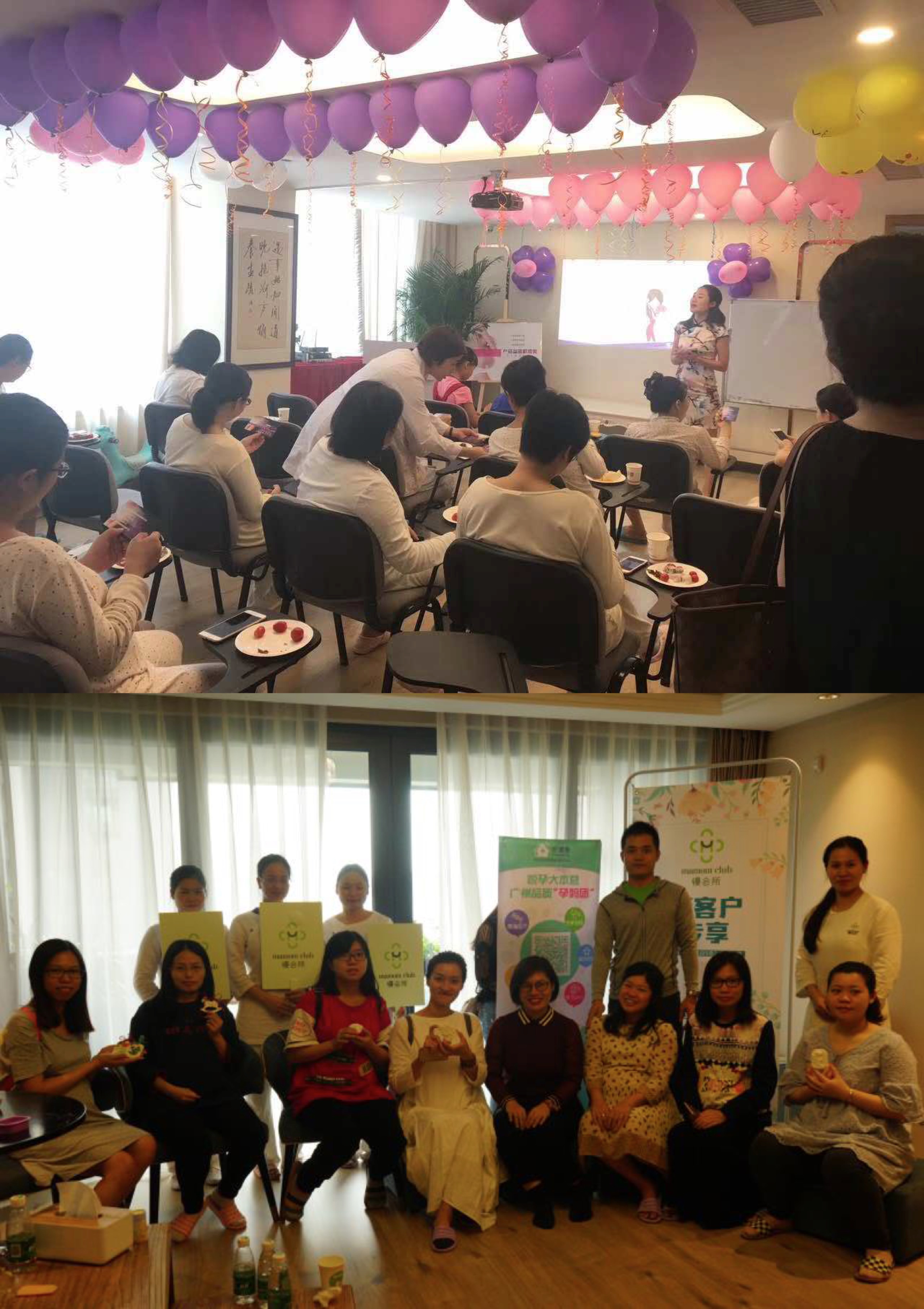
Match users with premium postpartum care centers; confinement consultants organize expectant mothers for on-site visits to strictly ensure quality.
“Currently, maternal and infant platforms are highly homogeneous, all relying on a survival model based on large user bases plus advertising from maternal and infant brands. We focus on screening mothers with purchasing power to address their actual needs, while favoring deep collaborations with a select group of offline merchants. For some merchants, 50% of customer acquisition comes from Yuejiankang. The maternal and infant industry is an area where organic traffic is scarce.” Hu Min has consistently emphasized returning to the essence of business.
Beneath its seemingly simple operations and business model lies the support of a robust, internet-enabled technical team. In the realm of the internet, core objectives revolve around user acquisition, retention, engagement activation, and conversion—all of which require powerful data mining capabilities. Yue Health’s technological advantages are reflected in its accumulated platform expertise in refined channel operations, precision marketing powered by big data, and social media management.
Reporters learned that the founding team of Yue Health comprises professionals with backgrounds in content creation, internet technology, and the maternal and infant sectors, boasting strong technical barriers to entry and achieving a seamless integration of business and technology.
Founders Hu Min, co-founders Xiao Shiliang and Huang Sheng, are highly experienced in big data mining, internet operations, and cross-industry resource integration. The 30-member team possesses strong capabilities in supply chain resource integration, technology research and development, online operations, and offline promotion.
“Therefore, any aspect of the business model that can be explored and solidified through technology will be prioritized for technological implementation. The business model itself does not create a moat; core capabilities lie either in content or in technology. However, it is actually quite difficult to establish a competitive moat based on content alone,” Hu Min revealed. With over a decade of experience in the IT industry, she has deep insights into the role technology plays in driving industry transformation.
Hu Min stated, “Yue Health’s content system, customer service system, and order management system have been fully optimized and integrated at the underlying infrastructure level. Although the platform may appear to be merely a WeChat Official Account, our proprietary big data technology constitutes our exclusive competitive advantage. We leverage technology to seamlessly integrate the internet and healthcare sectors.”
“We are a technology-driven company. Our technical partner, Xiao Shiliang, oversees both product development and channel operations, with the aim of ensuring that technology better serves the entire business operation chain. It is crucial to effectively integrate technology with healthcare. Currently, doctors conducting large-scale maternal and child health education in Guangzhou use Yue Jiankang as a primary care service tool.”
Unlike other maternal and child health platforms, Yue Health’s primary revenue model is not based on brand advertising; instead, it directly facilitates transactions, earning commissions through performance-based revenue sharing.
“Of course, when selecting partner merchants, Yue Health prioritizes those with strong reputations and strictly controls risks. ‘We then recommend merchants that users prefer—those willing to center their cooperation on serving users—based on user engagement levels. We do not partner with just any merchant; we have a comprehensive institutional evaluation mechanism,’ said Hu Min.”
Regarding the institution’s category selection, Hu Min told reporters that the focus is primarily on major categories, such as postpartum care centers, confinement nannies, prenatal exercise (yoga and Pilates), postpartum recovery and postpartum exercise, early childhood education, and photography. There is also significant potential for collaboration in areas such as postpartum medical aesthetics, high-end medical services, and parent-child entertainment.
“The evaluation mechanisms vary across different sectors. We strive to focus our efforts first on brand institutions with an established market presence. If a merchant’s brand is sufficiently strong, such as Zhuozheng Medical, we are willing to allocate additional resources to support it. This approach drives brand growth for both parties and delivers benefits to users,” she said.
However, the core of our platform lies in the operation of science-based health education content, which helps attract sticky maternal and infant users. “Service industries target those with the means; unlike other maternal and infant platforms that bombard users with ads all day, we continuously roll out curated welfare experiences. This allows users to participate, experience, and then make autonomous purchasing decisions. Yuejiankang merely serves as a bridge in this process. Behind this model is the support provided by our technology, algorithms, and buyer team.”
Hu Min believes that China as a whole is undergoing structural adjustment, shifting from traditional manufacturing to the service sector. The maternal and infant population has a strong need for care services, which has become particularly evident since the implementation of the two-child policy. Upgrading consumption in the maternal and infant sector is an inevitable trend.
Leveraging its proprietary technology and business operations capabilities, the Yue Jiankang platform has enhanced maternal and infant consumers’ awareness of health services and shortened the commercial conversion cycle. The company is currently profitable in the Guangzhou region, has expanded into the Shenzhen and Foshan markets, and is actively negotiating with offline partners in the maternal and infant sector to replicate its specialized content and services—combining universal appeal with regional customization—across first- and second-tier cities nationwide.