

Beyond Rankings: Insights from the Latest China Hospital List
On November 11, 2017, the Hospital Management Institute of Fudan University released the “China Hospital Rankings” and the “China Hospital Specialty Reputation Rankings” for the eighth consecutive year. Today, these rankings have become not only a benchmark and reference map for the strength of academic disciplines in hospitals across China, but also a guide for patients seeking medical care.
The data on the ranking list is self-evident, yet the message it conveys goes far beyond that. By integrating data trends with interview insights, VCBeat reveals the behind-the-scenes stories of the rankings.
“The Big Three” Solidify Their Positions as Research and Academia Reveal Subtle Clues
Without any suspense, the top three hospitals in the “2016 China Hospital Rankings (Comprehensive)” remain Peking Union Medical College Hospital, West China Hospital of Sichuan University, and the Chinese People's Liberation Army General Hospital.

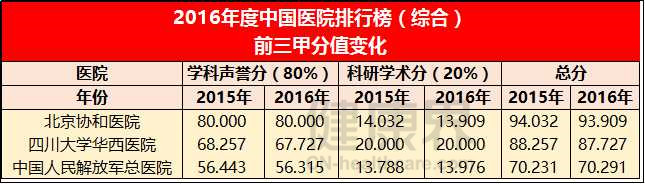
However, compared with the 2015 rankings, the total scores of Peking Union Medical College Hospital and West China Hospital of Sichuan University decreased by 0.123 and 0.53 points, respectively, while that of the Chinese PLA General Hospital increased by 0.06 points. In addition, the research and academic score, which reflects a hospital’s capacity for sustainable development, is composed of SCI publication scores and National Science and Technology Award scores. Notably, in the year-on-year comparison for the 2016 rankings, the research and academic scores of West China Hospital of Sichuan University and the Chinese PLA General Hospital were higher than that of Peking Union Medical College Hospital.
Stability and order do not mean being static.
In 2016, a survey conducted by the Hospital Management Institute of Fudan University showed that the rankings of best specialist reputations among hospitals across China remained relatively stable over a seven-year period. Statistics indicate that 65%–68% of the specialist reputation rankings did not experience single-digit changes, while fewer than 2% saw triple-digit shifts. Therefore, while the Fudan University Hospital Rankings are relatively stable, this does not mean they are immutable.
The academic research component, which accounts for 20% of the weighting, injects an element of “suspense” into the annual final rankings of the Fudan University Hospital Rankings, as hospitals vary each year in their research outputs, academic publications, and award-winning projects. The “sensitivity” to these subtle fluctuations and varying volumes of achievements has fostered a pattern of healthy competition among major hospitals across China. Further statistics confirm that hospital research productivity has entered a phase where “standing still means falling behind, and slow progress also constitutes regression.” In other words, only by making “significant strides” can hospitals secure “top rankings.”
No Changes in the “First Tier” of Overall Hospital Rankings
Another manifestation of stability and order is that the “first tier” in the 2016 annual ranking remained “unchanged” compared with 2015. This stems from the ranking’s focus on “discipline” as the evaluation dimension, while hospital discipline development is not achieved overnight.
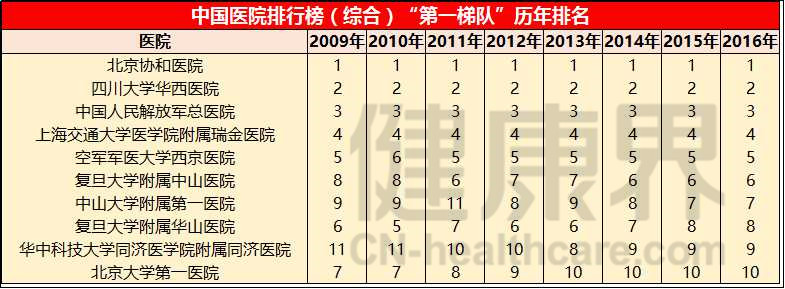
The top 10 hospitals in the China Hospital Rankings (Comprehensive) are Peking Union Medical College Hospital, West China Hospital of Sichuan University, Chinese PLA General Hospital, Ruijin Hospital Affiliated to Shanghai Jiao Tong University School of Medicine, Xijing Hospital of Air Force Medical University, Zhongshan Hospital Affiliated to Fudan University, The First Affiliated Hospital of Sun Yat-sen University, Huashan Hospital Affiliated to Fudan University, Tongji Hospital Affiliated to Tongji Medical College of Huazhong University of Science and Technology, and Peking University First Hospital.
Moreover, the score gap between the “first tier” and the “second tier” is gradually widening. Peking University First Hospital scored 4.085 points higher than Union Hospital, Tongji Medical College, Huazhong University of Science and Technology, which ranks 11th.
No Sharp Spikes, Sustained Growth Demonstrates Strength
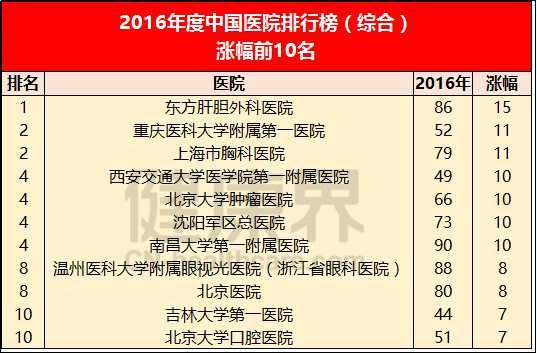
The biggest dark horse on the 2016 list was the Eastern Hepatobiliary Surgery Hospital, which “charged back” into the top 100 to rank 86th. However, its momentum was slightly less impressive than that of the 2015 dark horse, Zhongda Hospital Southeast University, which jumped 36 places from 89th in 2014 and continued its upward trajectory this year, rising from 53rd to 47th place.
Behind the sustained rise, Teng Gaojun, President of Zhongda Hospital, attributes it to the emergence of the hospital’s peak disciplines. Notably, its Department of Critical Care Medicine has ranked second nationwide since its debut on the list last year through this year. Similarly, the Affiliated Hospital of Qingdao University has also seen remarkable progress, climbing 13 places in two years from rank 75 in the 2016 rankings.
The Eye Hospital of Wenzhou Medical University (Zhejiang Provincial Eye Hospital) also delivered an impressive performance, rising to 88th place this year after debuting at 96th in 2016. Additionally, Henan Provincial People’s Hospital made its first appearance on the list, ranking 97th.
Better, Not Best
Starting this year, the Fudan University Hospital Rankings will no longer use “Best” as the title for hospital and specialty rankings.
According to Gao Jiechun, founder of the Fudan University Hospital Ranking and Director of the Institute of Hospital Management at Fudan University, although there are numerous hospital rankings across China, they vary in significance due to differences in dimensions and methodologies. All such rankings hold reference value, and their coexistence should be permitted. The merits or demerits of these rankings should be selected and evaluated by the public across all societal strata; this constitutes true intellectual diversity. In this sense, “there is only ‘better,’ not ‘best.’”
The selection principles and methodology for this year’s ranking remain unchanged from previous years. The notable difference is that the expert reviewer database has reached a new high, increasing from 3,960 experts in 2016 to 4,173. This year, 2,657 experts cast their “solemn votes” after comprehensively evaluating key factors for each hospital, including discipline development, clinical techniques and medical quality, and research capabilities. The valid response rate rose to 63.67%, up from 62.88% in 2016—a figure significantly higher than the 33.5% response rate of the U.S. Best Hospitals ranking, which has a 28-year history and has long become a standardized annual list.
Click to view the latest rankings
By Ma Xiaobei | Source: HJ Health