

Traditional Chinese Medicine Decoction Pieces Industry Enters Rapid Growth Phase: How Giants Like Kangmei and Xiangxue Are Expanding Their Strategic Layouts
Everyone wants a piece of the hot pie, but not everyone can have one.
Classified as agricultural and sideline products, traditional Chinese medicine (TCM) decoction pieces could be cultivated by farmers in the traditional economy. However, with the modern TCM industry’s demands for standardization and the surging market demand, this “hot potato” is not something everyone can handle with ease.
"Prepared slices of Chinese herbal medicines refer to the finished products obtained by specially processing and preparing raw Chinese medicinal materials under the guidance of traditional Chinese medicine theory, which can be directly used in clinical practice."
Traditional Chinese Medicine (TCM) decoction pieces occupy the midstream of the TCM industrial chain and represent the most critical segment within it:
Processed from upstream Chinese herbal materials, it can be sold directly for clinical use or further processed into proprietary Chinese medicines for resale.
The market contradiction of Chinese herbal decoction pieces lies in the following: Influenced by factors such as origin and natural conditions, the quality of the same type of Chinese herbal materials varies significantly, leading to price differences that can be several times or even more than tenfold. Additionally, the substantial variation in the quality of Chinese herbal materials results in multiple grades for the same variety of decoction pieces. Coupled with differences in processing techniques, this further diversifies the grading of processed Chinese herbal decoction pieces.
Since 2017, the state has been continuously strengthening the regulation of traditional Chinese medicine decoction pieces.
An analysis of the sampling inspections, unannounced inspections, and public exposure notices released by the China Food and Drug Administration (CFDA) reveals that dozens of traditional Chinese medicine (TCM) decoction piece manufacturers are added to the “blacklist” nearly every week due to failed product quality tests.
Taking the latest data as an example, on November 9, the Ningxia Food and Drug Administration reported that 18 batches of traditional Chinese medicine (TCM) decoction pieces failed spot checks; on November 8, the Henan Food and Drug Administration announced that 18 batches of TCM decoction pieces from 14 enterprises failed spot checks; on November 4, the Heilongjiang Provincial Food and Drug Administration reported four batches of non-compliant TCM decoction pieces...
VCBeat (WeChat ID: vcbeat) has found that, from 2017 to November 9, a total of 484 batches of traditional Chinese medicine decoction pieces failed quality inspections among the 17 batch sampling announcements issued by the China Food and Drug Administration.
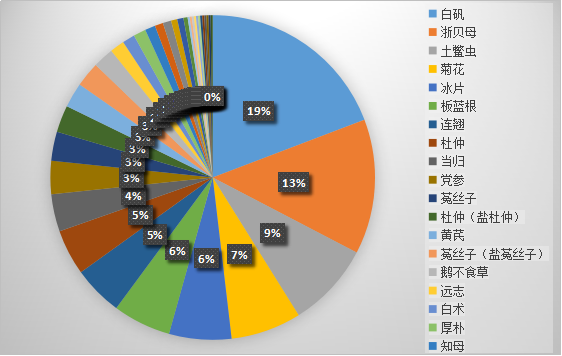
As of November 9, the Proportion of Non-compliant Traditional Chinese Medicine Decoction Pieces in the Spot Checks Conducted by the China Food and Drug Administration
On the other hand, driven by substantial market demand and supportive policies, major pharmaceutical companies are leveraging their strong capital reserves to intensify their strategic investments, expand production capacity, and acquire small and medium-sized enterprises. This trend will accelerate market consolidation through survival of the fittest, allowing leading enterprises to firmly establish their market positions. Consequently, this will facilitate the large-scale and standardized production of traditional Chinese medicine (TCM) decoction pieces.
Policy Support Fuels Extraordinary Growth in the TCM Decoction Pieces Industry
In April this year, the National Health and Family Planning Commission issued the "Notice on Comprehensively Promoting the Comprehensive Reform of Public Hospitals," providing further instructions on the elimination of drug markups in public hospitals.
The notice requires that all public hospitals eliminate drug markups by September 30, with the exception of traditional Chinese medicine decoction pieces.
Additionally, by the end of 2017, the proportion of drug costs in total revenue at public hospitals in pilot cities was to be reduced to approximately 30%, excluding traditional Chinese medicine (TCM) decoction pieces from the calculation.
In addition, to eliminate the practice of subsidizing medical services with drug profits and to promote the separation of pharmaceuticals from medical care, healthcare institutions across various provinces and cities began phasing out the previous policy of selling drugs at a 15% markup over wholesale prices starting in 2016, implementing a “zero-markup” system instead. The “zero-markup” policy has led to a significant decline in hospital profits, leaving many hospitals facing financial losses.
However, traditional Chinese medicine (TCM) decoction pieces are the only category of drugs excluded from this policy and continue to benefit from drug markups, drawing widespread attention from hospitals. To mitigate losses, hospitals will increase the utilization of TCM decoction pieces.
Many public hospitals have also issued documents encouraging increased prescriptions of traditional Chinese medicine (TCM) decoction pieces, which are exempt from drug proportion controls. As the retail prices of TCM decoction pieces are not subject to markup pricing restrictions and their costs continue to rise, hospitals and enterprises have an incentive to jointly drive up prices, potentially leading to a trend of simultaneous growth in both volume and price within the industry.
A survey conducted by certain institutions on hospitals that were among the first to implement the zero-markup policy revealed that the usage of traditional Chinese medicine (TCM) decoction pieces increased by more than 30% year-on-year after the policy’s implementation. Therefore, as the zero-markup policy is rolled out nationwide, hospital consumption of TCM decoction pieces is expected to rise significantly.
According to data from the "Plan for the Protection and Development of Chinese Crude Drugs (2015–2020)," investment in Chinese crude drugs is gaining momentum, special projects for the construction of production bases are underway, and the market size of Chinese herbal decoction pieces will continue to grow.
The new edition of the National Reimbursement Drug List also brings favorable impacts to the market for traditional Chinese medicine decoction pieces.
The 2017 updated National Reimbursement Drug List strictly restricted traditional Chinese medicine (TCM) injections, limiting the indications of 26 TCM injection products to use in medical institutions at Level II or above, and specified their use only for critically ill patients and certain indications.
This is expected to reduce the sales of major traditional Chinese medicine (TCM) injections by at least RMB 8.8 billion. Given the superior safety profile of TCM decoction pieces administered via conventional routes, they represent one of the best alternatives to TCM injections. Consequently, restrictions on TCM injections indirectly benefit the development of TCM decoction pieces.
In summary, under the combined effects of zero-markup policies, reduced drug revenue ratios, and the updated National Reimbursement Drug List, the Chinese herbal decoction pieces industry has reached an inflection point in its growth rate.
The Market for Traditional Chinese Medicine Decoction Pieces Enters a Period of Rapid Growth
Since 2004, the processed Chinese herbal slices industry has maintained strong growth momentum and remains the fastest-growing segment within the traditional Chinese medicine (TCM) industry.
On August 24, the "Completion Status of Major Economic Indicators for the Pharmaceutical Industry in the First Half of 2014" released by the Ministry of Industry and Information Technology showed that in the first half of 2017, the value-added of pharmaceutical industrial enterprises above designated size increased by 11.3% year-on-year, ranking among the top across all industrial sectors. Among the various sub-sectors of the pharmaceutical industry, the processing of traditional Chinese medicine (TCM) decoction pieces recorded the fastest revenue growth, with a year-on-year increase of 21.33%, reaching RMB 104.788 billion. Its profit growth was second only to that of biological pharmaceutical manufacturing, rising by 22.78% year-on-year to RMB 7.361 billion.
Meanwhile, the "Research Report on the Development of the Traditional Chinese Medicine (TCM) Decoction Pieces Industry in 2017," released at the "2017 China Pharmaceutical Retail Industry Information Press Conference," pointed out that over the ten-year period from 2006 to 2016, the average growth rate of TCM decoction pieces reached 26.25%, outpacing the overall industry growth. In 2016, retail sales revenue grew by 17.7% year-on-year to RMB 23.132 billion, making it the fastest-growing category in retail pharmacy sales.
According to the blue book released by the China Medical Pharmaceutical Material Association, the production capacity of China's traditional Chinese medicine (TCM) decoction pieces processing industry is projected to reach 5.3 million tons in 2017 and grow to 6.5 million tons by 2020, indicating an expanding market space for both TCM raw materials and TCM decoction pieces.
The market for processed traditional Chinese medicine (TCM) decoction pieces has entered a period of rapid development. According to the latest data, China's TCM decoction piece market is projected to grow by 19% in 2017 and 17% in 2018, with the market size exceeding RMB 270 billion in 2018.
Pharmaceutical Companies Ramp Up Investments in TCM Decoction Pieces to Capture Market Share
In addition to policy dividends, traditional Chinese medicine (TCM) decoction pieces have also become a “lucrative hotspot” for numerous TCM enterprises. As of November 9, according to statistics from VCBeat, 80 out of the 92 listed TCM companies that disclosed their third-quarter 2017 financial results reported year-on-year growth in net profit.
Fluctuations in the prices of Chinese herbal medicines affect the cost of TCM decoction pieces, while companies with upstream supply chain layouts maintain stable profitability. Prices of Chinese herbal medicines are influenced by multiple factors and exhibit significant volatility. Companies with upstream supply chain layouts can achieve partial self-sufficiency in raw materials, mitigate price fluctuation risks, and sustain stable profit levels.
In the market, numerous traditional Chinese medicine (TCM) enterprises are strategically positioning themselves in the upstream sector of TCM decoction piece raw materials. Companies such as Kangmei Pharmaceutical and Shaohuatang, which specialize in TCM decoction pieces, own their own TCM herbal material bases to produce the key raw materials required for these products. This vertical integration serves two primary purposes: first, it reduces procurement and distribution costs for TCM herbs, thereby lowering overall operational expenses; second, it mitigates the risks associated with frequent and significant price fluctuations in the TCM herb market, helping to maintain stable profitability.
In their efforts to strengthen their positioning in the Chinese herbal decoction pieces sector, leading listed companies primarily adopt three strategies: expanding factory production capacity, establishing medical institutions such as hospitals and clinics to deepen downstream sales channels, and acquiring upstream medicinal herb production bases.
As the industry leader,Kangmei PharmaceuticalThe company has established a comprehensive presence across the upstream, midstream, and downstream segments of the traditional Chinese medicine (TCM) industry chain. Its production layout now covers virtually all regions of China. It has developed over 50,000 mu of CAP-compliant and standardized cultivation bases in provinces such as Yunnan, Sichuan, Jilin, and Gansu, and established 11 TCM decoction piece production facilities in Guangdong, Beijing, Shanghai, Sichuan, Jilin, Anhui, and Gansu.
In the first half of 2017, Kangmei Pharmaceutical’s revenue from traditional Chinese medicine (TCM) decoction pieces grew by 35.81%, reaching RMB 2.7 billion, with the total annual scale for this segment projected to exceed RMB 6 billion.
“Smart Pharmacy” drives sales and volume growth, representing its unique advantage in the field of traditional Chinese medicine (TCM) decoction pieces. According to estimates by relevant institutions, the incremental contribution of “Smart Pharmacy” to TCM decoction pieces will reach RMB 1 billion this year.
In addition, Kangmei Pharmaceutical’s acquisition of Guangdong Hengxiang Pharmaceutical in October, a company specializing in traditional Chinese medicine (TCM) decoction pieces, will further solidify its leading position in this sector. According to reports, Hengxiang Pharmaceutical operates TCM decoction piece production lines compliant with Good Manufacturing Practice (GMP) standards. The company achieved a net profit of RMB 8.22 million in the first half of the year, and its revenue from TCM decoction pieces is expected to reach nearly RMB 30 million in the second half.
BOC International Research Report: Although Kangmei Pharmaceutical is the leader in the TCM decoction pieces business, it accounts for only 3% of the total market share, indicating significant room for future growth.
Hengkang Medical, a listed company with ownership of several hospitals, has seen its traditional Chinese medicine (TCM) decoction pieces business benefit from the continuous expansion of its hospital channels. Financial reports show that the TCM decoction pieces business generated RMB 294 million in revenue in the first half of the year, accounting for 26.59% of Hengkang Medical's total revenue.
It is reported that the traditional Chinese medicine (TCM) decoction pieces business is primarily conducted by Hengkangyuan Pharmaceutical. This year, Hengkangyuan has increased its investment in TCM decoction pieces, expanding the scale of this segment. By integrating with its hospital medical service lines, the TCM decoction pieces business has gradually been introduced into its affiliated hospitals, achieving significant growth.
Due to sales through the company’s internal system, there are fewer intermediary links, resulting in strong business sustainability and substantial profit margins.
As the undisputed leader in the field of traditional Chinese medicine (TCM) formula granules, renowned for its mergers and acquisitions,China Traditional Chinese MedicineThis year, the company accelerated the development of its full industry chain and expanded the coverage of its industrial value chain through the rapid acquisition of TCM decoction piece enterprises. In the first half of 2017, the TCM decoction piece business generated revenue of approximately RMB 185 million.
Last October, China Traditional Chinese Medicine Holdings Co. Limited acquired Shanghai Tongjitang Pharmaceutical. On October 22, the company announced that it would acquire four firms—Huamiao Pharmaceutical, Heilongjiang Sinopharm, Sichuan Jiangyou, and Huatai Traditional Chinese Medicine—for RMB 499 million, aiming to expand its TCM decoction pieces business by increasing production capacity, market share, and distribution channels.
Huamiao PharmaceuticalIt is the largest manufacturer of processed traditional Chinese medicine (TCM) decoction pieces in the Beijing region, while Jiangyou, Sichuan Province, is home to China’s largest production base for toxic processed TCM decoction pieces. Currently, China Traditional Chinese Medicine Holdings Co., Ltd. operates production bases in Guangdong, Shanghai, Guiyang, and Gansu, and plans to establish additional processing and production facilities in key provinces with high sales volumes of processed TCM decoction pieces.
In the first half of this year, revenue from Chinese herbal decoction pieces reached approximately RMB 185 million, representing a growth rate of 493.2%. The Chinese herbal decoction pieces business is poised to become a new revenue growth driver comparable to its Chinese herbal granule business.
Another Leading EnterpriseXiangxue PharmaceuticalIt has also been highly active in mergers and acquisitions.
In April last year, Xiangxue Pharmaceutical completed the acquisition of Hubei Tianji, which led to rapid development in its Chinese herbal decoction pieces business. Recently, Xiangxue Pharmaceutical injected a substantial capital of RMB 300 million into Hubei Tianji to support the completion of its new production base project for Chinese herbal decoction pieces and preparations in Wuhan. This move is expected to further enhance Xiangxue Pharmaceutical’s brand influence and expand its market share in the Chinese herbal decoction pieces sector.
Revenue from traditional Chinese medicine (TCM) decoction pieces reached RMB 400 million in the first half of the year, representing a 75.7% year-on-year increase. The TCM decoction pieces business has gradually become a primary revenue source, accounting for over 35% of Xiangxue Pharmaceutical’s total operating income during the same period.
In the first half of this year, the subsidiaries Hubei Tianji and Huqiao Pharmaceutical each established wholly-owned subsidiaries—Hubei Tianji Smart Traditional Chinese Medicine Technology Co., Ltd. and Jinan Xiangxue Smart Traditional Chinese Medicine Technology Co., Ltd., respectively—aiming to further develop smart TCM medical services and increase the market share of their TCM decoction piece business.
Regarding companies listed on the New Third Board,Yuanhe PharmaceuticalandShaohuatangprimarily relies on expanding production capacity to increase market share.
Yuanhe Pharmaceutical, which accounted for 0.53% of the Chinese herbal decoction pieces market in 2016, has significantly expanded the cultivation area of its strategic product, saffron, this year. The planting area is expected to exceed 1,000 mu in 2017. The fully launched saffron series will become a new revenue growth point for the company’s product portfolio.
While continuing to strengthen and expand its traditional Chinese medicine (TCM) materials and TCM decoction pieces businesses, Shaohuatang has actively pioneered innovative services such as warehouse receipt pledging, the “Decoction Pieces Supermarket” distribution platform, and Guoyi Guan clinics. By integrating upstream and downstream resources, the company has generated synergies with its TCM decoction pieces operations, thereby driving new momentum for performance growth.
After expanding its workshop last year to add 3,000 tons of production capacity, Shaohuatang launched the construction of a digital GMP-compliant production facility for traditional Chinese medicine (TCM) decoction pieces this October. The new facility is expected to increase production capacity by approximately 10,000 tons, with a total output value reaching RMB 3 billion. Shaohuatang’s performance growth rate is projected to rise compared to 2016, reaching 13% over the next two years.