

GE Announces Major Restructuring to Focus on Healthcare, Power, and Aviation
VCBeat (WeChat ID: vcbeat) has learned that on November 14, John Flannery, the new CEO and Chairman of the Board of GE Group, announced,GE will focus on its three core business lines—healthcare, power, and aviation—and is considering exiting most of its other businesses.
This is the latest revolutionary move by this 125-year-old industrial giant!
Based on GE's total revenue for the first three quarters,GE’s three retained business lines (Power 31%, Aviation 24%, Healthcare 16%) account for the largest share, with oil and gas accounting for 14%, renewable energy 9%, transportation 4%, and lighting just 2% of other business segments.
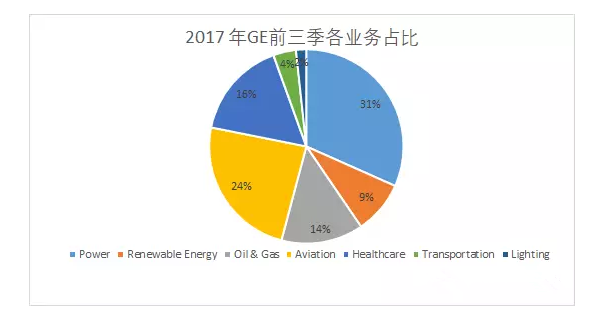
GE has announced to its employees that it will streamline over $20 billion worth of business within the next one to two years, with healthcare, power, and aviation becoming the company’s core businesses. Meanwhile, GE also stated that it will exit the transportation and GE Lighting businesses. GE’s transportation segment is one of the oldest and largest diesel locomotive manufacturers globally, while its lighting business, dating back to the Edison era, primarily produces LED products and energy management sensors.
In July 2017, GE spun off its oil and gas business into an independent publicly listed company, Baker Hughes. However, recent reports indicate that GE will divest its majority stake in Baker Hughes.
It is reported that GE holds a 63% stake in Baker Hughes, whose market capitalization reached $40 billion based on last Friday’s closing price. Although GE plans to divest its stake in Baker Hughes, the transaction has not yet been executed and is expected to require further deliberation and final approval by the boards of directors of both companies.
In addition to a major restructuring of its business portfolio, GE has also announced significant layoff plans, with workforce reductions across various business segments.
It remains unclear how many layoffs are planned and how quickly they will be implemented. Statistics show that by the end of 2016, GE employed approximately 295,000 people; even a 10% reduction in workforce would eliminate nearly 30,000 jobs.
Currently, apart from the main business divisions, GE’s research, digital, and corporate functional departments employ approximately 24,000 people. GE has 13,000 employees in its digital business unit, including traditional IT personnel. Reports indicate that the layoffs are not limited to sales staff; the software development department is also affected. It is understood that GE began laying off sales representatives and other employees in its software division last week.
To improve the company's profits, John Flannery will also announce a plan to cut costs and streamline operations, aiming to reduce expenses by $3 billion by the end of 2018.
GE’s major move to adjust its business operations and implement layoffs is primarily due to severe cash shortages and a sharp decline in its stock price in recent years.
GE’s industrial division has struggled to generate sufficient cash flow to cover its $8 billion dividend, particularly after scaling back GE Capital. This year, GE’s stock price has cumulatively fallen 35%, hitting its lowest level since 2012, while the S&P 500 Index rose 15% over the same period. Notably, since July, GE’s market capitalization has shrunk by $50 billion, after investors were informed that CEO John Flannery would need nearly four months to complete an internal review and reset long-term financial targets.
Under significant pressure from various stakeholders, Flannery announced business restructuring and layoff plans at the shareholders’ meeting on the 13th, aiming to stabilize the company’s development by cutting costs and divesting certain business units. It remains uncertain whether this move will satisfy the company’s investors.
Sustained growth, cost reduction, and a focus on core areas were the key themes for global foreign-invested enterprises in 2017. In addition to GE, the other two giants among the “GPS” trio—Philips and Siemens—also made significant moves this year. VCBeat will continue to track and report on these developments; stay tuned!