

China's CFDA Proposes Ban on Online Prescription Drug Sales and Information Disclosure in New Draft Regulation
VCBeat (WeChat ID:vcbeat) learned that the China Food and Drug Administration11Month14released the “Administrative Measures for the Supervision and Management of Online Drug Operations (Draft for Comments)” (hereinafter referred to as the “Measures”).
"The Measures" stipulate that the scope of online drug sales shall not exceed the scope permitted under the enterprise's Drug Operation License.If the operator is a drug manufacturer or wholesaler, it shall not sell drugs to individual consumers; if the operator is a chain drug retailer, it shall not sell prescription drugs or drugs subject to special state management requirements via online channels.
In addition, the Measures also stipulate that “Websites selling drugs to individual consumers shall not publish prescription drug information online..” This regulation may have a significant impact on the current pharmaceutical e-commerce sector, particularly on online pharmacy operations.
Since the beginning of this year, the pharmaceutical e-commerce sector has benefited from multiple rounds of favorable policies. First, the Class B and Class C licenses for pharmaceutical e-commerce were abolished, deregulating online pharmacies. Next, new delivery models such as “order online, pick up in-store” and “order online, deliver from store” were encouraged to foster innovative services and business formats. Furthermore, various regions launched pilot programs for electronic prescriptions and prescription outflow, creating opportunities for the “Internet + Healthcare” model. Finally, even the most prestigious Class A license was abolished, resulting in a comprehensive deregulation of the pharmaceutical e-commerce industry.
While deregulating, oversight of pharmaceutical e-commerce has not been relaxed. Requirements include strengthening Good Manufacturing Practice (GMP) and Good Supply Practice (GSP) certifications, strictly vetting online drug transaction service providers, enforcing principal responsibility, establishing an online information disclosure system to facilitate public inquiries, and implementing a “blacklist” mechanism. Crackdowns on illegal online drug sales will be intensified, and the red line prohibiting the online sale of prescription drugs must not be crossed.
2017 Policies Related to Pharmaceutical E-commerce
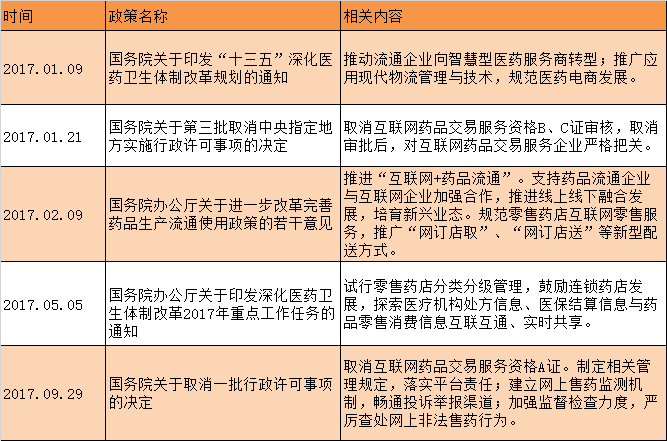
In addition to the aforementioned prohibitions on the sale of prescription drugs and the dissemination of prescription drug information, the Measures also impose mandatory requirements on pharmaceutical e-commerce platforms following the abolition of qualification approval, including:
(1) Possess application software, network security measures, and related databases that meet the actual needs of enterprise management, ensuring compliance with business operational requirements;
(2) Establish a safety management system for online drug sales to ensure full-process traceability and verifiability of drug sales;
(3) Establish a distribution management system to ensure drug quality and safety;
(4) Establish systems for handling complaints and reports, protecting consumer rights and interests, etc.;
(5) Establish an online system for monitoring and reporting adverse drug reactions (events);
For sales to individual consumers, an online pharmaceutical service system shall also be established, with licensed pharmacists assigned to provide guidance on rational drug use.
In terms of supervision and administration, the Measures stipulate that the China Food and Drug Administration (CFDA) shall establish a nationwide online drug trading monitoring system. Information on suspected illegal activities identified through monitoring shall be transmitted via this system to the provincial-level food and drug regulatory authorities in the jurisdictions where such violations occurred for handling. The provincial-level food and drug regulatory authorities shall promptly investigate and address online drug-related violations and report the results to the CFDA.
It is also worth noting that, once adopted, these Measures will replace the 2005 Interim Provisions on the Approval of Online Drug Trading Services.
According to data from the Market Order Department of the Ministry of Commerce, the total sales revenue of pharmaceutical e-commerce companies with direct reporting obligations amounted to RMB 61.2 billion in 2016. Of this, B2B business sales reached RMB 57.6 billion, while B2C business sales totaled RMB 3.6 billion. Additionally, data from Choice indicates that the scale of B2C pharmaceutical e-commerce was RMB 28.6 billion in 2016.
In terms of growth, the B2B pharmaceutical e-commerce sector has achieved a compound annual growth rate (CAGR) of 40% over the past five years, with the transaction volume expected to reach RMB 76 billion in 2017. The B2C pharmaceutical e-commerce sector has recorded a CAGR of over 100% during the same period, with its 2017 transaction volume projected to exceed RMB 50 billion. Overall, the total scale of pharmaceutical e-commerce is anticipated to surpass RMB 100 billion in 2017.
At this juncture, the introduction of the Measures will steer the rapidly growing pharmaceutical e-commerce sector onto the right track, thereby facilitating the industry’s sustainable development.
Appendix: The General Office of the State Administration for Market Regulation Publicly Solicits Comments on the “Administrative Measures for the Supervision and Management of Online Drug Operations (Draft for Comment)”