

WeDoctor Launches WeDoctor Cloud with Dual AI Diagnostic Systems for TCM and Western Medicine Ahead of Hong Kong IPO
On November 15, VCBeat (WeChat ID: vcbeat), as a strategic partner media outlet, was invited to participate in the inaugural International Smart Healthcare Conference. At the conference, WeDoctor, an internet healthcare “unicorn,” launched WeDoctor Cloud, a cloud platform dedicated to smart healthcare, and demonstrated its capabilities on-site based onWeDoctor Cloud’s Ruiyi Intelligent Doctor and Huatuo Intelligent Doctor.
WeDoctor Cloud is the world’s first cloud platform dedicated to intelligent healthcare. Leveraging Micro Medical Group’s seven years of experience in internet-based healthcare, and powered by cloud computing, big data, and artificial intelligence technologies, it provides one-stop, multi-scenario cloud solutions for governments, hospitals, primary care institutions, and healthcare enterprises.
Ruiyi AI DoctorThis is an AI-powered diagnostic and treatment application for Western medicine, jointly developed by WeDoctor and the Zhejiang University Ruiyi Artificial Intelligence Research Center. Compared with IBM Watson and Baidu Medical Brain, Ruiyi Smart Doctor can only be considered a “newcomer.” However, after more than a year of deep learning on millions of high-quality data records, Ruiyi Smart Doctor has achieved key breakthroughs in over ten specialized fields, including pulmonary nodule detection, diabetic retinopathy screening, cervical cancer screening, bone age assessment, and general practice auxiliary diagnosis.
Among them, the accuracy and sensitivity of cervical cancer screening exceed those of clinicians;Most datasets for AI-based binary classification of diabetic retinopathy achieve a specificity of 99% and a sensitivity of 95%., this technical indicator surpasses that of AI giant Google, reaching an internationally leading level.
Huatuo AI DoctorCentered on the core principle of TCM syndrome differentiation and treatment, this is a suite of AI-driven TCM diagnostic and therapeutic applications that consolidates the clinical expertise of renowned TCM practitioners and their classic prescriptions. Currently, Huatuo Intelligent Doctor has been deployed in 400 TCM clinics across 11 prefecture-level cities in Zhejiang Province, having assisted in generating over 1.6 million prescriptions to date, thereby becoming the most widely applied “Cloud-based TCM Brain” internationally.
Recently, CCTV’s “Economic Half Hour” featured a special report on the application value of the Huatuo AI Doctor in grassroots TCM communities, stating that since the Hangzhou Mishixiang Community Health Center adopted the system in 2016, the volume of TCM services has increased significantly, with the proportion of services involving TCM decoction pieces and non-pharmacological therapies rising from less than 30% initially to nearly 50%.
In addition to its two flagship AI products, Weiyi Cloud leverages Weiyi’s seven years of deep engagement in the internet healthcare industry to deliver a suite of cloud-based solutions across multiple healthcare scenarios, including internet hospitals, medical consortia, regional population health information platforms, family doctor contracting platforms, health insurance platforms, and pharmaceutical enterprises.
“Connectivity and cloud adoption have broken down hospital walls, progressively enabling data, workforce, and resource collaboration, thereby delivering breakthrough capability enhancements across the entire healthcare industry.” At this conference, Liao Jieyuan, founder of WeDoctor, unveiled WeDoctor’s latest smart healthcare strategy and stated that WeDoctor has evolved from an internet-based healthcare platform into an internationally leading smart healthcare platform.
Medical AI Alliance with Nearly 90% Hospital Participation
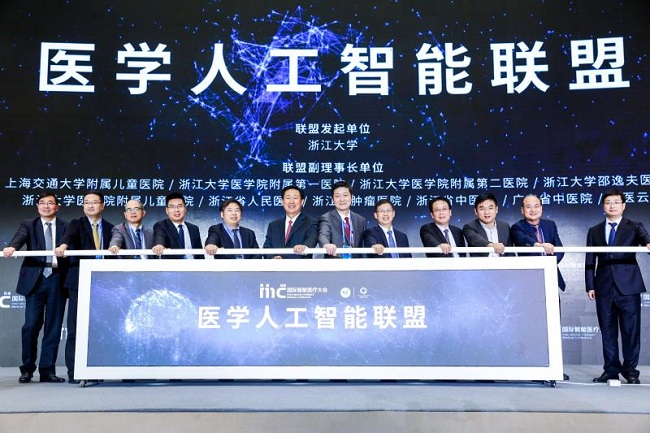
The First Smart Healthcare Industry Alliance—Medical Artificial Intelligence Alliance Released
At the conference, the Medical Artificial Intelligence Alliance, initiated by Zhejiang University, was also announced to be established. The alliance has a total of 12 members, including Zhejiang University, 10 hospitals, and Weiyi Cloud.
These 10 hospitals include:
Shanghai Children's Hospital, Shanghai Jiao Tong University
The First Affiliated Hospital, Zhejiang University School of Medicine
The Second Affiliated Hospital, Zhejiang University School of Medicine
Sir Run Run Shaw Hospital, Zhejiang University School of Medicine
The Children's Hospital, Zhejiang University School of Medicine
Zhejiang Provincial People's Hospital
Zhejiang Cancer Hospital
Zhejiang Provincial Hospital of Traditional Chinese Medicine
Women's Hospital, School of Medicine, Zhejiang University
Guangdong Provincial Hospital of Chinese Medicine
WeDoctor Cloud is the only corporate member among the vice-chairman units of the alliance. A close examination of the alliance’s membership reveals that nearly 90% are hospitals, underscoring the critical importance of hospital settings, physicians, and medical data to the development of artificial intelligence in healthcare.
As a vice-chairman unit of the alliance, WeDoctor announced that it would open its WeDoctor Cloud’s cloud computing and cloud storage capabilities to the entire industry. By fostering multi-directional collaboration with alliance members, as well as more medical institutions, physician teams, pharmaceutical companies, and research organizations, WeDoctor aims to jointly promote the development of smart healthcare in China and enhance its international influence.
This alliance also serves as a prime example of the integration of industry, academia, and research. The hospital provides data, clinical scenarios, and requirements; Zhejiang University, the hospital, and Weiyi Cloud jointly conduct R&D; and Weiyi Cloud then facilitates the commercialization of the developed products, delivering the most advanced research findings to the public at the fastest possible speed.
WeDoctor Cloud has been deployed across 30 provinces in China
Since 2010, starting with online appointment registration, and leveraging WeDoctor’s seven years of deep cultivation in China’s internet healthcare industry and its product penetration across 30 provinces, WeDoctor Cloud better understands the technological needs of China’s healthcare sector.
As of June 2017, Weiyi Cloud had connected more than 2,400 hospitals across China, over 7,300 expert medical teams, 290,000 physicians, more than 100 medical consortia, and 18,000 pharmacy-clinics, serving 172 million real-name registered users. In the first half of 2017, it provided services to 380 million patient visits.
Diabetic Retinopathy Screening Surpasses Google in Sensitivity
Ruiyi Intelligent Doctor’s fundus diabetic retinopathy computer-aided diagnosis system was developed in collaboration with Beijing Tongren Hospital, a national leader in ophthalmology. Trained on hundreds of thousands of high-quality datasets, validated through cross-annotation by three experts, and powered by deep learning AI, the system achieves 99% specificity and 95% sensitivity for binary classification of diabetic retinopathy across most datasets, outperforming tech giant Google. While ophthalmologists typically require 3–5 minutes to interpret a single image, this AI-assisted system can complete staging diagnosis, report generation, and clinical recommendations for one fundus image within 10 seconds. It can screen at least 8,640 fundus images per day, making its diagnostic speed more than 18 times faster than that of human physicians.
In addition to assisting Western medicine diagnostics, WeDoctor Cloud is also making significant strides in the intelligentization of Traditional Chinese Medicine (TCM). Centered on the core TCM principle of syndrome differentiation and treatment, Huatuo AI Doctor’s “Xuanhu Tai” TCM-assisted diagnosis and treatment system leverages big data and artificial intelligence technologies to integrate 1,441 syndrome patterns, 1,528 drug contraindications, thousands of prescriptions, and tens of thousands of knowledge entries into a cloud-based solution. This comprehensive solution covers disease syndromes, therapeutic methods, body constitutions, prescriptions, and herbal compatibility, thereby assisting physicians in constitution identification, intelligent prescription generation, and case-specific clinical modifications.
Currently, more than 300 TCM clinics have been integrated, achieving comprehensive coverage across all 11 prefecture-level cities in Zhejiang Province. The cumulative number of prescriptions has exceeded 1.6 million. Serving as the core “Syndrome Differentiation and Treatment” module of the National Health Information Platform for TCM Diagnosis and Treatment Areas (TCM Clinics) in Primary Healthcare Institutions, it has been deployed in TCM clinics nationwide, becoming the most widely used “Cloud-Based TCM Brain” in China.
Five Major Application Scenarios of WeDoctor Cloud
Currently, the Wuzhen Internet Hospital, powered by WeDoctor Cloud technology, has connected more than 2,400 hospitals, over 7,300 expert teams, and 290,000 doctors across China. It has been implemented in 18 provinces and municipalities, establishing 12 specialized remote consultation centers for specific diseases, including a Pancreatic Cancer Remote Consultation Center. An investment of RMB 270 million has been made to build a remote diagnosis and treatment platform as well as a physician collaboration platform.
In 2017, Wuzhen Internet Hospital comprehensively upgraded into a medical consortium based on its existing internet hospital systems across 19 provinces and municipalities, exporting its three core capabilities—system infrastructure, patient traffic, and operational expertise—to 1,000 central hospitals at the provincial, municipal, and county levels, as well as to 100,000 grassroots healthcare facilities nationwide. As of June 2017, the daily patient consultation volume at Wuzhen Internet Hospital had exceeded 72,000 visits, with remote consultation services accounting for over 12,000 visits.To Become China's Largest Telemedicine Collaboration Network。
As the technical provider for the Heilongjiang Provincial Population Health Information Management Platform, Weiyi Cloud has completed the initial construction of the platform. By leveraging five core platforms—Cloud Health Big Data, Cloud Imaging, Cloud Laboratory Information, Cloud Electronic Health Records, and Health Cloud Cards—it has successfully achieved integration with the national platform. Three foundational databases have been established, covering population demographics, electronic medical records, and health records. Plans are in place to sequentially develop nine additional application systems. Distinct from other platforms, the Heilongjiang platform is driven by public benefit services, focusing on the lifelong health needs of residents. The “Healthy Longjiang” public service app has already been launched.
By establishing a cross-institutional, cross-regional, and cross-departmental population health information management platform, Heilongjiang has built a regional health information system characterized by unified standards, shared resources, interconnectivity, comprehensive functionality, and system security. This initiative enables information sharing and business collaboration across medical and health services, eliminates information silos and vertical data barriers, and provides efficient information support and services to health management and decision-making personnel, thereby enhancing management efficiency and the level of scientific decision-making.
Ms. Chen (a pseudonym), who had also signed up with a family doctor, noticed her urine was light red during a nighttime void and promptly contacted her family doctor. The family doctor suspected a urinary tract infection and advised her to seek hospital treatment as soon as possible, later assisting the patient throughout the entire medical care process.
“This service is excellent; for a small fee, we can enjoy ‘personalized’ care from doctors. We all trust Dr. Gu, and she is the most suitable choice to serve as our community physician,” said Gu Kunsheng, a resident of Dongyuan Community in Wuzhen Town, who wished to sign up with Dr. Gu Lijin at the Community Health Service Station. Dr. Gu Lijin scanned Mr. Gu’s ID card on a device, instantly importing his basic information into the computer system, completing his medical records, and establishing his health file, thereby finalizing the entire enrollment process. “This assigned physician model is somewhat similar to the family doctors seen on television,” remarked Mr. Gu.
These changes are all attributable to the Tongxiang Family Doctor Contracting Platform, jointly developed by the Tongxiang Municipal Government and WeDoctor based on WeDoctor Cloud technology. The Tongxiang Family Doctor Contracting Platform features a “five-in-one” model, integrating a diagnosis and treatment service platform, a health management platform, a physician collaboration platform, a doctor-patient interaction platform, and a comprehensive management platform, thereby achieving paperless, seamless connectivity between community physicians and residents.
Since September this year, Tongxiang City has officially implemented the contracted service model for community responsibility physicians. Within just over a month, the program has covered all 12 community health service centers across the city, with 151 family doctor teams and 719 family doctor members completing “health agreements” with 160,000 residents through both online and offline channels. As the permanent host city of the World Internet Conference, Tongxiang’s family doctor contracting initiative fully reflects the characteristics of the era, showcasing a distinct “tech-savvy” approach.
Leveraging the medical consortium technological capabilities of WeDoctor Cloud, Jia County in Henan Province established the Jia County Internet Medical Consortium. Centered on the Jia County Traditional Chinese Medicine Hospital, this initiative integrally connects two subdistricts, 14 townships, and 376 villages within the county, serving a population of 600,000. Benefiting from the Jia County Remote ECG Diagnosis Center, Jia County Remote Imaging Diagnosis Center, and Jia County Remote Consultation Center—jointly built and operated by the Jia County Internet Medical Consortium and the Jia County Traditional Chinese Medicine Hospital—14 township health centers and 101 village clinics in Jia County have been equipped with integrated systems and ECG devices. As a result, residents of Jia County can access high-quality medical services close to home.
The dwindling resources of renowned veteran TCM practitioners and the challenges in transmitting their expertise, coupled with the lack of guidance and clinical learning tools for primary-care TCM physicians, have made improving the quality of primary-level TCM services a critical issue in the inheritance of Traditional Chinese Medicine, especially in the face of 960 million TCM consultations.
Leveraging the Xuanhu Tai Traditional Chinese Medicine (TCM) Auxiliary Diagnosis and Treatment System developed by WeDoctor Cloud’s Huatuo Intelligent Doctor, Zhejiang Province has established a health information platform for TCM diagnosis and treatment areas (TCM halls) in primary healthcare institutions, effectively enhancing the quality of primary TCM services.
Xuanhu Tai centers on the core TCM principle of syndrome differentiation and treatment, consolidating the expertise of renowned physicians and classic prescriptions into a cloud-based solution that covers disease syndromes, therapeutic methods, constitutional types, formulas, and herbal compatibility. Leveraging existing big data resources, it has also developed a specialized module for cardiovascular and cerebrovascular diseases. Based on patients’ constitutional profiles and chronic disease screening data, the system performs syndrome differentiation and provides recommended prescriptions, similar case studies, and various guidance recommendations, thereby achieving targeted treatment for specific diseases. This is akin to having a wise and erudite TCM expert guiding and assisting every primary-care TCM practitioner in prescribing, while also enabling formula modifications tailored to individual patient conditions.
Currently, the system has been integrated into more than 300 TCM clinics, comprehensively covering all 11 prefecture-level cities in Zhejiang Province, with a cumulative total of over 1.6 million prescriptions issued. In the future, at least 665 community-based TCM clinics in Zhejiang Province will adopt this platform. The system also serves as the core “syndrome differentiation and treatment” module for the National Primary Healthcare Institutions’ TCM Diagnosis and Treatment Area (TCM Clinic) Health Information Platform, and is deployed in TCM clinics nationwide, becoming the most widely used “Cloud-Based TCM Brain” across China. Prescription volume continues to grow steadily, with nearly 90,000 prescriptions issued in October alone.
Moreover, the prescription data from over 1.6 million grassroots TCM practitioners will be “fed back” into Weiyi Cloud and Xuanhu Platform to continuously enhance the system’s intelligence, fostering a virtuous cycle that integrates technology, platform capabilities, and clinical expertise.
Xuanhutai also serves as the core of the “Syndrome Differentiation and Treatment” module within the national health information platform for Traditional Chinese Medicine (TCM) diagnosis and treatment areas (TCM Halls) at primary healthcare institutions. Deployed across TCM Halls throughout China, it effectively enhances the service capabilities of primary-level TCM practitioners and leverages innovation to support the inheritance and development of Traditional Chinese Medicine.