

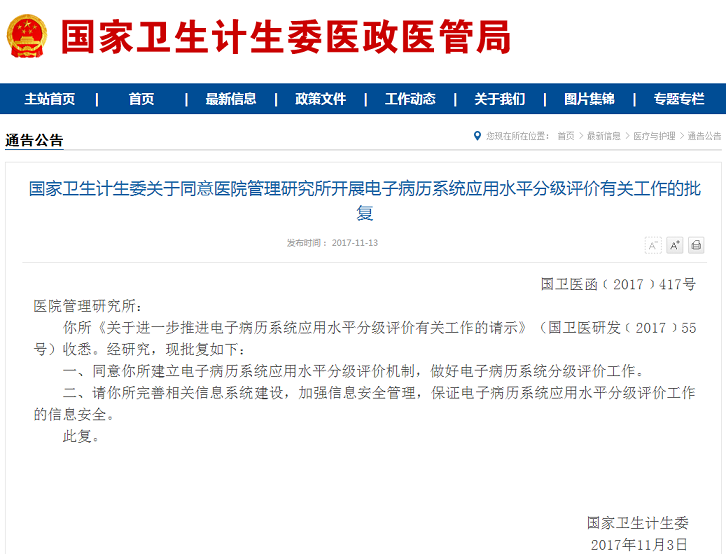
National Health and Family Planning Commission Approves Launch of EMR System Application Level Evaluation
Institute of Hospital Management:
We have received your “Request for Instructions on Further Advancing the Work Related to the Graded Evaluation of the Application Level of Electronic Medical Record Systems” (Guo Wei Yi Yan Fa [2017] No. 55). After review, we hereby provide the following reply:
I. Approval is granted for the tiered evaluation mechanism you have established for the application level of the electronic medical record (EMR) system; ensure the proper implementation of the EMR system tiered evaluation work.
II. Improve the construction of relevant information systems, strengthen information security management, and ensure the information security of the graded evaluation of electronic medical record system application levels.
This is the reply.
National Health and Family Planning Commission
November 3, 2017
Background Information
As a new form of medical records in the information age, electronic medical records (EMRs) have become synonymous with the core of hospital clinical and management information systems. Promoting EMR implementation, standardizing EMR management, and evaluating the actual impact and effectiveness of EMR applications on various aspects of hospital operations constitute an important foundation for modern hospital management.
In 2010, commissioned by the Department of Medical Administration of the former Ministry of Health, the Hospital Management Institute of the National Health and Family Planning Commission established the Electronic Medical Record (EMR) Pilot Office. Over the past seven years, the Hospital Management Institute has drafted and formulated all business specifications and managerial industry standards related to EMRs, including documents such as the Basic Specifications for Electronic Medical Records, Functional Specifications for Electronic Medical Record Systems, Graded Evaluation Standards for Application Levels of Electronic Medical Record Systems, Administrative Norms for the Application of Electronic Medical Records, and Administrative Norms for Electronic Medical Record File Management (under drafting). Among these, the “Graded Evaluation of EMR System Application Levels,” conducted based on the Graded Evaluation Standards for Application Levels of Electronic Medical Record Systems, is the most well-known and has yielded the most significant results.
Since 2011, the Hospital Research Institute has self-funded the development of a data submission platform, conducted training on national hospital informatization infrastructure capacity building and dissemination of standard content, and organized graded evaluations of electronic medical record (EMR) system application levels for secondary and higher-level medical institutions across China.
Achievements
1. Over the past six years since the initiation of the evaluation work, the Hospital Research Institute has conducted tiered assessments of electronic medical record (EMR) system application levels for nearly 6,000 hospitals across China. Among these, secondary hospitals accounted for 52% of all secondary hospitals nationwide, while tertiary hospitals accounted for 80% of all tertiary hospitals nationwide.
2. Over the past six years, the hospital research institute has reviewed data from more than 200 high-level hospitals, organized over a dozen training sessions, and trained nearly 10,000 participants, with the aim of establishing a tiered talent pipeline for health information management across China.
3. Through data collection and analysis of results, the "National Annual Report on the Application Level of Electronic Medical Record Systems (2011–2016)" was completed and submitted to the National Health and Family Planning Commission, providing a comprehensive understanding of issues such as IT investment in hospitals at all levels and across various categories in China, staffing configurations in information centers, market distribution and service capabilities of vendors, as well as the informatization management level, application level, existing deficiencies, and key priorities for future development in medical institutions.
4. Serve as a critical data source and supporting tool for achieving the various objectives of medical administration and healthcare management. The Electronic Medical Record (EMR) system constitutes the most comprehensive, objective, and accurate data source, providing the foundational data for the calculation and analysis of healthcare quality indicators. By extracting and analyzing clinical data from EMRs, hospitals can implement high-quality nursing care, promote rational drug use, conduct quality evaluations, enhance patient safety, perform performance assessments, manage clinical pathways, and facilitate tiered diagnosis and treatment. These measures help standardize medical practice, effectively mitigate potential risks of medical disputes, and strengthen the capacity for evidence presentation in medical liability cases.
5. The evaluation results serve as an objective reference for the National Health and Family Planning Commission in formulating policies and making decisions on key initiatives, including healthcare reform, big data applications, and “Internet Plus” strategies.
6. To become a highly renowned IT evaluation standard in China’s healthcare information industry, characterized by extensive hospital participation and strong industry reputation (emphasizing public welfare, objectivity, guidance, continuity, and comparability).
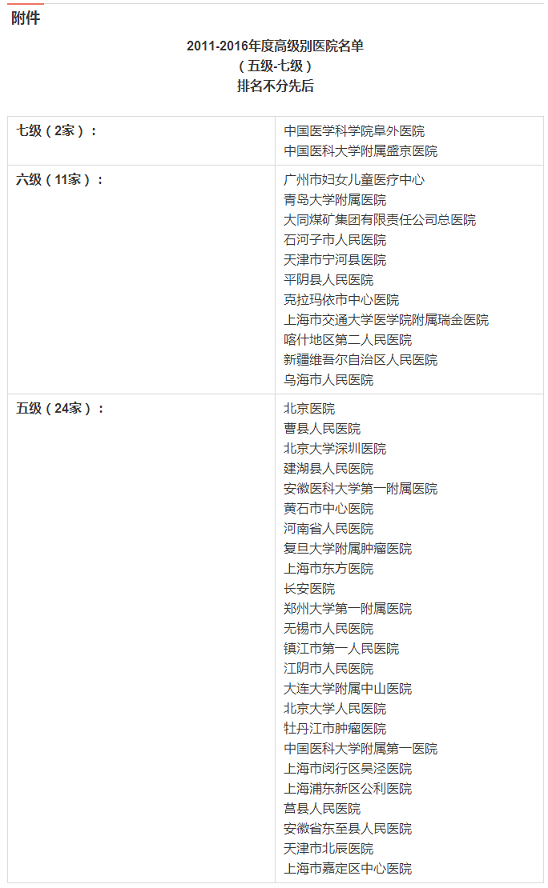
Data Source: China Digital Medicine